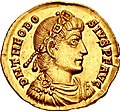
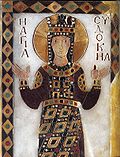
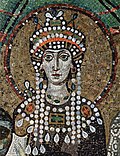
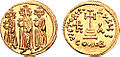
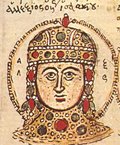
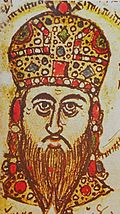
The Roman Empire continued in the East: Christian, Greek-speaking, ruled from Constantinople, and outliving the West until the Ottomans took its capital.
The Byzantine Empire was the Roman Empire continuing in the East, centred on Constantinople; its people called themselves Romans. Constantine I made Christianity lawful and moved the capital there, and Theodosius I made it the state religion. Justinian I briefly won back Italy and North Africa, but Arab armies took Syria and Egypt in the 630s and 640s. Often recovering, it was shattered by the Fourth Crusade in 1204 and ended when the Ottomans took Constantinople in 1453.
What the record holdsShow less
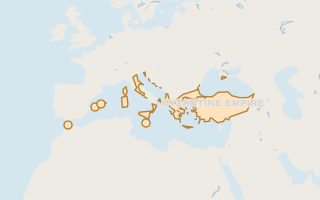
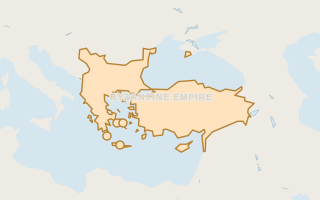
The Byzantine Empire began in 330, replacing the Roman Empire and the Western Roman Empire.↓ In 395, the first year its borders are mapped, it covered 1.98 million km².↓ Between the start and the end of the Arab–Byzantine wars, 629 – 1050, it went from 2.45 million km² to 1.21 million km².↓
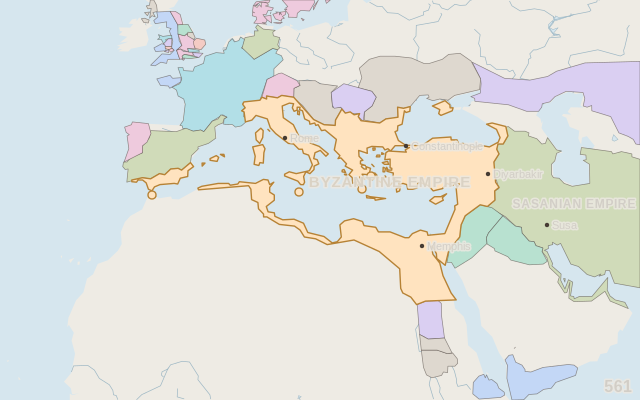
It reached its greatest extent in 561: 2.60 million km².↓ The record names 140 rulers in its line, covering 337 – 1453, the median reign 8 years; 78 of 132 handovers were irregular.↓ The best known of them are Justinian I, Theodosius I and Heraclius.↓ Most of the 421 rows the atlas files under it are people.↓
It was replaced by the Ottoman Empire, the Empire of Nicaea and the Umayyad Caliphate in 1453, 1,123 years after it began.↓ Its end fits “Challenge, failed response and dissolution”, every condition present.↓
Its life in chapters, drawn from its article’s own history; each opens on the live map.
I330 – 518
A Christian Rome in the East
Diocletian's division of the empire into eastern and western halves outlasts his Tetrarchy. Constantine makes Christianity lawful and founds his capital at Constantinople; Theodosius I makes it the state religion, Greek slowly displaces Latin in government, and the eastern empire survives the fall of the West in the 5th century.
Justinian I recasts Roman law as the Corpus Juris Civilis, crushes the Nika revolt of 532 CE and rebuilds Hagia Sophia. Belisarius takes the Vandal kingdom and invades Italy. Plague from c. 541 CE and long wars with Persia drain the empire; in the 630s and 640s Arab armies take Syria and Egypt, and Africa falls in 698 CE.
Leo III and Constantine V hold off Arab attacks, and Leo issues the Ekloge law code and wins a notable victory in 740 CE. Under the Macedonian dynasty the empire expands and flourishes for two centuries; Leo VI has Justinian's law rendered in Greek as the Basilika. Civil war and Seljuk raids then cost most of Asia Minor.
The general Alexios I seizes the throne in 1081. He, his son John II and his grandson Manuel I restore the empire's regional standing for nearly a century, driving off Robert Guiscard's Normans, crushing the Pechenegs in 1091 and asking Pope Urban II for help against the Seljuks. In 1204 the Fourth Crusade sacks Constantinople.
Crusaders crown Baldwin I in a Latin Empire, while Greek successor states rise at Nicaea, Trebizond and Epirus. Constantinople is won back in 1261, but the restored empire is only a regional power, and the Ottomans annex its lands in wars of the 14th and 15th centuries, until the city falls in 1453 under Constantine XI Palaiologos.
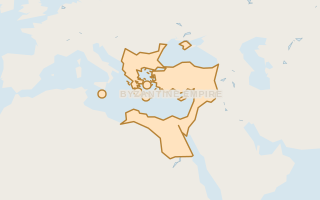
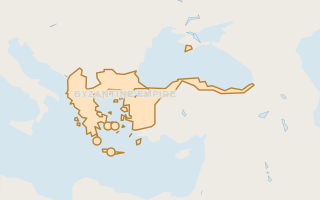
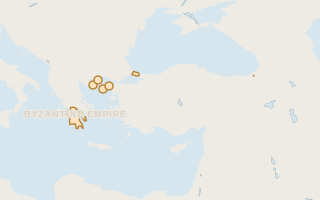
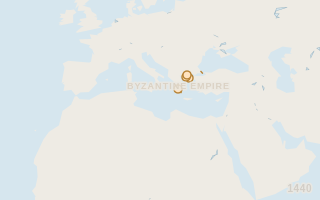
The rise and the fall in one frame: drag across it from 561, at its largest at 2.60 million km², to 1440, last mapped at 23,600 km². Open the live map in 561 or 1440.
Before and after
The states the record files it as replacing or following, and those that replaced or followed it - Wikidata's own statements, each read from this state's side.
ended otherwisecoded by Kokkonen & Sundelldied in battle
sibling
140 rulers, 126 with terms dated as terms, covering 337 – 1453. Median reign 8 years. 78 of 132 handovers irregular - a killing, a deposition, a rival claimant, a rising or a coup beside it. A blank in the last column means no kin on record, which is coverage, never “unrelated”.
The line also names one holder with a page of their own whose term the record gives no first year, so the table cannot place it: Robert of Courtenay.
Each column is a share of the states; gold is the Byzantine Empire.
98%Stood longer than 98% of 3,073 states
How long it stood, among the states with a recorded end or still standing.
94%Held more ground at its peak than 94% of 1,464 states
The most ground it held, among the states with a border in Cliopatria.
95%Had more wars on record per century than 95% of 3,073 states
Wars recorded per century, among the states, counting the wars the atlas hosts under each.
Why it fell
Why did the Byzantine Empire fall?
Reduced to a regional power and stripped of its lands by the Ottomans in wars of the 14th and 15th centuries, it ended when Constantinople fell in 1453.
Historians still argue. Here is what the atlas records about its last century:
The investigation's own picture: 13 causes the record names and 6 results, the strongest six of each at their own years, joined to the state by the kind of claim - a recorded statement solid, the article's sentence dashed, a theory dash-dot.
linkedcoincidence
Open the investigation: every row with its evidence, the conditions at the time, the theories condition by condition, and the succession analysed.
Theories that apply to its ending
Of 5 theories of why states fall, 1 has every condition present at this ending; each is applied by its own logic, condition by condition, and whether its authors named this case is a footnote.
Challenge, failed response and dissolution
Toynbee 1934 · Toynbee & Somervell 1946
Applies by its own logic: 2 of its 2 conditions held here (it needs all of them), and this is the kind of outcome it predicts — the state's ending.
territory shrank by 25% over the 100 y ending 25 y before — territory -93
unrest, adverse regime change or atrocity within 100 y in the state, or a war the state is fighting, still under way, or a war the state fought, ended within 50 y, or battle within 50 y in the state — prior; prior
Its centuries in the record
Wars and battles in red, risings, coups and massacres beside them, everything else in grey, by the century each began in. A tall bar is partly a fact about Wikipedia: better-documented centuries hold more.
Share this pageCopy linkEmbed the mapCite this page
“Byzantine Empire”, Pastlas, a historical atlas, 2026-11-26. https://app.pastlas.com/state/byzantine-empire/
How this page is made
Drawn from Wikidata (Q12544, CC0), the opening and history of its English Wikipedia article retold by the atlas (CC BY-SA 4.0), borders from Cliopatria (CC BY 4.0), coast and rivers from Natural Earth, cities from Reba, Reitsma & Seto 2016 (CC BY 4.0). Data built 2026-11-26 · Pastlas v2.47.1, by Oleh Voronko; the published atlas and its data are for non-commercial use.
How to read it
Areas are measured on an equal-area grid from borders simplified to about five kilometres. “c.” marks an approximate date, and a date known to the century is never printed to the year. Counts are what the atlas holds, and they follow Wikipedia’s coverage: a busy century is partly a fact about the record.
Wikidata records foundings in 285 and 286 and 330 and 395; the atlas draws the article's infobox.
Something wrong?
Tell us and name the entry. We fix the data, not just this page.