State · Europe

Visigothic Kingdom

476 – 718 · 242 years

Came after Western Roman Empire and Kingdom of the Suebi · became al-Andalus

The Gothic kingdom that ruled from Toulouse and then Toledo, turned Catholic under Reccared, and fell to the Muslim conquest.

The Visigothic Kingdom began when the Roman government settled the Visigoths of King Wallia in Gallia Aquitania, and conquest carried it over all of Hispania. Under Euric it shed its status as Roman foederati and ruled from Toulouse; after losing most of Gaul to the Franks early in the 6th century it was ruled from Toledo. In 711 CE a Muslim invasion killed King Roderic at the Guadalete River, and the conquerors took much of southern Spain and Toledo.

What the record holds

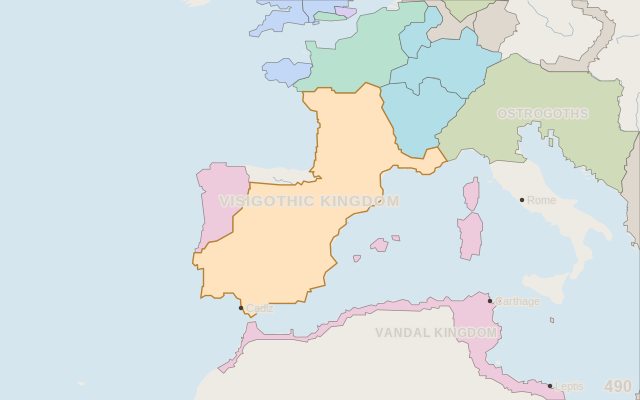
The Visigothic Kingdom began in 476, replacing the Western Roman Empire and the Kingdom of the Suebi.↓ Its borders are first mapped in 476, around 668,700 km².↓ The Franco-Visigothic Wars, 492 – 589, began with it holding 688,700 km² and ended with 528,900 km².↓

Its ground peaked in 490 at 688,700 km².↓ Its highest office was held by 29 rulers, covering 466 – 720, the median reign 7 years; 10 of 28 handovers were irregular.↓ Among them, Alaric II, Roderic and Euric are the best known.↓ The atlas files 35 rows under it, most of them people.↓

In 718, after 242 years, it was replaced by al-Andalus.↓

From Wikipedia’s article, retold · CC BY-SA 4.0

242 years

Longer than the Gupta Empire, shorter than the Golden Horde

689,000 km²

At its height in 490 · about the size of Myanmar

29 rulers

the king of Wisigoths

3 wars and battles

More per century than 88% of states · 35 entries in all

Map: Visigothic Kingdom in 490, its borders in gold among its neighbours
Franco-Visigothic Wars, 492 – 589: 688,700 km² → 528,900 km²Battle of Guadalete, 711Treaty of Orihuela, 713500550600650700
Beside it on the map in 490: Ostrogoths, Vandal Kingdom, Salian Franks, Kingdom of Burgundy, Alamannia and Kingdom of the Suebi.How far it reached, year by year: its ground inside the borders Cliopatria draws (CC BY 4.0), measured on an equal-area grid; the map shows it at its largest, with the cities of the year.

The story

Four acts, 476 – 718

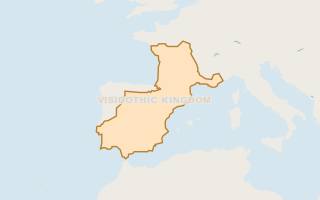
Visigothic Kingdom in 506, at the end of act I
I476 – 507669,000 → 689,000 km²

The Kingdom of Toulouse

Euric, king since 466 CE, takes Mérida in 469 CE and Hispania Tarraconensis, the last Roman stronghold in Spain, in 472 CE, and crushes a Roman army at Arles. Alaric II reigns from 484 CE, but from 492 CE the Visigoths are at war with the Franks, who take most of their lands in Gaul.

Watch this act on the live map, from 476
Visigothic Kingdom in 585, at the end of act II
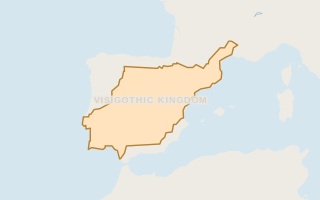
II507 – 586689,000 → 438,000 km²

The Arian kingdom of Hispania

After Alaric II's death Theodoric the Great deposes Gesalec and makes his grandson Amalaric king, with Theudis as regent; in 531 CE Amalaric is beaten by Childebert I of the Franks and murdered. A civil war from 549 CE brings in Byzantine troops, who seize Cartagena and much of the south, while Liuvigild conquers the Kingdom of the Suebi.

Watch this act on the live map, from 507
Visigothic Kingdom in 710, at the end of act III
III586 – 711438,000 → 578,000 km²

The Catholic kingdom of Toledo

Reccared I turns from Arian to Chalcedonian Christianity on taking the throne and in 589 CE, at the Third Council of Toledo, denounces Arianism; he takes the name Flavius and styles himself heir to the Roman emperors. By 624 CE Swinthila has driven out the last Byzantine garrisons. Recceswinth, Wamba and Egica follow on the throne.

Watch this act on the live map, from 586
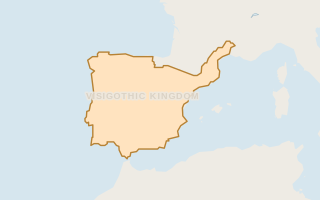
Visigothic Kingdom in 717, at the end of act IV
IV711 – 718578,000 → 578,000 km²

The Muslim conquest

In 711 CE Tariq ibn Ziyad lands with about seven thousand Berbers while Roderic is fighting the Basques. At the Guadalete River Roderic's troops turn on him and he is killed; the Muslims take much of southern Spain and then Toledo. Musa follows in 712 CE, and the Treaty of Orihuela is agreed in 713 CE.

Watch this act on the live map, from 711
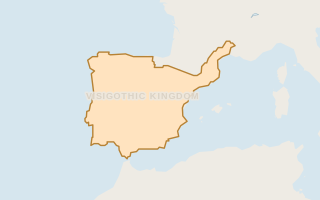
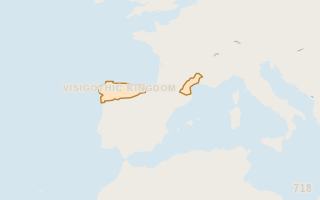
Visigothic Kingdom in 718, last mappedVisigothic Kingdom in 490, at its largest
The rise and the fall in one frame: drag across it from 490, at its largest at 688,700 km², to 718, last mapped at 99,900 km². Open the live map in 490 or 718.

Before and after

Before it

After it

  • al-Andalus · replaced by

Where it sits in time

3000 BCE2000 BCE1000 BCE110002000Kingdom of the Suebi: 409 – 585Western Roman Empire: 395 – 476Visigothic Kingdom: 476 – 718

Five thousand years, 3000 BCE to 2026; the state in gold, what it replaced or followed and what replaced or followed it in grey.

Its people

Lives across the Visigothic Kingdom

450500550600650700
Statesmen and generalsAll its people on the timeline →

How it was governed

29 kings

29 kings on record, 466 to 720; a reign lasted 7 years at the median. Each bar is a reign, as long as it lasted.

Euric · 466 – 484 · died in office, manner not recordedAlaric II · 484 – 507 · died in battleAmalaric · 510 – 531 · killedTheudis · 531 – 548 · killedTheudigisel · 548 – 549 · killedAgila I · 549 – 555 · the term ends after the recorded deathAthanagild · 555 – 567 · died in office, manner not recordedLiuva I · 567 – 572 · died in office, manner not recordedLiuvigild · 568 – 586 · died in office, manner not recordedReccared I · 586 – 601 · died in office, manner not recordedLiuva II · 601 – 603 · died in office, manner not recordedWitteric · 603 – 610 · killedGundemar · 610 – 612 · died in office, manner not recordedSisebut · 612 – 621 · died in office, manner not recordedReccared II · 621 – 621 · died in office, manner not recordedSuintila · 621 – 631 · no death date to read the end againstReccimer · 625 – 631 · died in office, manner not recordedSisenand · 631 – 636 · died in office, manner not recordedChintila · 636 – 639 · died in office, manner not recordedTulga · 639 – 642 · died in office, manner not recordedChindasuinth · 642 – 653 · died in office, manner not recordedRecceswinth · 653 – 672 · died in office, manner not recordedWamba · 672 – 680 · left office aliveErwig · 680 – 687 · died in office, manner not recordedEgica · 687 – 702 · died in office, manner not recordedWittiza · 700 – 710 · died in office, manner not recordedRoderic · 710 – 711 · ended by a named eventAchila II · 710 – 713 · left office aliveArdo · 713 – 720 · left office alive500550600650700
a second row: a reign that began before the last had ended — rival claimants, or a shared throne
How their terms ended, where it is known (27 of 29):Killed 5Died in office 18Left office alive 4Not on record 2
Every term, with how it ended and its source

Rulers

How 29 reigns ended - choose one to show only those

How they died, where the record says: killed 5 · died in battle 1.

RulerReignLengthHow it ended · sourceTo the ruler before
5th century · 2 reigns · 1 killed or removed
Euric · aged 46466 – 48418 yearsdied in officeread off the dates alone
Alaric II · aged 26484 – 50723 yearsdied in battleWikidata's manner of deathchild
6th century · 8 reigns · 3 killed or removed
Amalaric · aged 8510 – 53121 yearskilled in officeWikidata's manner of deathchild
Theudis · aged 51531 – 54817 yearskilled in officeWikidata's manner of death
Theudigisel · aged 48548 – 5491 yearkilled in officeWikidata's manner of death
Agila I549 – 5556 yearsdates disagreeread off the dates alonekilled
Athanagild555 – 56712 yearsdied in officeread off the dates alone
Liuva I · aged 17567 – 5725 yearsdied in officeread off the dates alone
Liuvigild · aged 49568 – 58618 yearsdied in officeread off the dates alonesibling
Reccared I · aged 27586 – 60115 yearsdied in officeread off the dates alonechild
7th century · 16 reigns · 1 killed or removed
Liuva II · aged 17601 – 6032 yearsdied in officeread off the dates alonechild
Witteric · aged 38603 – 6107 yearskilled in officeWikidata's manner of death
Gundemar · aged 10610 – 6122 yearsdied in officeread off the dates alone
Sisebut · aged 47612 – 6219 yearsdied in officeread off the dates alone
Reccared II621 – 621under a yeardied in officeread off the dates alonechild
Suintila · aged 27621 – 63110 yearsending not on record
Reccimer · aged 15625 – 6316 yearsdied in officeread off the dates alonechild
Sisenand · aged 26631 – 6365 yearsdied in officeread off the dates alone
Chintila · aged 30636 – 6393 yearsdied in officeread off the dates alone
Tulga · aged 17639 – 6423 yearsdied in officeread off the dates alonechild
Chindasuinth · aged 79642 – 65311 yearsdied in officeread off the dates alone
Recceswinth653 – 67219 yearsdied in officeread off the dates alonechild
Wamba · aged 39672 – 6808 yearsleft office aliveread off the dates alone
Erwig · aged 37680 – 6877 yearsdied in officeread off the dates alone
Egica · aged 77687 – 70215 yearsdied in officeread off the dates alonein-law
Wittiza · aged 14700 – 71010 yearsdied in officeread off the dates alonechild
8th century · 3 reigns
Roderic · aged 22710 – 7111 yearended by an eventWikidata's end cause on the term
Achila II · aged 15710 – 7133 yearsleft office aliveread off the dates alone
Ardo · aged 13713 – 7207 yearsleft office aliveread off the dates alone

29 rulers, 29 with terms dated as terms, covering 466 – 720. Median reign 7 years. 10 of 28 handovers irregular - a killing, a deposition, a rival claimant, a rising or a coup beside it. A blank in the last column means no kin on record, which is coverage, never “unrelated”.

Flag or arms

  • Leovigild CNG 97-722237 (obverse)
    coin, undatedLeovigild CNG 97-722237 (obverse) · CC BY-SA 3.0 · You may select the license of your choice.

Its world

Rivals, and who else stood

Who it fought most

Wars and battles both took part in, on whichever side: the record names who took part, not who fought whom.

Meanwhile, elsewhere

The best-known states of other regions that stood while it did; the band is the Visigothic Kingdom’s own years.

500600700

How it compares

Among 3,073 states

Stood longer than 68% of 3,073 states
Visigothic Kingdom · 242 yearsGupta EmpireGolden HordeHow long it stood, among the states with a recorded end or still standing.
Held more ground at its peak than 79% of 1,464 states
Visigothic Kingdom · 688,700 km²MyanmarZambiaThe most ground it held, among the states with a border in Cliopatria.
Had more wars on record per century than 88% of 3,073 states
Visigothic Kingdom · 0.4Wars recorded per century, among the states, counting the wars the atlas hosts under each.

Why it fell

Why did the Visigothic Kingdom fall?

Historians still argue. Here is what the atlas records about its last century:

2

wars and battles in its last century, more than in any before it

What led to it, and what came of it

Battle of Arelate · Linked · 458Battle of ArelateWestern Roman Empire · Linked · 395 – 476Western Roman EmpireKingdom of the Suebi · Linked · 409 – 585Kingdom of the SuebiVisigothic Kingdom of Tolosa · Linked · 418 – 507Visigothic Kingdom of TolosaVisigothic Kingdom · 476 – 718Visigothic Kingdomal-Andalus · Linked · 711 – 1492al-Andalus400600800100012001400
linked

Open the investigation: every row with its evidence, the conditions at the time, the theories condition by condition, and the succession analysed.

Its centuries in the record

400 – 499: 4 recorded — 1 wars and battles, 0 risings, regime changes and massacres, 3 other400500 – 599: 13 recorded — 0 wars and battles, 0 risings, regime changes and massacres, 13 other500600 – 699: 12 recorded — 0 wars and battles, 0 risings, regime changes and massacres, 12 other600700 – 799: 6 recorded — 2 wars and battles, 0 risings, regime changes and massacres, 4 other700

Wars and battles in red, risings, coups and massacres beside them, everything else in grey, by the century each began in. A tall bar is partly a fact about Wikipedia: better-documented centuries hold more.

Each century’s own page:400 – 499500 – 599600 – 699700 – 799

Keep exploring

Share this page
Copy link
Embed the map
Cite this page

How this page is made

Drawn from Wikidata (Q126936, CC0), the opening and history of its English Wikipedia article retold by the atlas (CC BY-SA 4.0), borders from Cliopatria (CC BY 4.0), coast and rivers from Natural Earth, cities from Reba, Reitsma & Seto 2016 (CC BY 4.0), symbols from Wikimedia Commons, each under its own licence. Data built 2026-11-26 · Pastlas v2.47.1, by Oleh Voronko; the published atlas and its data are for non-commercial use.

How to read it

Areas are measured on an equal-area grid from borders simplified to about five kilometres. “c.” marks an approximate date, and a date known to the century is never printed to the year. Counts are what the atlas holds, and they follow Wikipedia’s coverage: a busy century is partly a fact about the record.

Something wrong?

Tell us and name the entry. We fix the data, not just this page.

Report a problem