State · Middle East and North Africa

Empire of Nicaea

1204 – 1261 · 57 years

Came after Byzantine Empire

The Greek rump state of the Laskaris family in Anatolia, which kept the Byzantine Empire alive and won back Constantinople.

When the Fourth Crusade seized Constantinople in 1204, Byzantine aristocrats fled and set up three Greek rump states, of which the Empire of Nicaea, founded by the Laskaris family in northwestern Anatolia, was the largest. In 1205 it claimed the Byzantine titles and machinery of government, and the Despotate of Epirus, which contested that claim, gave it up in 1242. In 1261 the Empire of Nicaea retook Constantinople and restored the Byzantine Empire.

What the record holds

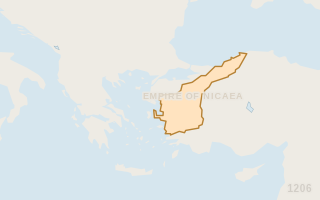
Its record opens in 1204, replacing the Byzantine Empire.↓ When the borders dataset first draws it, in 1206, it held 93,200 km².↓

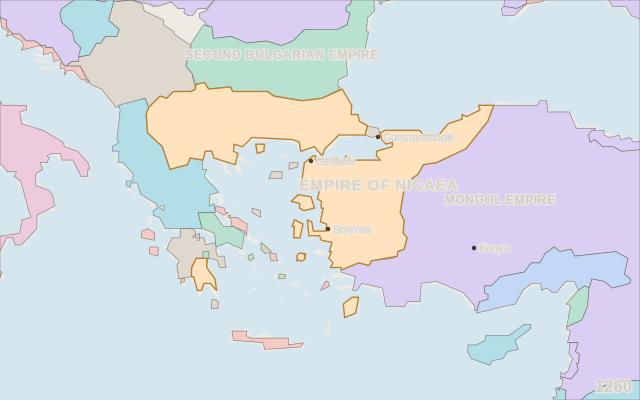
At its largest, in 1260, it held 242,400 km².↓ The record names 6 rulers in its line, covering 1204 – 1258, the median reign 6 years; 1 of 5 handovers was irregular.↓ Among them, Marie of Courtenay, Anna Komnene Angelina and Irene Laskarina are the best known.↓ The atlas files 14 rows under it, people the largest group of them.↓ It ended in 1261, 57 years after it began.↑

From Wikipedia’s article, retold · CC BY-SA 4.0

57 years

Longer than Hamburg, shorter than the Austrian Empire

242,000 km²

At its height in 1260 · about the size of Ghana

6 rulers

the empress of Nicaea

5 wars and battles

14 entries in all

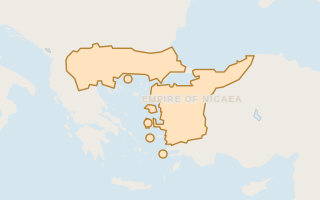
Map: Empire of Nicaea in 1260, its borders in gold among its neighbours
Treaty of Nymphaeum (1214), 1214Battle of Poimanenon, 1224Battle of Pelagonia, 1259Treaty of Nymphaeum (1261), 126112201230124012501260
Beside it on the map in 1260: Mongol Empire, Second Bulgarian Empire, Kingdom of Serbia (1217–1346), Despotate of Epirus, Kingdom of Sicily and Armenian Kingdom of Cilicia.How far it reached, year by year: its ground inside the borders Cliopatria draws (CC BY 4.0), measured on an equal-area grid; the map shows it at its largest, with the cities of the year.

The story

Three acts, 1204 – 1261

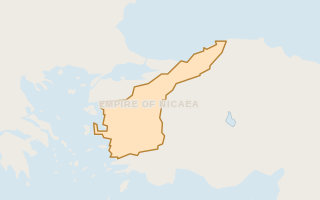
Empire of Nicaea in 1223, at the end of act I
I1204 – 1224

Refuge in Bithynia

As crusaders storm Constantinople in 1204, Theodore I Laskaris, son-in-law of Alexios III Angelos, is proclaimed emperor but flees to Nicaea in Bithynia. The Latin Empire the Crusaders set up holds little of the old Byzantine lands, and Greek successor states rise in Epirus, Trebizond and Nicaea, the nearest to the Latin Empire.

Watch this act on the live map, from 1204
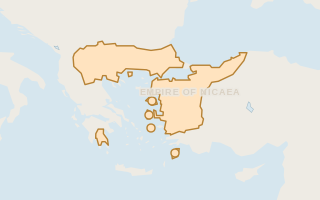
Empire of Nicaea in 1258, at the end of act II
II1224 – 125993,300 → 236,000 km²

Vatatzes extends the realm

Vatatzes beats Theodore I's brothers and their Latin Empire allies at Poimanenon in 1224, securing his throne and nearly all the Latin Empire's Asian lands. That year Theodore Komnenos Doukas of Epirus takes Thessalonica and crowns himself emperor, but his realm falls under Bulgarian control after Klokotnitsa in 1230, and Epirus renounces its claim in 1242.

Watch this act on the live map, from 1224
Empire of Nicaea in 1260, at the end of act III
III1259 – 1261236,000 → 242,000 km²

Constantinople regained

After the Battle of Pelagonia in 1259, Michael turns on Constantinople itself in 1260, allied with Genoa. In July 1261, with most of the Latin army away, his general Alexios Strategopoulos persuades the guards to open the gates and burns the Venetian quarter. Weeks later Michael is recognised as emperor, and the Byzantine Empire is restored.

Watch this act on the live map, from 1259
Empire of Nicaea in 1260, at its largestEmpire of Nicaea in 1206, first mapped
The rise and the fall in one frame: drag across it from 1206, first mapped at 93,200 km², to 1260, at its largest at 242,400 km². Open the live map in 1206 or 1260.

Before and after

Before it

Where it sits in time

3000 BCE2000 BCE1000 BCE110002000Byzantine Empire: 330 – 1453Empire of Nicaea: 1204 – 1261

Five thousand years, 3000 BCE to 2026; the state in gold, what it replaced or followed and what replaced or followed it in grey.

Its people

Lives across the Empire of Nicaea

12001225125012751300
Statesmen and generalsScientists and explorersLived on after it endedAll its people on the timeline →

How it was governed

6 empresses

6 empresses on record, 1204 to 1258; a reign lasted 6 years at the median. Each bar is a reign, as long as it lasted.

Anna Komnene Angelina · 1204 – 1212 · ended otherwise, as coded — neither deposed nor a natural deathPhilippa of Armenia · 1214 – 1216 · no death date to read the end againstMarie of Courtenay · 1219 – 1222 · died a natural deathIrene Laskarina · 1221 – 1239 · died a natural deathAnna of Hohenstaufen · 1244 – 1254 · died a natural deathElena Asenina of Bulgaria · 1254 – 1258 · died a natural death121012201230124012501260
a second row: a reign that began before the last had ended — rival claimants, or a shared throne
How their terms ended, where it is known (5 of 6):Died in office 4Left office alive 1Not on record 1
Every term, with how it ended and its source

Rulers

How 6 reigns ended - choose one to show only those
RulerReignLengthHow it ended · sourceTo the ruler before
13th century · 6 reigns
Anna Komnene Angelina · aged 281204 – 12128 yearsended otherwisecoded by Kokkonen & Sundell
Philippa of Armenia · aged 311214 – 12162 yearsending not on record
Marie of Courtenay · aged 151219 – 12223 yearsnatural deathcoded by Kokkonen & Sundell
Irene Laskarina · aged 211221 – 123918 yearsnatural deathcoded by Kokkonen & Sundell
Anna of Hohenstaufen · aged 141244 – 125410 yearsnatural deathcoded by Kokkonen & Sundell
Elena Asenina of Bulgaria · aged 531254 – 12584 yearsnatural deathcoded by Kokkonen & Sundell

6 rulers, 6 with terms dated as terms, covering 1204 – 1258. Median reign 6 years. 1 of 5 handovers irregular - a killing, a deposition, a rival claimant, a rising or a coup beside it. A blank in the last column means no kin on record, which is coverage, never “unrelated”.

Its world

Rivals, and who else stood

Who it fought most

Wars and battles both took part in, on whichever side: the record names who took part, not who fought whom.

Meanwhile, elsewhere

The best-known states of other regions that stood while it did; the band is the Empire of Nicaea’s own years.

1200122012401260

How it compares

Among 3,073 states

Stood longer than 36% of 3,073 states
Empire of Nicaea · 57 yearsHamburgAustrian EmpireHow long it stood, among the states with a recorded end or still standing.
Held more ground at its peak than 62% of 1,464 states
Empire of Nicaea · 242,400 km²GhanaGuineaThe most ground it held, among the states with a border in Cliopatria.

Why it fell

Why did the Empire of Nicaea fall?

Historians still argue. Here is what the atlas records about its last century:

What led to it, and what came of it

Byzantine Empire · Linked · 330 – 1453Byzantine EmpireTheodore I Laskaris · Coincidence · 1174 – 1221Theodore I LaskarisEmpire of Nicaea · 1204 – 1261Empire of Nicaea5001000
linkedcoincidence

Open the investigation: every row with its evidence, the conditions at the time, the theories condition by condition, and the succession analysed.

In the record

14 entries the atlas files under it, all in 1200 – 1299.

Keep exploring

Share this page
Copy link
Embed the map
Cite this page

How this page is made

Drawn from Wikidata (Q181254, CC0), the opening and history of its English Wikipedia article retold by the atlas (CC BY-SA 4.0), borders from Cliopatria (CC BY 4.0), coast and rivers from Natural Earth, cities from Reba, Reitsma & Seto 2016 (CC BY 4.0). Data built 2026-11-26 · Pastlas v2.47.1, by Oleh Voronko; the published atlas and its data are for non-commercial use.

How to read it

Areas are measured on an equal-area grid from borders simplified to about five kilometres. “c.” marks an approximate date, and a date known to the century is never printed to the year. Counts are what the atlas holds, and they follow Wikipedia’s coverage: a busy century is partly a fact about the record.

Something wrong?

Tell us and name the entry. We fix the data, not just this page.

Report a problem