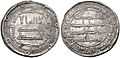
State · Middle East and North Africa

Umayyad Caliphate

661 – 750 · 89 years

Came after Byzantine Empire and Rashidun Caliphate · became Abbasid Caliphate and Emirate of Córdoba

The first hereditary caliphate: a Damascus dynasty that conquered from the Iberian Peninsula to Sindh, until the Abbasids overthrew it.

Second of the Islamic caliphates, the Umayyad Caliphate was ruled by the Umayyad family from Damascus from 661 CE to 750 CE. Mu'awiya, victor of the First Fitna, made the office hereditary, and after a second civil war Abd al-Malik restored and centralised Umayyad power. Its armies took Sindh, Central Asia, the Maghreb and the Iberian Peninsula, making it one of history's largest empires, until constant war, revolts and tribal feuds wore it down.

What the record holds

The Umayyad Caliphate began in 661, replacing the Rashidun Caliphate and the Kingdom of the Nemencha.↓ When the borders dataset first draws it, in 661, it held 925,100 km².↓ The Second Fitna, 680 – 692, began with it holding 7.01 million km² and ended with 8.62 million km².↓

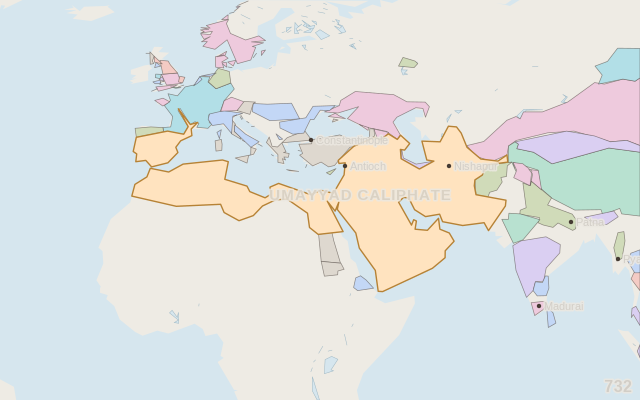
It reached its greatest extent in 732: 9.89 million km².↓ The record names 14 rulers in its line, covering 661 – 750, the median reign 3 years; 7 of 13 handovers were irregular.↓ The best known of them are Mu'awiya I, Abd al-Malik ibn Marwan and Umar ibn Abd al-Aziz.↓ Most of the 71 rows the atlas files under it are people.↓

In 750, after 89 years, it was followed by the Abbasid Caliphate and the Emirate of Córdoba.↓ Its end fits “Demographic-structural breakdown”, every condition present.↓

From Wikipedia’s article, retold · CC BY-SA 4.0

89 years

Longer than the Kingdom of Italy, shorter than the Inca Empire

9.89 million km²

At its height in 732 · about the size of Canada

14 rulers

the Umayyad Caliph

11 wars and battles

More per century than 98% of states · 71 entries in all

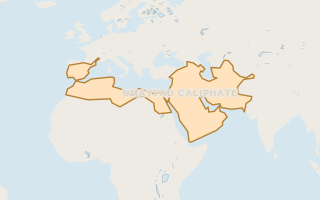
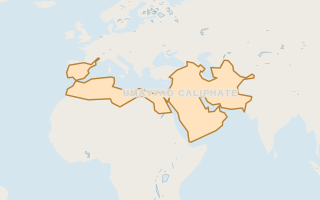
Map: Umayyad Caliphate in 732, its borders in gold among its neighbours
Second Fitna, 680 – 692: 7.01 million km² → 8.62 million km²Battle of Karbala, 680Berber Revolt, 739 – 743Abbasid revolution, 746 – 750Battle of the Zab, 750680700720740
Beside it on the map in 732: Türgesh, Tibetan Empire, Khazaria, Francia, Tang dynasty and Byzantine Empire.How far it reached, year by year: its ground inside the borders Cliopatria draws (CC BY 4.0), measured on an equal-area grid; the map shows it at its largest, with the cities of the year.

The story

Five acts, 661 – 750

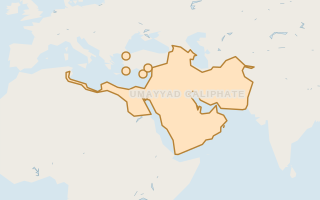
Umayyad Caliphate in 679, at the end of act I
I661 – 680925,000 → 7.01 million km²

Mu'awiya's kingdom in Syria

Recognised as caliph in Kufa after the First Fitna, Mu'awiya moves the capital and treasury to Damascus, where he has built his power for twenty years, and leans on the Quda'a tribes of Syria. In 676 CE he names his son Yazid as heir, bringing hereditary rule to the caliphate and making it, in practice, a kingship.

Watch this act on the live map, from 661

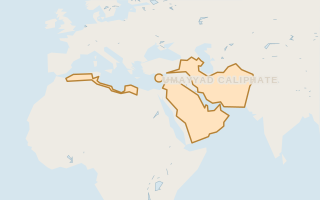
Umayyad Caliphate in 691, at the end of act II
II680 – 6927.01 million → 5.84 million km²

The Second Fitna

Yazid I is challenged almost at once, and the Battle of Karbala is fought in 680 CE. After Mu'awiya II dies, many Syrian factions recognise Ibn al-Zubayr and Umayyad rule nearly collapses. Marwan ibn al-Hakam claims the caliphate in 684 CE, founding the Marwanid line, and his son Abd al-Malik defeats the Zubayrids in 692 CE.

Watch this act on the live map, from 680
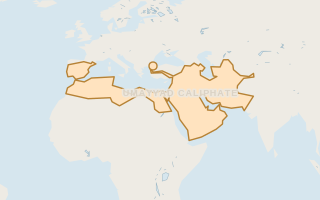
Umayyad Caliphate in 723, at the end of act III
III692 – 7248.62 million → 9.85 million km²

Reform and the widest reach

Abd al-Malik centralises power, rebuilds the army and Arabizes the bureaucracy, while his governor al-Hajjaj crushes the Kharijite revolts in Iraq and Iran. Under al-Walid I the caliphate reaches its greatest extent: Carthage falls in 698 CE and Armenia is annexed by 705 CE. Umar ibn Abd al-Aziz reforms taxes to make Arabs and mawali equal; Yazid II undoes it.

Watch this act on the live map, from 692
Umayyad Caliphate in 742, at the end of act IV
IV724 – 7439.86 million → 9.85 million km²

Hisham and the end of expansion

Hisham holds court at Resafa, nearer the Byzantine frontier, and renews raids into Anatolia, but suffers a heavy defeat at Akroinon and wins little ground. Expansion halts in the west as well. The Battle of Kharistan, the Berber Revolt and the revolt of Zayd ibn Ali strain the caliphate.

Watch this act on the live map, from 724
Umayyad Caliphate in 749, at the end of act V
V743 – 7509.85 million → 9.85 million km²

Civil war and the Abbasids

Al-Walid II makes enemies by executing his opponents and is killed in 744 CE by the army of Yazid III, who dies six months later. The Third Fitna follows. In Khurasan the Hashimiyya, secretly led by the Abbasid family, gather adherents; in 750 CE the Abbasids overthrow Marwan II and kill most of the Umayyad family.

Watch this act on the live map, from 743
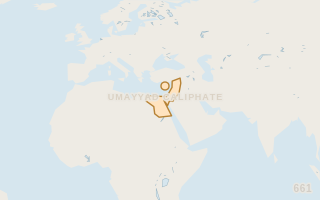
Umayyad Caliphate in 732, at its largestUmayyad Caliphate in 661, first mapped
The rise and the fall in one frame: drag across it from 661, first mapped at 925,100 km², to 732, at its largest at 9.89 million km². Open the live map in 661 or 732.

Before and after

Before it

  • Rashidun Caliphate · replaces · 632 – 661
  • Byzantine Empire · follows · 330 – 1453
  • Kingdom of the Nemencha · replaces
  • Exarchate of Africa · replaces
  • Kingdom of Toledo · follows

After it

Where it sits in time

3000 BCE2000 BCE1000 BCE110002000Rashidun Caliphate: 632 – 661Byzantine Empire: 330 – 1453Abbasid Caliphate: 750 – 1258Emirate of Córdoba: 756 – 929Umayyad Caliphate: 661 – 750

Five thousand years, 3000 BCE to 2026; the state in gold, what it replaced or followed and what replaced or followed it in grey.

Its people

Lives across the Umayyad Caliphate

600650700750800
Statesmen and generalsWriters, artists and thinkersScientists and explorersLived on after it endedAll its people on the timeline →

How it was governed

14 caliphs

14 caliphs on record, 661 to 750; a reign lasted 3 years at the median. Each bar is a reign, as long as it lasted.

Mu'awiya I · 661 – 680 · died in office, manner not recordedYazid I · 680 – 683 · killed, the article saysMu'awiya II · 683 – 684 · died in office of natural causesMarwan I · 684 – 685 · exiled, imprisoned or confined, the article saysAbd al-Malik ibn Marwan · 685 – 705 · died in office, manner not recordedAl-Walid I · 705 – 715 · died in office, manner not recordedSulayman ibn Abd al-Malik · 715 – 717 · died in office, manner not recordedUmar ibn Abd al-Aziz · 717 – 720 · killedYazid II · 720 – 724 · died in office of natural causesHisham ibn Abd al-Malik · 724 – 743 · died in office of natural causesAl-Walid II · 743 – 744 · died in battleYazid III · 744 – 744 · died in office of natural causesIbrahim ibn al-Walid · 744 – 744 · abdicated, the article saysMarwan II · 744 – 750 · killed680700720740
How their terms ended, where it is known (14 of 14):Killed 4Deposed or removed 2Died in office 8
Every term, with how it ended and its source

Rulers

How 14 reigns ended - choose one to show only those

How they died, where the record says: died of natural causes 4 · killed 2 · died in battle 1 · executed 1.

RulerReignLengthHow it ended · sourceTo the ruler before
7th century · 5 reigns · 2 killed or removed
Mu'awiya I · aged 58661 – 68019 yearsdied in officeread off the dates alone
Yazid I · aged 34680 – 6833 yearskilledread from the ruler's own articlechild
Mu'awiya II · aged 22683 – 6841 yeardied in officeWikidata's manner of deathdied of natural causeschild
Marwan I · aged 61684 – 6851 yearexiledread from the ruler's own article
Abd al-Malik ibn Marwan · aged 39685 – 70520 yearsdied in officeread off the dates alonechild
8th century · 9 reigns · 4 killed or removed
Al-Walid I · aged 37705 – 71510 yearsdied in officeread off the dates alonechild
Sulayman ibn Abd al-Malik · aged 40715 – 7172 yearsdied in officeread off the dates alonesibling
Umar ibn Abd al-Aziz · aged 36717 – 7203 yearskilled in officeWikidata's manner of death
Yazid II · aged 33720 – 7244 yearsdied in officeWikidata's manner of deathdied of natural causes
Hisham ibn Abd al-Malik · aged 33724 – 74319 yearsdied in officeWikidata's manner of deathdied of natural causessibling
Al-Walid II · aged 43743 – 7441 yeardied in battleWikidata's manner of deathnephew or niece
Yazid III · aged 43744 – 744under a yeardied in officeWikidata's manner of deathdied of natural causes
Ibrahim ibn al-Walid744 – 744under a yearabdicatedread from the ruler's own articleexecutedsibling
Marwan II · aged 56744 – 7506 yearskilled in officeWikidata's manner of death

14 rulers, 14 with terms dated as terms, covering 661 – 750. Median reign 3 years. 7 of 13 handovers irregular - a killing, a deposition, a rival claimant, a rising or a coup beside it. A blank in the last column means no kin on record, which is coverage, never “unrelated”.

Its world

Rivals, and who else stood

Who it fought most

Wars and battles both took part in, on whichever side: the record names who took part, not who fought whom.

Meanwhile, elsewhere

The best-known states of other regions that stood while it did; the band is the Umayyad Caliphate’s own years.

660680700720740760

How it compares

Among 3,073 states

Stood longer than 44% of 3,073 states
Umayyad Caliphate · 89 yearsKingdom of ItalyInca EmpireHow long it stood, among the states with a recorded end or still standing.
Held more ground at its peak than 99% of 1,464 states
Umayyad Caliphate · 9,888,900 km²United StatesCanadaThe most ground it held, among the states with a border in Cliopatria.
Had more wars on record per century than 98% of 3,073 states
Umayyad Caliphate · 3.0Wars recorded per century, among the states, counting the wars the atlas hosts under each.

Why it fell

Why did the Umayyad Caliphate fall?

Historians still argue. Here is what the atlas records about its last century:

5

wars and battles in its last century

750

Marwan II, killed in office

What led to it, and what came of it

Byzantine Empire · Linked · 330 – 1453Byzantine EmpireKingdom of Toledo · Linked · 549 – 711Kingdom of ToledoExarchate of Africa · Linked · 585 – 698Exarchate of AfricaRashidun Caliphate · Linked · 632 – 661Rashidun CaliphateArab invasion of Armenia · Linked · 642 – 744Arab invasion of ArmeniaMuslim conquest of the Maghreb · Linked · 647 – 709Muslim conquest of the MaghrebUmayyad Caliphate · 661 – 750Umayyad CaliphateAbbasid Caliphate · Linked · 750 – 1258Abbasid CaliphateEmirate of Córdoba · Linked · 756 – 929Emirate of Córdoba5001000
linked

Open the investigation: every row with its evidence, the conditions at the time, the theories condition by condition, and the succession analysed.

Theories that apply to its ending

  • Demographic-structural breakdown

    Goldstone 1991 · Turchin & Nefedov 2009

    Applies by its own logic: 3 of its 3 conditions held here (it needs 2), and this is the kind of outcome it predicts — unrest, adverse regime change or the state's ending.

    • famine, plague or disaster within 30 y in the state, or population up 25% over 50 y — prior
    • overlapping reigns — rival claimants — within 20 y, or 3 or more changes of ruler within 20 y, or 2 or more reigns of two years or less within 20 y, or a monarch deposed or killed within 20 y — handovers 4; shortReigns 3
    • a war the state is fighting, still under way, or a war the state fought, ended within 10 y — warEnded

Its centuries in the record

600 – 699: 43 recorded — 6 wars and battles, 0 risings, regime changes and massacres, 37 other600700 – 799: 21 recorded — 5 wars and battles, 3 risings, regime changes and massacres, 13 other700

Wars and battles in red, risings, coups and massacres beside them, everything else in grey, by the century each began in. A tall bar is partly a fact about Wikipedia: better-documented centuries hold more.

Each century’s own page:600 – 699700 – 799

Keep exploring

Share this page
Copy link
Embed the map
Cite this page

How this page is made

Drawn from Wikidata (Q8575586, CC0), the opening and history of its English Wikipedia article retold by the atlas (CC BY-SA 4.0), borders from Cliopatria (CC BY 4.0), coast and rivers from Natural Earth, cities from Reba, Reitsma & Seto 2016 (CC BY 4.0). Data built 2026-11-26 · Pastlas v2.47.1, by Oleh Voronko; the published atlas and its data are for non-commercial use.

How to read it

Areas are measured on an equal-area grid from borders simplified to about five kilometres. “c.” marks an approximate date, and a date known to the century is never printed to the year. Counts are what the atlas holds, and they follow Wikipedia’s coverage: a busy century is partly a fact about the record.

Something wrong?

Tell us and name the entry. We fix the data, not just this page.

Report a problem