Civilisation · Europe

Vikings

793 – 1332 · 539 years

Seafarers from Scandinavia who raided, traded and settled from Vinland to the Volga, leaving behind Normandy, the Rus and Iceland.

The Vikings were seafaring Scandinavians from the lands that are now Denmark, Norway and Sweden. From the first recorded raid in 793 CE they raided, traded and settled across Europe, sailing their longships as far as the Mediterranean, the Caspian Sea and Vinland in North America. They founded settlements from Iceland and Greenland to Normandy and the Volga, and helped establish Kievan Rus'. Their age is held to end with the Norman conquest of England in 1066.

What the record holds

Vikings began in 793.↑ When the borders dataset first draws it, in 793, it held 5,700 km².↓ At its largest, in 876, it held 134,000 km².↓ It ended in 1332, 539 years after it began.↑

From Wikipedia’s article, retold · CC BY-SA 4.0

Best known for

539 years

Longer than Macedonia, shorter than Kathmandu

134,000 km²

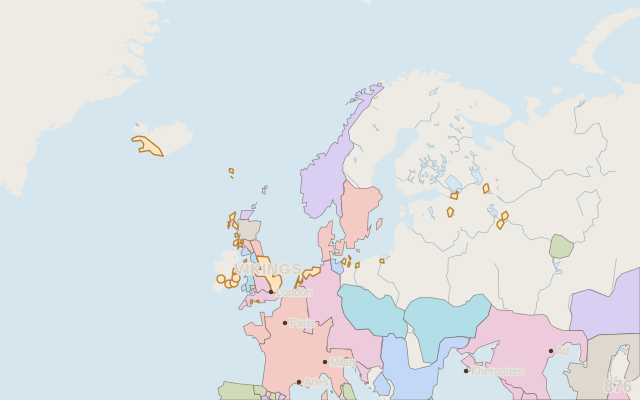
At its height in 876 · about the size of Eritrea

1 war or battle

1 entries in all

Map: Vikings in 876, its borders in gold among its neighbours
8009001000110012001300
Beside it on the map in 876: West Francia, Khazaria, East Francia, Kimak–Kipchak confederation, Hungarians and Kingdom of Norway (872–1397).How far it reached, year by year: its ground inside the borders Cliopatria draws (CC BY 4.0), measured on an equal-area grid; the map shows it at its largest, with the cities of the year.

The story

Two acts, 793 – 1332

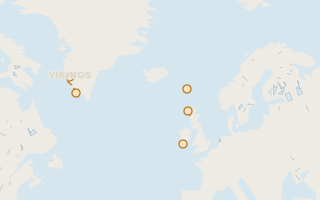
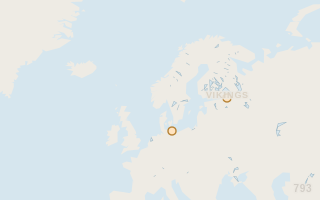
Vikings in 1065, at the end of act I
I793 – 10665,700 → 47,000 km²

Raiders, traders and settlers

From the first raids of 793 CE, Norse longships reach the British Isles, the Baltic and far beyond. Norwegians colonise Iceland in the 9th century, Vikings are granted Normandy in the 10th, and Varangians trade along the Dnieper and Volga, some serving the Byzantine emperor. Sweyn Forkbeard claims England's throne, and the homelands grow into three kingdoms.

Watch this act on the live map, from 793
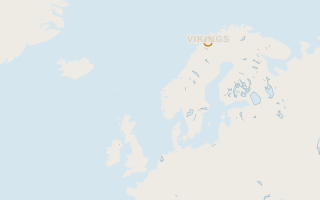
Vikings in 1331, at the end of act II
II1066 – 133247,000 → 400 km²

Christian kingdoms of the North

By the late 11th century the Church backs the royal dynasties of Denmark, Norway and Sweden. Dioceses take root, the first Scandinavian archbishopric is founded at Lund in 1103, and towns, markets and coinage follow English and German models. After 1130 the islanders of the North Atlantic begin writing their own history in sagas and chronicles.

Watch this act on the live map, from 1066
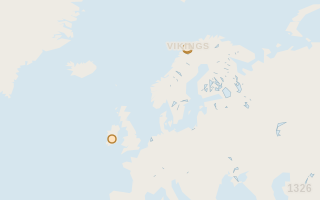
Vikings in 1326, last mappedVikings in 793, first mapped
The rise and the fall in one frame: drag across it from 793, first mapped at 5,700 km², to 1326, last mapped at 400 km². Open the live map in 793 or 1326.

Where it sits in time

3000 BCE2000 BCE1000 BCE110002000Vikings: 793 – 1332

Five thousand years, 3000 BCE to 2026; the state in gold.

Its world

Rivals, and who else stood

Who it fought most

Wars and battles both took part in, on whichever side: the record names who took part, not who fought whom.

Meanwhile, elsewhere

The best-known states of other regions that stood while it did; the band is Vikings’s own years.

800100012001400

How it compares

Among 3,073 states

Stood longer than 88% of 3,073 states
Vikings · 539 yearsMacedoniaKathmanduHow long it stood, among the states with a recorded end or still standing.
Held more ground at its peak than 52% of 1,464 states
Vikings · 134,000 km²EritreaTajikistanThe most ground it held, among the states with a border in Cliopatria.

Why it fell

Why did Vikings fall?

Historians still argue. Here is what the atlas records about its last century:

÷118

its land, between 1232 and 1331

Its centuries in the record

700 – 799: 0 recorded — 0 wars and battles, 0 risings, regime changes and massacres, 0 other700800 – 899: 1 recorded — 1 wars and battles, 0 risings, regime changes and massacres, 0 other800900 – 999: 0 recorded — 0 wars and battles, 0 risings, regime changes and massacres, 0 other9001000 – 1099: 0 recorded — 0 wars and battles, 0 risings, regime changes and massacres, 0 other10001100 – 1199: 0 recorded — 0 wars and battles, 0 risings, regime changes and massacres, 0 other11001200 – 1299: 0 recorded — 0 wars and battles, 0 risings, regime changes and massacres, 0 other12001300 – 1399: 0 recorded — 0 wars and battles, 0 risings, regime changes and massacres, 0 other1300

Wars and battles in red, risings, coups and massacres beside them, everything else in grey, by the century each began in. A tall bar is partly a fact about Wikipedia: better-documented centuries hold more.

Each century’s own page:700 – 799800 – 899900 – 9991000 – 10991100 – 11991200 – 12991300 – 1399

Keep exploring

Share this page
Copy link
Embed the map
Cite this page

How this page is made

Drawn from Wikidata (Q12567, CC0), the opening and history of its English Wikipedia article retold by the atlas (CC BY-SA 4.0), borders from Cliopatria (CC BY 4.0), coast and rivers from Natural Earth, cities from Reba, Reitsma & Seto 2016 (CC BY 4.0). Data built 2026-11-26 · Pastlas v2.47.1, by Oleh Voronko; the published atlas and its data are for non-commercial use.

How to read it

Areas are measured on an equal-area grid from borders simplified to about five kilometres. “c.” marks an approximate date, and a date known to the century is never printed to the year. Counts are what the atlas holds, and they follow Wikipedia’s coverage: a busy century is partly a fact about the record.

  • Wikidata records a founding in 745 and no end; the borders dataset maps it from 793 to 1332, and those are the years drawn here.

Something wrong?

Tell us and name the entry. We fix the data, not just this page.

Report a problem