 Alessandro Mancini,
 Paolo Rondelli and
 Valeria Ciavatta are the best known.
Battle of Sena Gallica
battle · 551
State · Europe
301 – present · 1,725 years · still standing
A republic on Monte Titano, entirely surrounded by Italy, that claims to be the oldest sovereign state still standing.
San Marino, a microstate on the slopes of the Apennine Mountains wholly enclosed by Italy, dates its founding to 301 CE, when Saint Marinus, a stonemason fleeing Diocletian's persecution, is said to have built a chapel on Monte Titano. Every six months its elected Grand and General Council chooses two Captains Regent from rival parties to serve together as heads of state. In 1865 it abolished the death penalty, before any other state still in existence.
From Wikipedia’s article, retold · CC BY-SA 4.0
Best known for
1,725 years
Longer than Rhodes, shorter than Ancient Greece
1 marino a year
546 on record, 1,442 of their terms dated
8 wars and battles
549 entries in all
Its borders aren’t on record
The borders dataset does not draw San Marino. The live map still shows where it stood among the states of its years.
Find it on the live mapThe story
The best-known wars, battles, risings and changes of regime the record files under it; a war within a war is folded into it.
battle · 551
battle · 552
battle · 23 May 1915
battle · 17 September 1944
battle · 16 June 1944
Five thousand years, 3000 BCE to 2026; the state in gold.
Its people
One axis for everyone, so you can see who knew whom: the best-known, ordered by birth.
 Marino Riccardiregent1958 – present
 Valeria Ciavattaregent1959 – present
 Antonella Mularoniregent · diplomat1961 – present
 Mariella Mularoniregent1962 – present
 Paolo Rondelliregent · diplomat1963 – present
 Alessandro Rossiregent1967 – present
 Francesco Mussoniregent1971 – present
 Filippo Tamagniniregent1972 – present
 Luca Beccariregent1974 – present
 Alessandro Manciniregent1975 – present
 Nicola Renziregent1979 – present
How it was governed
San Marino filled the office of Captain Regent of San Marino anew each year, several at a time, over 1,725 years: 546 holders on record, 1,442 of their terms dated, some held by the same people more than once. Each column below is one year; the upper cell its first holder, the lower its second.
The line of Captain Regent of San Marino - the office this state names as its head of state.
Captain Regent of San Marino: 546 holders, drawn and never measured - San Marino elects two Captains Regent every six months, who reign together.
546 rulers, 0 with terms dated as terms. A blank in the last column means no kin on record, which is coverage, never “unrelated”.
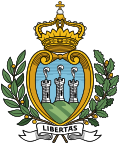
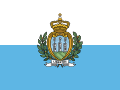
Each symbol with the years its own statement gives; the timeline flies the one of the year on screen.

Its world
Wars and battles both took part in, on whichever side: the record names who took part, not who fought whom.
The best-known states of other regions that stood while it did; the band is San Marino’s own years.
 United StatesAmericas and Oceania
 MexicoAmericas and Oceania
 TurkeyMiddle East and North Africa
 JapanEast and Southeast Asia
 People's Republic of ChinaEast and Southeast Asia
 IndiaSouth Asia
 EgyptMiddle East and North Africa
 South AfricaSub-Saharan Africa
How it compares
Each column is a share of the states; gold is San Marino.
How it began
It began, by its own account, in 301 CE, when Saint Marinus founded a monastic community on Monte Titano.
Wars and battles in red, risings, coups and massacres beside them, everything else in grey, by the century each began in. A tall bar is partly a fact about Wikipedia: better-documented centuries hold more.
Each century’s own page:300 – 399400 – 499500 – 599600 – 699700 – 799800 – 899900 – 9991000 – 10991100 – 11991200 – 12991300 – 13991400 – 14991500 – 15991600 – 16991700 – 17991800 – 18991900 – 19992000 – 2099
“San Marino”, Pastlas, a historical atlas, 2026-11-26. https://app.pastlas.com/state/san-marino/
Drawn from Wikidata (Q238, CC0), the opening and history of its English Wikipedia article retold by the atlas (CC BY-SA 4.0), borders from Cliopatria (CC BY 4.0), coast and rivers from Natural Earth, cities from Reba, Reitsma & Seto 2016 (CC BY 4.0), symbols from Wikimedia Commons, each under its own licence. Data built 2026-11-26 · Pastlas v2.47.1, by Oleh Voronko; the published atlas and its data are for non-commercial use.
Areas are measured on an equal-area grid from borders simplified to about five kilometres. “c.” marks an approximate date, and a date known to the century is never printed to the year. Counts are what the atlas holds, and they follow Wikipedia’s coverage: a busy century is partly a fact about the record.


