State · Middle East and North Africa

Kingdom of Aksum

401 BCE – 960 CE · 1,361 years

A Horn of Africa kingdom that commanded Red Sea trade between Rome and India and made Christianity its state religion.

The Kingdom of Aksum grew out of the earlier Dʿmt civilization in today's Eritrea and northern Ethiopia, with its capital at Axum. Controlling trade between Rome and India, it struck its own coins, and Mani counted it one of four great powers of its day. Under Ezana it became Christian; under Kaleb it ruled Himyar in Yemen. From the 7th century it declined, and c. 960 a queen called Gudit is said to have sacked it.

What the record holds

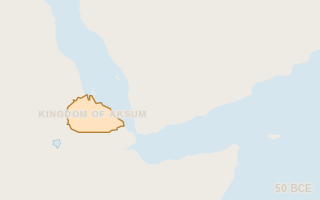
The Kingdom of Aksum began in the 5th century BCE.↑ In 50 BCE, the first year its borders are mapped, it covered 97,400 km².↓

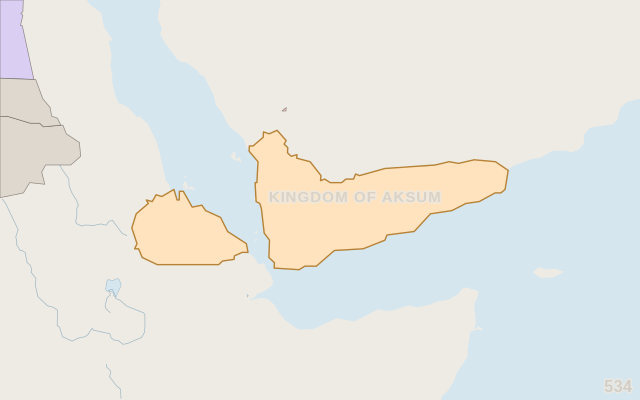
At its largest, in 534, it held 394,200 km².↓ Its highest office was held by 30 rulers, covering 100 – 630, the median reign 13.5 years; 2 of 21 handovers were irregular.↓ The best known of them are Ezana of Axum, Najashi and Kaleb of Axum.↓ Most of the 26 rows the atlas files under it are people.↓ Its record closes in 960, after 1,361 years.↑

From Wikipedia’s article, retold · CC BY-SA 4.0

1,361 years

Longer than Indus Valley Civilisation, shorter than Babylonia

394,000 km²

At its height in 534 · about the size of Zimbabwe

30 rulers

the Ethiopia, AKSUM

1 war or battle

26 entries in all

Map: Kingdom of Aksum in 534, its borders in gold among its neighbours
1200400600800
Beside it on the map in 534: Alodia, Nobatia, Kingdom of Makuria and Himyar.How far it reached, year by year: its ground inside the borders Cliopatria draws (CC BY 4.0), measured on an equal-area grid; the map shows it at its largest, with the cities of the year.

The story

Four acts, 401 BCE – 960 CE

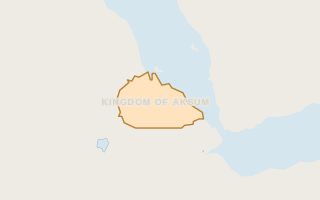
Kingdom of Aksum in 199, at the end of act I
I401 BCE – 200 CE

From Dʿmt to the Periplus

Before Aksum, a kingdom called Dʿmt holds Eritrea and the Tigray Plateau, shaped by Sabaean contacts that bring the script later grown into Geʽez. Aksum itself arises in the 1st century CE: the Periplus of the Erythraean Sea puts Axum and the port of Adulis in the realm of Zoskales, a land of ivory.

Watch this act on the live map, from 401 BCE
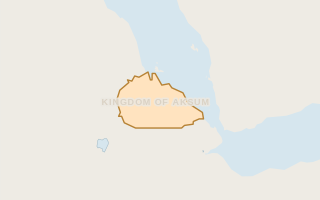
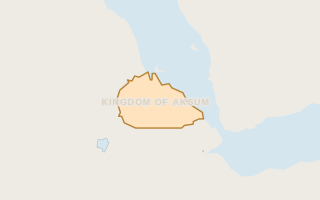
Kingdom of Aksum in 513, at the end of act II
II200 – 51497,400 → 97,400 km²

Coins, Christianity and Meroë

Gedara becomes the first king drawn into South Arabian affairs, holding much of western Yemen until a Himyarite-Sabean alliance pushes Aksum out. Endybis mints coins that turn up in Caesarea and southern India. Ezana makes Christianity the state religion and conquers Meroë in 330, inheriting from it the name Ethiopia.

Watch this act on the live map, from 200
Kingdom of Aksum in 614, at the end of act III
III514 – 61597,400 → 97,400 km²

Kaleb's empire across the Red Sea

At the urging of the Byzantine emperor Justin I, Kaleb invades the Himyarite Kingdom to end the Jewish king Dhu Nuwas's persecution of Christians, and Aksum reaches its greatest extent. Its direct hold on South Arabia ends in 525, when Abraha deposes Sumyafa Ashwa, and the Aksumite–Persian wars take the territory for good.

Watch this act on the live map, from 514
IV615 – 960

Islam and the long decline

Persian conquests and defeats in Yemen hurt Aksum's Red Sea trade, and the rise of Islam does lasting harm. Relations begin well: in 615 Muslims fleeing Mecca find refuge at Axum. But as the Arabs advance, trade with the Byzantine world stops, coins are no longer minted, and c. 960 Gudit is said to sack the city.

Watch this act on the live map, from 615
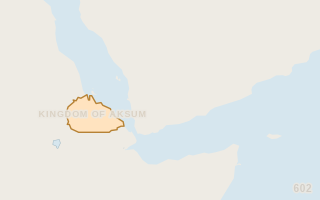
Kingdom of Aksum in 602, last mappedKingdom of Aksum in 50 BCE, first mapped
The rise and the fall in one frame: drag across it from 50 BCE, first mapped at 97,400 km², to 602, last mapped at 97,400 km². Open the live map in 50 BCE or 602.

Where it sits in time

3000 BCE2000 BCE1000 BCE110002000Kingdom of Aksum: 401 BCE – 960

Five thousand years, 3000 BCE to 2026; the state in gold.

Its people

Lives across the Kingdom of Aksum

Notable figures

How it was governed

30 aksums

30 aksums on record, 100 to 630; a reign lasted 13.5 years at the median. Each bar is a reign, as long as it lasted.

Zoskales · 100 – 200 · no death date to read the end againstGDRT · 200 – 230 · left office aliveʽDBH · 230 – 240 · no death date to read the end againstSembrouthes · 240 – 260 · left office aliveDTWNS · 260 – 270 · no death date to read the end againstEndybis · 270 – 300 · no death date to read the end againstAphilas · 300 – 310 · no death date to read the end againstOusanas · 320 – 333 · left office aliveEzana of Axum · 325 – 356 · no death date to read the end againstWazeba of Axum · 333 – 356 · left office aliveAlla Amidas · 432 – 439 · left office aliveEbana · 439 – 450 · left office aliveNezool · 450 – 486 · left office aliveOusas · 486 – 493 · no death date to read the end againstKaleb of Axum · 514 – 534 · left office aliveWazena of Axum · 550 – 570 · left office aliveWʽZB · 570 – 580 · left office aliveIoel · 580 – 585 · left office aliveHataz · 585 – 590 · no death date to read the end againstIsrael of Axum · 590 – 600 · no death date to read the end againstGersem of Axum · 600 – 614 · no death date to read the end againstNajashi · 614 – 630 · died in office, manner not recorded1500
a second row: a reign that began before the last had ended — rival claimants, or a shared throne
How their terms ended, where it is known (12 of 22):Died in office 1Left office alive 11Not on record 10
Every term, with how it ended and its source

Rulers

How 22 reigns ended - choose one to show only those
RulerReignLengthHow it ended · sourceTo the ruler before
1st century · 1 reign
Zoskales · aged 50100 – 200100 yearsending not on record
2nd century · 1 reign
GDRT200 – 23030 yearsleft office aliveread off the dates alone
3rd century · 5 reigns
ʽDBH · aged 129230 – 24010 yearsending not on record
Sembrouthes · aged 40240 – 26020 yearsleft office aliveread off the dates alone
DTWNS260 – 27010 yearsending not on record
Endybis270 – 30030 yearsending not on record
Aphilas300 – 31010 yearsending not on record
4th century · 3 reigns
Ousanas · aged 20320 – 33313 yearsleft office aliveread off the dates alone
Ezana of Axum325 – 35631 yearsending not on recordchild
Wazeba of Axum · aged 33333 – 35623 yearsleft office aliveread off the dates alone
5th century · 4 reigns
Alla Amidas432 – 4397 yearsleft office aliveread off the dates alone
Ebana439 – 45011 yearsleft office aliveread off the dates alonechild
Nezool450 – 48636 yearsleft office aliveread off the dates alonesibling
Ousas · aged 86486 – 4937 yearsending not on recordsibling
6th century · 7 reigns
Kaleb of Axum · aged 64514 – 53420 yearsleft office aliveread off the dates alonechild
Wazena of Axum · aged 50550 – 57020 yearsleft office aliveread off the dates alone
WʽZB570 – 58010 yearsleft office aliveread off the dates alone
Ioel · aged 80580 – 5855 yearsleft office aliveread off the dates alone
Hataz585 – 5905 yearsending not on record
Israel of Axum590 – 60010 yearsending not on record
Gersem of Axum600 – 61414 yearsending not on record
7th century · 1 reign
Najashi · aged 64614 – 63016 yearsdied in officeread off the dates alone

30 rulers, 22 with terms dated as terms, covering 100 – 630. Median reign 13.5 years. 2 of 21 handovers irregular - a killing, a deposition, a rival claimant, a rising or a coup beside it. A blank in the last column means no kin on record, which is coverage, never “unrelated”.

The line also names one holder with a page of their own whose term the record gives no first year, so the table cannot place it: Eon of Axum.

Flag or arms

  • KingEndybisEthiopia227-235CE
    coin, undatedKingEndybisEthiopia227-235CE · CC BY-SA 3.0 · PHGCOM

Its world

Rivals, and who else stood

Who it fought most

Wars and battles both took part in, on whichever side: the record names who took part, not who fought whom.

Meanwhile, elsewhere

The best-known states of other regions that stood while it did; the band is the Kingdom of Aksum’s own years.

500 BCE15001000

How it compares

Among 3,073 states

Stood longer than 99% of 3,073 states
Kingdom of Aksum · 1,361 yearsIndus Valley CivilisationBabyloniaHow long it stood, among the states with a recorded end or still standing.
Held more ground at its peak than 70% of 1,464 states
Kingdom of Aksum · 394,200 km²ZimbabweParaguayThe most ground it held, among the states with a border in Cliopatria.

Why it fell

Why did the Kingdom of Aksum fall?

Historians still argue. Here is what the atlas records about its last century:

Its centuries in the record

500 BCE – 401 BCE: 0 recorded — 0 wars and battles, 0 risings, regime changes and massacres, 0 other500 BCE400 BCE – 301 BCE: 0 recorded — 0 wars and battles, 0 risings, regime changes and massacres, 0 other300 BCE – 201 BCE: 0 recorded — 0 wars and battles, 0 risings, regime changes and massacres, 0 other300 BCE200 BCE – 101 BCE: 0 recorded — 0 wars and battles, 0 risings, regime changes and massacres, 0 other100 BCE – 1 BCE: 0 recorded — 0 wars and battles, 0 risings, regime changes and massacres, 0 other100 BCE0 – 99: 1 recorded — 0 wars and battles, 0 risings, regime changes and massacres, 1 other100 – 199: 1 recorded — 0 wars and battles, 0 risings, regime changes and massacres, 1 other100200 – 299: 3 recorded — 0 wars and battles, 0 risings, regime changes and massacres, 3 other300 – 399: 5 recorded — 0 wars and battles, 0 risings, regime changes and massacres, 5 other300400 – 499: 4 recorded — 0 wars and battles, 0 risings, regime changes and massacres, 4 other500 – 599: 8 recorded — 1 wars and battles, 0 risings, regime changes and massacres, 7 other500600 – 699: 3 recorded — 0 wars and battles, 0 risings, regime changes and massacres, 3 other700 – 799: 0 recorded — 0 wars and battles, 0 risings, regime changes and massacres, 0 other700800 – 899: 1 recorded — 0 wars and battles, 0 risings, regime changes and massacres, 1 other900 – 999: 0 recorded — 0 wars and battles, 0 risings, regime changes and massacres, 0 other900

Wars and battles in red, risings, coups and massacres beside them, everything else in grey, by the century each began in. A tall bar is partly a fact about Wikipedia: better-documented centuries hold more.

Each century’s own page:500 BCE – 401 BCE400 BCE – 301 BCE300 BCE – 201 BCE200 BCE – 101 BCE100 BCE – 1 BCE0 – 99100 – 199200 – 299300 – 399400 – 499500 – 599600 – 699700 – 799800 – 899900 – 999

Keep exploring

Share this page
Copy link
Embed the map
Cite this page

How this page is made

Drawn from Wikidata (Q139377, CC0), the opening and history of its English Wikipedia article retold by the atlas (CC BY-SA 4.0), borders from Cliopatria (CC BY 4.0), coast and rivers from Natural Earth, cities from Reba, Reitsma & Seto 2016 (CC BY 4.0), symbols from Wikimedia Commons, each under its own licence. Data built 2026-11-26 · Pastlas v2.47.1, by Oleh Voronko; the published atlas and its data are for non-commercial use.

How to read it

Areas are measured on an equal-area grid from borders simplified to about five kilometres. “c.” marks an approximate date, and a date known to the century is never printed to the year. Counts are what the atlas holds, and they follow Wikipedia’s coverage: a busy century is partly a fact about the record.

Something wrong?

Tell us and name the entry. We fix the data, not just this page.

Report a problem