City-state · Americas and Oceania

Tenochtitlan

1325 – 1521 · 196 years

Became Mexico City

The Mexica island city in Lake Texcoco, capital of the expanding Aztec Empire and the largest city of the pre-Columbian Americas.

Tenochtitlan, or Mexico-Tenochtitlan, was a Mexica city-state built on an island in Lake Texcoco, in the Valley of Mexico, which it shared with Tlatelolco. Its exact founding date is unknown; 1325 is the year chosen for its anniversary. In the 15th century it became capital of the growing Aztec Empire and, at its peak, the largest city of the pre-Columbian Americas, until the Tlaxcaltec and the Spanish captured it in 1521.

What the record holds

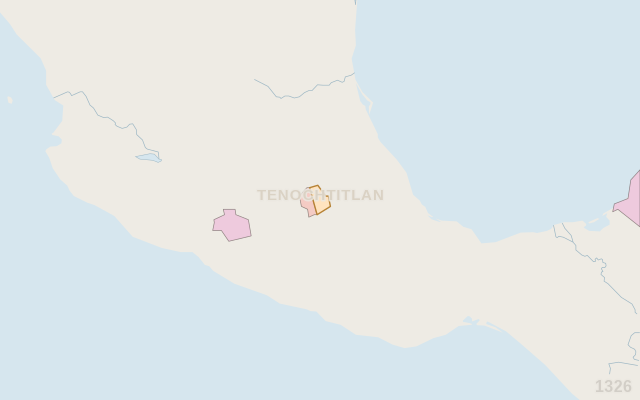
The record dates its beginning to 1325.↑ Its borders are first mapped in 1326, around 2,500 km².↓

Its highest office was held by 29 rulers, covering 1367 – 1530, the median reign 12.5 years; 10 of 18 handovers were irregular.↓ The best known of them are Moctezuma II, Moctezuma I and Cuitláhuac.↓ Most of the 23 rows the atlas files under it are people.↓

Mexico City replaced it in 1521, after 196 years.↓

From Wikipedia’s article, retold · CC BY-SA 4.0

196 years

Longer than the Mongol Empire, shorter than Greenland

2,500 km²

At its height in 1326 · about the size of Luxembourg

29 rulers

the tlatoani

Map: Tenochtitlan in 1326, its borders in gold among its neighbours
13401360138014001420
Beside it on the map in 1326: Maya civilization and Texcoco.How far it reached, year by year: its ground inside the borders Cliopatria draws (CC BY 4.0), measured on an equal-area grid; the map shows it at its largest, with the cities of the year.

The story

Two acts, 1325 – 1521

II1502 – 1521

Moctezuma II and the Spanish

Moctezuma II rules from 1502. When Cortés and his men invade, he chooses to greet Cortés as an envoy instead of risking a war that aggrieved native peoples might join. At the feast of Toxcatl, Pedro de Alvarado, left in command, fears a surprise attack, and the Spaniards come armed and seal the courtyard. Cuitláhuac reigns in 1520.

Watch this act on the live map, from 1502

Before and after

After it

  • Mexico City · replaced by

Where it sits in time

3000 BCE2000 BCE1000 BCE110002000Tenochtitlan: 1325 – 1521

Five thousand years, 3000 BCE to 2026; the state in gold.

Its people

Lives across Tenochtitlan

13001350140014501500
Statesmen and generalsLived on after it endedAll its people on the timeline →

How it was governed

29 tlatoanis

29 tlatoanis on record, 1367 to 1530; a reign lasted 12.5 years at the median. Each bar is a reign, as long as it lasted.

Tezozomoc · 1367 – … · no end recordedAcamapichtli · 1376 – 1395 · died in office, manner not recordedTlacacuitlahuatzin · 1395 – 1450 · no death date to read the end againstHuitzilihuitl · 1396 – 1417 · died in office, manner not recordedChimalpopoca · 1417 – 1427 · died by suicideMaxtla · 1426 – 1428 · died in office, manner not recordedItzcoatl · 1427 – 1440 · died in office, manner not recordedMoctezuma I · 1440 – 1469 · died in office, manner not recordedXilomantzin · 1440 – 1473 · died in office, manner not recordedAxayacatl · 1469 – 1481 · died in office, manner not recordedChimalpopoca (Tlacopan) · 1469 – 1489 · died in office, manner not recordedTizoc · 1481 – 1486 · killedAhuitzotl · 1486 – 1502 · died in office, manner not recordedMoctezuma II · 1502 – 1520 · killed, the article saysCuitláhuac · 1520 – 1520 · died in office of natural causesCuauhtémoc · 1521 – 1521 · left office aliveHernando Cetochtzin · 1521 – 1526 · left office aliveXicotencatl I · 1522 – 1522 · died in office, manner not recordedAndrés de Tapia Motelchiuh · 1525 – 1530 · died in office, manner not recorded1350140014501500
a second row: a reign that began before the last had ended — rival claimants, or a shared throne
How their terms ended, where it is known (17 of 19):Killed 2Died in office 13Left office alive 2Not on record 2
Every term, with how it ended and its source

Rulers

How 19 reigns ended - choose one to show only those

How they died, where the record says: killed 2 · died by suicide 1 · died of natural causes 1.

RulerReignLengthHow it ended · sourceTo the ruler before
14th century · 4 reigns
Tezozomoc · aged 471367 – —no end recordedending not on record
Acamapichtli1376 – 139519 yearsdied in officeread off the dates alone
Tlacacuitlahuatzin1395 – 145055 yearsending not on record
Huitzilihuitl · aged 161396 – 141721 yearsdied in officeread off the dates alone
15th century · 9 reigns · 1 killed or removed
Chimalpopoca · aged 201417 – 142710 yearsdied by suicideWikidata's manner of deathdied by suicidechild
Maxtla · aged 261426 – 14282 yearsdied in officeread off the dates alone
Itzcoatl · aged 471427 – 144013 yearsdied in officeread off the dates alone
Moctezuma I · aged 421440 – 146929 yearsdied in officeread off the dates alonenephew or niece
Xilomantzin1440 – 147333 yearsdied in officeread off the dates alone
Axayacatl · aged 201469 – 148112 yearsdied in officeread off the dates alone
Chimalpopoca (Tlacopan)1469 – 148920 yearsdied in officeread off the dates alone
Tizoc · aged 451481 – 14865 yearskilled in officeWikidata's manner of death
Ahuitzotl · aged 361486 – 150216 yearsdied in officeread off the dates alonesibling
16th century · 6 reigns · 1 killed or removed
Moctezuma II · aged 361502 – 152018 yearskilledread from the ruler's own articlenephew or niece
Cuitláhuac · aged 441520 – 1520under a yeardied in officeWikidata's manner of deathdied of natural causessibling
Cuauhtémoc · aged 261521 – 1521under a yearleft office aliveread off the dates alonekilled
Hernando Cetochtzin1521 – 15265 yearsleft office aliveread off the dates alone
Xicotencatl I · aged 221522 – 1522under a yeardied in officeread off the dates alone
Andrés de Tapia Motelchiuh · aged 251525 – 15305 yearsdied in officeread off the dates alone

29 rulers, 19 with terms dated as terms, covering 1367 – 1530. Median reign 12.5 years. 10 of 18 handovers irregular - a killing, a deposition, a rival claimant, a rising or a coup beside it. A blank in the last column means no kin on record, which is coverage, never “unrelated”.

Flag or arms

  • Tenochtitlan Glyph ZP
    coat of arms, undatedTenochtitlan Glyph ZP · Public domain

Its world

Who else stood

Meanwhile, elsewhere

The best-known states of other regions that stood while it did; the band is Tenochtitlan’s own years.

130013501400145015001550

How it compares

Among 3,073 states

Stood longer than 61% of 3,073 states
Tenochtitlan · 196 yearsMongol EmpireGreenlandHow long it stood, among the states with a recorded end or still standing.
Held more ground at its peak than 6% of 1,464 states
Tenochtitlan · 2,500 km²LuxembourgCyprusThe most ground it held, among the states with a border in Cliopatria.

Why it fell

Why did Tenochtitlan fall?

Historians still argue. Here is what the atlas records about its last century:

1520

Moctezuma II, killed in office

What led to it, and what came of it

Tenochtitlan · 1325 – 1521TenochtitlanMexico City · Linked · 1325Mexico City1350140014501500
linked

Open the investigation: every row with its evidence, the conditions at the time, the theories condition by condition, and the succession analysed.

Its centuries in the record

1300 – 1399: 8 recorded — 0 wars and battles, 0 risings, regime changes and massacres, 8 other13001400 – 1499: 10 recorded — 0 wars and battles, 0 risings, regime changes and massacres, 10 other14001500 – 1599: 4 recorded — 0 wars and battles, 0 risings, regime changes and massacres, 4 other1500

Wars and battles in red, risings, coups and massacres beside them, everything else in grey, by the century each began in. A tall bar is partly a fact about Wikipedia: better-documented centuries hold more.

Each century’s own page:1300 – 13991400 – 14991500 – 1599

Keep exploring

Share this page
Copy link
Embed the map
Cite this page

How this page is made

Drawn from Wikidata (Q13695, CC0), the opening and history of its English Wikipedia article retold by the atlas (CC BY-SA 4.0), borders from Cliopatria (CC BY 4.0), coast and rivers from Natural Earth, cities from Reba, Reitsma & Seto 2016 (CC BY 4.0), symbols from Wikimedia Commons, each under its own licence. Data built 2026-11-26 · Pastlas v2.47.1, by Oleh Voronko; the published atlas and its data are for non-commercial use.

How to read it

Areas are measured on an equal-area grid from borders simplified to about five kilometres. “c.” marks an approximate date, and a date known to the century is never printed to the year. Counts are what the atlas holds, and they follow Wikipedia’s coverage: a busy century is partly a fact about the record.

Something wrong?

Tell us and name the entry. We fix the data, not just this page.

Report a problem