State · Middle East and North Africa

Abbasid Caliphate

750 – 1258 · 508 years

Came after Umayyad Caliphate · became Ottoman Empire and Fatimid Caliphate

Baghdad's caliphate, centre of the Golden Age of Islam, whose caliphs sank to figureheads before the Mongols ended it.

The Abbasid Caliphate, the third Islamic caliphate, took power in 750 CE when the Abbasid Revolution overthrew the Umayyads, and ruled from Iraq until 1258. Its second caliph, al-Mansur, founded Baghdad in 762 CE, and the city became the heart of the Golden Age of Islam, home to the House of Wisdom. After Harun al-Rashid the provinces drifted toward autonomy, and from the 10th century CE Buyids and Seljuq Turks reduced the caliphs to figureheads.

What the record holds

The Abbasid Caliphate began in 750, after the Umayyad Caliphate.↓ Its borders are first mapped in 750, around 2.74 million km².↓ The Anarchy at Samarra, 861 – 870, began with it holding 7.79 million km² and ended with 7.27 million km².↓

Its ground peaked in 778 at 8.16 million km².↓ Its highest office was held by 49 rulers, covering 750 – 1302, the median reign 10 years; 18 of 42 handovers were irregular.↓ Among them, Harun al-Rashid, Al-Ma'mun and Al-Mansur are the best known.↓ The atlas files 97 rows under it, most of them people.↓

It was replaced by the Ottoman Empire, the Fatimid Caliphate and Ilkhanate in 1258, 508 years after it began.↓

From Wikipedia’s article, retold · CC BY-SA 4.0

508 years

Longer than Hittites, shorter than Macedonia

8.16 million km²

At its height in 778 · about the size of Australia

49 rulers

the Abbasid caliph

15 wars and battles

More per century than 91% of states · 97 entries in all

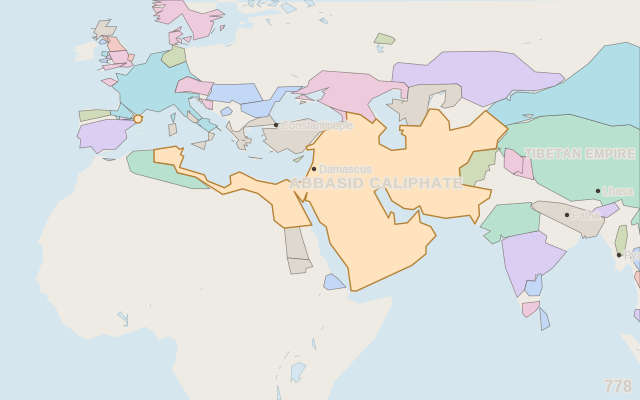
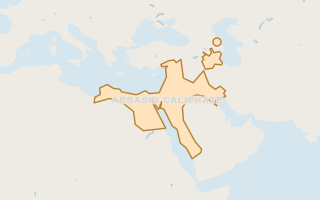
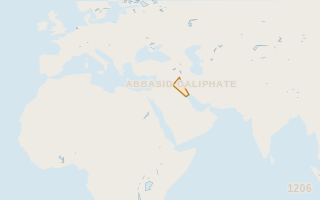
Map: Abbasid Caliphate in 778, its borders in gold among its neighbours
Fourth Fitna, 811 – 819: 7.90 million km² → 7.88 million km²Sack of Damietta, 853Anarchy at Samarra, 861 – 870: 7.79 million km² → 7.27 million km²Zanj Rebellion, 869 – 883Siege of Baghdad, 1258800900100011001200
Beside it on the map in 778: Tibetan Empire, Uyghur Khaganate, Kimak–Kipchak confederation, Francia, Khazaria and Rashtrakuta Empire.How far it reached, year by year: its ground inside the borders Cliopatria draws (CC BY 4.0), measured on an equal-area grid; the map shows it at its largest, with the cities of the year.

The story

Five acts, 750 – 1258

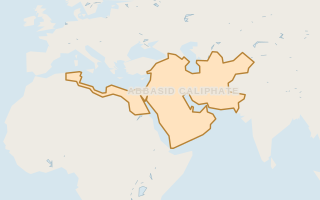
Abbasid Caliphate in 774, at the end of act I
I750 – 7752.74 million → 8.15 million km²

Revolution and a new capital

Kin of Muhammad through his uncle Abbas ibn Abd al-Muttalib, the Abbasids rise in Khurasan and overthrow the Umayyads in 750 CE. Al-Saffah consolidates their rule while Abu Muslim, Abu Ja'far and Abdallah ibn Ali hold power; in 751 CE an Abbasid army defeats Tang China at Talas. In 762 CE al-Mansur founds Baghdad and makes it the capital.

Watch this act on the live map, from 750
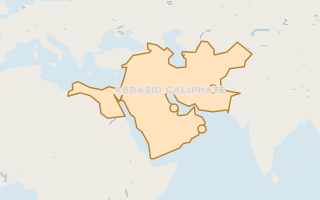
Abbasid Caliphate in 860, at the end of act II
II775 – 8618.15 million → 7.79 million km²

The golden age

Under Harun al-Rashid, from 786 CE to 809 CE, Abbasid power and prestige reach their height, and the vizier's office grows powerful under the Barmakids. After Harun's death a civil war brings new divisions; an army drawn mostly from Turkic slaves follows, and in 836 CE a new capital is built at Samarra.

Watch this act on the live map, from 775
Abbasid Caliphate in 944, at the end of act III
III861 – 9457.79 million → 2.12 million km²

Fragmentation

After the Anarchy at Samarra, the caliphs can no longer hold the empire together. Aghlabids, Tahirids, Samanids, Saffarids and Tulunids rule their regions with growing autonomy, and the Zanj rise in revolt. The seat of the caliphate returns to Baghdad in 892 CE, and in 945 CE the Buyids take the city.

Watch this act on the live map, from 861
Abbasid Caliphate in 1257, at the end of act V
V1118 – 1258

Revival and the Mongol end

Caliph al-Mustarshid becomes the first caliph since the 10th century CE to lead his own army in battle, but a Seljuk army defeats him in 1135. Under al-Muqtafi and his vizier Ibn Hubayra a caliphal state re-emerges in Iraq, and al-Nasir extends it into Iran. Then Hulagu Khan's Mongol campaign ends with the conquest of Baghdad in 1258.

Watch this act on the live map, from 1118
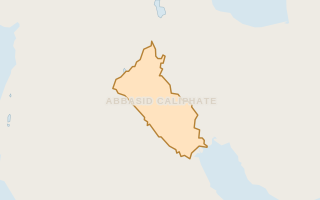
Abbasid Caliphate in 1206, last mappedAbbasid Caliphate in 778, at its largest
The rise and the fall in one frame: drag across it from 778, at its largest at 8.16 million km², to 1206, last mapped at 168,200 km². Open the live map in 778 or 1206.

Before and after

Before it

After it

Where it sits in time

3000 BCE2000 BCE1000 BCE110002000Umayyad Caliphate: 661 – 750Ottoman Empire: 1299 – 1922Fatimid Caliphate: 909 – 1171Mamluk Sultanate: 1250 – 1517Abbasid Caliphate: 750 – 1258

Five thousand years, 3000 BCE to 2026; the state in gold, what it replaced or followed and what replaced or followed it in grey.

Its people

Lives across the Abbasid Caliphate

800900100011001200
Statesmen and generalsWriters, artists and thinkersScientists and explorersLived on after it endedAll its people on the timeline →

How it was governed

49 caliphs

49 caliphs on record, 750 to 1302; a reign lasted 10 years at the median. Each bar is a reign, as long as it lasted.

Al-Saffah · 750 – 754 · died in office of natural causesAl-Mansur · 754 – 775 · died in office, manner not recordedAl-Mahdi · 775 – 785 · died in office, manner not recordedAl-Hadi · 785 – 786 · died in office, manner not recordedHarun al-Rashid · 786 – 809 · died in office, manner not recordedAl-Amin · 809 – 813 · killedAl-Ma'mun · 813 – 833 · died in office, manner not recordedAl-Mu'tasim · 833 – 842 · died in office, manner not recordedAl-Wathiq · 842 – 847 · died in office, manner not recordedAl-Mutawakkil · 847 – 861 · killedAl-Muntasir · 861 – 862 · killedAl-Musta'in · 862 – 865 · executedAl-Mu'tazz · 866 – 869 · deposed, the article saysAl-Muhtadi · 869 – 870 · exiled, imprisoned or confined, the article saysAl-Mu'tamid · 870 – 892 · died in office, manner not recordedAl-Mu'tadid · 892 – 902 · died in office, manner not recordedAl-Muktafi · 902 – 908 · died in office, manner not recordedAl-Muqtadir · 908 – 932 · died in battleAl-Qahir · 932 – 934 · left office aliveAl-Radi · 934 – 940 · died in office, manner not recordedAl-Muttaqi · 940 – 944 · killed, the article saysAl-Mustakfi · 944 – 946 · deposed, the article saysAl-Muti' · 946 – 974 · died in office, manner not recordedAl-Ta'i' · 974 – 991 · deposed, the article saysAl-Qadir · 991 – 1031 · died in office, manner not recordedAl-Muqallad ibn al-Musayyab · 996 – 1001 · no death date to read the end againstSalih ibn Mirdas · 1025 – 1029 · died in office, manner not recordedShibl al-Dawla Nasr · 1029 – 1038 · died in office, manner not recordedAl-Qa'im (Abbasid caliph at Baghdad) · 1031 – 1075 · died in office, manner not recordedMu'izz al-Dawla Thimal · 1042 – 1062 · no death date to read the end againstAl-Muqtadi · 1075 – 1094 · died in office, manner not recordedAl-Mustazhir · 1094 – 1118 · died in office, manner not recordedAl-Mustarshid · 1118 – 1135 · killedAl-Rashid Billah · 1135 – 1136 · killed, the article saysAl-Muqtafi · 1136 – 1160 · died in office, manner not recordedAl-Mustanjid · 1160 – 1170 · died in office, manner not recordedAl-Mustadi · 1170 – 1180 · died in office, manner not recordedAl-Nasir · 1180 – 1225 · died in office, manner not recordedAl-Zahir bi-Amr Allah · 1225 – 1226 · died in office, manner not recordedAl-Mustansir I · 1226 – 1242 · died in office, manner not recordedAl-Musta'sim · 1242 – 1258 · executedAl-Mustansir II · 1261 – 1261 · died in battleAl-Hakim I · 1262 – 1302 · died in office, manner not recorded800900100011001200
a second row: a reign that began before the last had ended — rival claimants, or a shared throne
How their terms ended, where it is known (41 of 43):Killed 10Deposed or removed 4Died in office 26Left office alive 1Not on record 2
Every term, with how it ended and its source

Rulers

4 terms are shared from Mirdasid dynasty and Uqaylid dynasty.

How 43 reigns ended - choose one to show only those

How they died, where the record says: killed 6 · executed 2 · died in battle 2 · died of natural causes 1.

RulerReignLengthHow it ended · sourceTo the ruler before
8th century · 5 reigns
Al-Saffah · aged 28750 – 7544 yearsdied in officeWikidata's manner of deathdied of natural causes
Al-Mansur · aged 41754 – 77521 yearsdied in officeread off the dates alonesibling
Al-Mahdi · aged 31775 – 78510 yearsdied in officeread off the dates alonechild
Al-Hadi · aged 24785 – 7861 yeardied in officeread off the dates alonechild
Harun al-Rashid · aged 20786 – 80923 yearsdied in officeread off the dates alonesibling
9th century · 11 reigns · 6 killed or removed
Al-Amin · aged 22809 – 8134 yearskilled in officeWikidata's manner of deathchild
Al-Ma'mun · aged 27813 – 83320 yearsdied in officeread off the dates alonesibling
Al-Mu'tasim · aged 37833 – 8429 yearsdied in officeread off the dates alonesibling
Al-Wathiq · aged 30842 – 8475 yearsdied in officeread off the dates alonechild
Al-Mutawakkil · aged 25847 – 86114 yearskilled in officeWikidata's manner of deathsibling
Al-Muntasir · aged 23861 – 8621 yearkilled in officeWikidata's manner of deathchild
Al-Musta'in · aged 28862 – 8653 yearsexecutedWikidata's manner of death
Al-Mu'tazz · aged 19866 – 8693 yearsdeposedread from the ruler's own articlenephew or niece
Al-Muhtadi · aged 44869 – 8701 yearexiledread from the ruler's own article
Al-Mu'tamid · aged 27870 – 89222 yearsdied in officeread off the dates alone
Al-Mu'tadid · aged 38892 – 90210 yearsdied in officeread off the dates alonenephew or niece
10th century · 10 reigns · 4 killed or removed
Al-Muktafi · aged 25902 – 9086 yearsdied in officeread off the dates alonechild
Al-Muqtadir · aged 13908 – 93224 yearsdied in battleWikidata's manner of deathsibling
Al-Qahir · aged 33932 – 9342 yearsleft office aliveread off the dates alonesibling
Al-Radi · aged 25934 – 9406 yearsdied in officeread off the dates alonenephew or niece
Al-Muttaqi · aged 32940 – 9444 yearskilledread from the ruler's own articlesibling
Al-Mustakfi · aged 40944 – 9462 yearsdeposedread from the ruler's own article
Al-Muti' · aged 32946 – 97428 yearsdied in officeread off the dates alone
Al-Ta'i' · aged 45974 – 99117 yearsdeposedread from the ruler's own articlechild
Al-Qadir · aged 44991 – 103140 yearsdied in officeread off the dates alone
Al-Muqallad ibn al-Musayyab · from the line of Uqaylid dynasty996 – 10015 yearsending not on recordkilled
11th century · 6 reigns
Salih ibn Mirdas · from the line of Mirdasid dynasty · aged 731025 – 10294 yearsdied in officeread off the dates alone
Shibl al-Dawla Nasr · from the line of Mirdasid dynasty1029 – 10389 yearsdied in officeread off the dates alonechild
Al-Qa'im (Abbasid caliph at Baghdad) · aged 301031 – 107544 yearsdied in officeread off the dates alone
Mu'izz al-Dawla Thimal · from the line of Mirdasid dynasty1042 – 106220 yearsending not on record
Al-Muqtadi · aged 191075 – 109419 yearsdied in officeread off the dates alone
Al-Mustazhir · aged 171094 – 111824 yearsdied in officeread off the dates alonechild
12th century · 6 reigns · 2 killed or removed
Al-Mustarshid · aged 261118 – 113517 yearskilled in officeWikidata's manner of deathchild
Al-Rashid Billah · aged 261135 – 11361 yearkilledread from the ruler's own articlechild
Al-Muqtafi · aged 401136 – 116024 yearsdied in officeread off the dates alonenephew or niece
Al-Mustanjid · aged 441160 – 117010 yearsdied in officeread off the dates alonechild
Al-Mustadi · aged 281170 – 118010 yearsdied in officeread off the dates alonechild
Al-Nasir · aged 221180 – 122545 yearsdied in officeread off the dates alonechild
13th century · 5 reigns · 2 killed or removed
Al-Zahir bi-Amr Allah · aged 501225 – 12261 yeardied in officeread off the dates alonechild
Al-Mustansir I · aged 341226 – 124216 yearsdied in officeread off the dates alonechild
Al-Musta'sim · aged 301242 – 125816 yearsexecutedWikidata's manner of deathchild
Al-Mustansir II · aged 711261 – 1261under a yeardied in battleWikidata's manner of deathnephew or niece
Al-Hakim I · aged 151262 – 130240 yearsdied in officeread off the dates alone

49 rulers, 43 with terms dated as terms, covering 750 – 1302. Median reign 10 years. 18 of 42 handovers irregular - a killing, a deposition, a rival claimant, a rising or a coup beside it. A blank in the last column means no kin on record, which is coverage, never “unrelated”.

Flag or arms

  • Black flag
    flag, undatedBlack flag · Public domain

Its world

Rivals, and who else stood

Who it fought most

Wars and battles both took part in, on whichever side: the record names who took part, not who fought whom.

Meanwhile, elsewhere

The best-known states of other regions that stood while it did; the band is the Abbasid Caliphate’s own years.

80010001200

How it compares

Among 3,073 states

Stood longer than 87% of 3,073 states
Abbasid Caliphate · 508 yearsHittitesMacedoniaHow long it stood, among the states with a recorded end or still standing.
Held more ground at its peak than 98% of 1,464 states
Abbasid Caliphate · 8,160,200 km²AustraliaBrazilThe most ground it held, among the states with a border in Cliopatria.
Had more wars on record per century than 91% of 3,073 states
Abbasid Caliphate · 1.0Wars recorded per century, among the states, counting the wars the atlas hosts under each.

Why it fell

Why did the Abbasid Caliphate fall?

Historians still argue. Here is what the atlas records about its last century:

1

wars and battles in its last century

1261

Al-Mustansir II, killed in office

What led to it, and what came of it

Arab–Byzantine wars · Linked · 629 – 1050Arab–Byzantine warsArab–Khazar wars · Linked · 642 – 799Arab–Khazar warsUmayyad Caliphate · Linked · 661 – 750Umayyad CaliphateBashmurian revolts · Linked · 720 – 832Bashmurian revoltsSiege of Wasit · Linked · 749 – 750Siege of WasitMuhammad al-Nafs al-Zakiyya · Coincidence · 695 – 762Muhammad al-Nafs al-ZakiyyaAbbasid Caliphate · 750 – 1258Abbasid CaliphateIlkhanate · Linked · 1256 – 1335IlkhanateMamluk Sultanate · Linked · 1250 – 1517Mamluk SultanateOttoman Empire · Linked · 1299 – 1922Ottoman Empire10001500
linkedcoincidence

Open the investigation: every row with its evidence, the conditions at the time, the theories condition by condition, and the succession analysed.

Its centuries in the record

700 – 799: 26 recorded — 5 wars and battles, 1 risings, regime changes and massacres, 20 other700800 – 899: 40 recorded — 8 wars and battles, 2 risings, regime changes and massacres, 30 other800900 – 999: 14 recorded — 1 wars and battles, 1 risings, regime changes and massacres, 12 other9001000 – 1099: 6 recorded — 0 wars and battles, 0 risings, regime changes and massacres, 6 other10001100 – 1199: 8 recorded — 0 wars and battles, 0 risings, regime changes and massacres, 8 other11001200 – 1299: 3 recorded — 1 wars and battles, 0 risings, regime changes and massacres, 2 other1200

Wars and battles in red, risings, coups and massacres beside them, everything else in grey, by the century each began in. A tall bar is partly a fact about Wikipedia: better-documented centuries hold more.

Each century’s own page:700 – 799800 – 899900 – 9991000 – 10991100 – 11991200 – 1299

Keep exploring

Share this page
Copy link
Embed the map
Cite this page

How this page is made

Drawn from Wikidata (Q12536, CC0), the opening and history of its English Wikipedia article retold by the atlas (CC BY-SA 4.0), borders from Cliopatria (CC BY 4.0), coast and rivers from Natural Earth, cities from Reba, Reitsma & Seto 2016 (CC BY 4.0), symbols from Wikimedia Commons, each under its own licence. Data built 2026-11-26 · Pastlas v2.47.1, by Oleh Voronko; the published atlas and its data are for non-commercial use.

How to read it

Areas are measured on an equal-area grid from borders simplified to about five kilometres. “c.” marks an approximate date, and a date known to the century is never printed to the year. Counts are what the atlas holds, and they follow Wikipedia’s coverage: a busy century is partly a fact about the record.

  • Held with the record of Abbasids, merged into this one.

Something wrong?

Tell us and name the entry. We fix the data, not just this page.

Report a problem