State · South Asia

Gupta Empire

320 – 550 · 230 years

Came after Kushan Empire and Kanva dynasty · became Hephthalites and Pala Empire

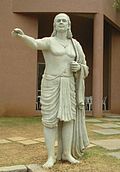
The classical Indian empire of the Guptas, called by some the Golden Age of India, where Kalidasa wrote and Aryabhata reckoned.

The Gupta Empire ruled much of the northern Indian subcontinent in the classical age, from the mid 3rd century to the mid 6th century CE. Some historians call it the Golden Age of India; others dispute the label. Under Samudragupta, Chandragupta II and Kumaragupta I culture flowered: the Mahabharata and Ramayana took their canonical form, and it produced scholars such as Kalidasa and Aryabhata. Breakaway feudatories and invading Huna peoples from Central Asia brought it down.

What the record holds

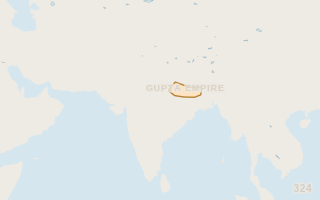
It was founded in 320, replacing the Kushan Empire and the Kanva dynasty.↓ Its borders are first mapped in 324, around 145,500 km².↓

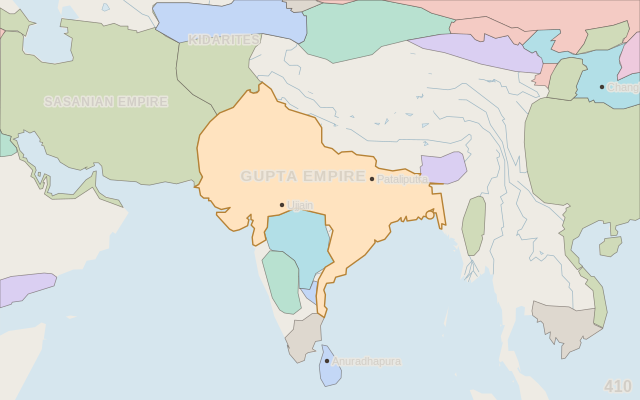
Its ground peaked in 410 at 2.50 million km².↓ Its line counts 12 rulers, covering 280 – 476, the median reign 15 years; none of its 8 handovers was irregular.↓ The best known of them are Samudragupta, Chandragupta I and Chandragupta II.↓ Most of the 11 rows the atlas files under it are people.↓

Hephthalites and the Pala Empire replaced it in 550, after 230 years.↓

From Wikipedia’s article, retold · CC BY-SA 4.0

230 years

Longer than the Polish–Lithuanian Commonwealth, shorter than the Golden Horde

2.5 million km²

At its height in 410 · about the size of Kazakhstan

12 rulers

the Gupta emperor

Map: Gupta Empire in 410, its borders in gold among its neighbours
350400450500550
Beside it on the map in 410: Sasanian Empire, Jin dynasty (266–420), Kidarites, Protectorate of the Western Regions, Rouran Khaganate and Hephthalites.How far it reached, year by year: its ground inside the borders Cliopatria draws (CC BY 4.0), measured on an equal-area grid; the map shows it at its largest, with the cities of the year.

The story

Three acts, 320 – 550

Gupta Empire in 379, at the end of act I
I320 – 380

Chandragupta I and Samudragupta

Chandragupta I, grandson of the dynasty's founder Gupta, hands the throne to Samudragupta. The Allahabad Pillar inscription by his courtier Harisena credits Samudragupta with wide conquests: uprooting eight kings of Āryāvarta in the north, the Nagas among them, subduing the kings of the forest region, and defeating twelve rulers of Dakshinapatha in the south.

Watch this act on the live map, from 320
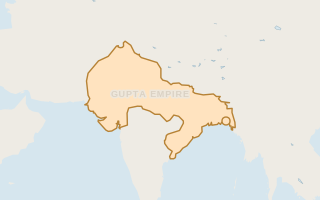
Gupta Empire in 454, at the end of act II
II380 – 4551.97 million → 2.22 million km²

Vikramaditya and the pilgrims

Chandragupta II, called Vikramaditya, wins the west from the Saka Western Kshatrapas, taking Malwa, Gujarat and Saurashtra by 409 CE. The Chinese monk Faxian, in India from 405 CE to 411 CE, finds a mild government that punishes crimes only with fines. His son Kumaragupta I founds Nalanda University; late in his reign the Pushyamitras threaten the empire.

Watch this act on the live map, from 380
Gupta Empire in 549, at the end of act III
III455 – 5502.22 million → 1.01 million km²

Huns and decline

Skandagupta, the last great Gupta emperor, defeats the Pushyamitras and repels a Huna attack c. 455 CE, but the cost of war drains the empire. After his death the Guptas lose much of western India, and Toramana and Mihirakula, leading the Alchon Huns, overrun much of the northwest by 500 CE. Brief reigns follow down to Vishnugupta.

Watch this act on the live map, from 455
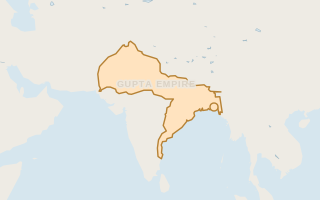
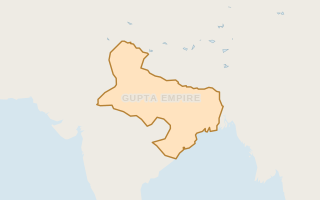
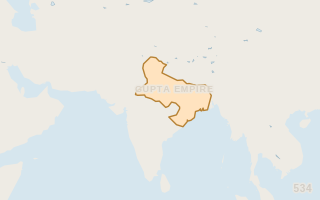
Gupta Empire in 534, last mappedGupta Empire in 324, first mapped
The rise and the fall in one frame: drag across it from 324, first mapped at 145,500 km², to 534, last mapped at 1.01 million km². Open the live map in 324 or 534.

Before and after

Before it

After it

Where it sits in time

3000 BCE2000 BCE1000 BCE110002000Western Satraps: 35 – 405Kushan Empire: 30 – 375Mahameghavahana dynasty: 250 BCE – 500Hephthalites: 408 – 670Gurjara-Pratihara: 800 – 1036Pala Empire: 750 – 1174Gupta Empire: 320 – 550

Five thousand years, 3000 BCE to 2026; the state in gold, what it replaced or followed and what replaced or followed it in grey.

Its people

Lives across the Gupta Empire

350400450500550
Statesmen and generalsScientists and explorersAll its people on the timeline →

How it was governed

12 emperors

12 emperors on record, 280 to 476; a reign lasted 15 years at the median. Each bar is a reign, as long as it lasted.

Ghatotkacha Gupta · 280 – 319 · died in office, manner not recordedChandragupta I · 320 – 335 · died in office, manner not recordedSamudragupta · 335 – 380 · died in office, manner not recordedRamagupta · 380 – 380 · no death date to read the end againstChandragupta II · 380 – 415 · left office aliveKumaragupta I · 415 – 455 · died in office, manner not recordedSkandagupta · 455 – 467 · died in office, manner not recordedPurugupta · 467 – 473 · no death date to read the end againstKumaragupta II · 473 – 476 · no death date to read the end against350400450500550
How their terms ended, where it is known (6 of 9):Died in office 5Left office alive 1Not on record 3
Every term, with how it ended and its source

Rulers

How 9 reigns ended - choose one to show only those
RulerReignLengthHow it ended · sourceTo the ruler before
3rd century · 1 reign
Ghatotkacha Gupta280 – 31939 yearsdied in officeread off the dates alone
4th century · 4 reigns
Chandragupta I · aged 70320 – 33515 yearsdied in officeread off the dates alonechild
Samudragupta335 – 38045 yearsdied in officeread off the dates alonechild
Ramagupta380 – 380under a yearending not on recordchild
Chandragupta II380 – 41535 yearsleft office aliveread off the dates alonesibling
5th century · 4 reigns
Kumaragupta I · aged 16415 – 45540 yearsdied in officeread off the dates alonechild
Skandagupta455 – 46712 yearsdied in officeread off the dates alonechild
Purugupta467 – 4736 yearsending not on recordsibling
Kumaragupta II473 – 4763 yearsending not on recordchild

12 rulers, 9 with terms dated as terms, covering 280 – 476. Median reign 15 years. 0 of 8 handovers irregular - a killing, a deposition, a rival claimant, a rising or a coup beside it. A blank in the last column means no kin on record, which is coverage, never “unrelated”.

Its world

Who else stood

Meanwhile, elsewhere

The best-known states of other regions that stood while it did; the band is the Gupta Empire’s own years.

300350400450500550

How it compares

Among 3,073 states

Stood longer than 66% of 3,073 states
Gupta Empire · 230 yearsPolish–Lithuanian CommonwealthGolden HordeHow long it stood, among the states with a recorded end or still standing.
Held more ground at its peak than 93% of 1,464 states
Gupta Empire · 2,499,300 km²AlgeriaKazakhstanThe most ground it held, among the states with a border in Cliopatria.

Why it fell

Why did the Gupta Empire fall?

Historians still argue. Here is what the atlas records about its last century:

÷2.5

its land, between 450 and 549

What led to it, and what came of it

Kanva dynasty · Linked · 70 BCE – 25 BCEKanva dynastyMahameghavahana dynasty · Linked · 250 BCE – 500Mahameghavahana dynastyKushan Empire · Linked · 30 – 375Kushan EmpireWestern Satraps · Linked · 35 – 405Western SatrapsBharshiva dynasty · Linked · 170 – 350Bharshiva dynastyKidarites · In the article · 350 · “The Bhitari Pillar inscription of Skandagupta, the successor of Chandragupta, recalls the near annihilation of the Gupta Empire following the attacks of the K…”KidaritesGupta Empire · 320 – 550Gupta EmpireEmpire of Harsha · Linked · 606 – 647Empire of HarshaHephthalites · Linked · 408 – 670HephthalitesPala Empire · Linked · 750 – 1174Pala EmpireGurjara-Pratihara · Linked · 750 – 1036Gurjara-PratiharaRashtrakuta Empire · Linked · 753 – 982Rashtrakuta Empire15001000
in the articlelinked

Open the investigation: every row with its evidence, the conditions at the time, the theories condition by condition, and the succession analysed.

Its centuries in the record

300 – 399: 3 recorded — 0 wars and battles, 0 risings, regime changes and massacres, 3 other300400 – 499: 7 recorded — 0 wars and battles, 0 risings, regime changes and massacres, 7 other400500 – 599: 0 recorded — 0 wars and battles, 0 risings, regime changes and massacres, 0 other500

Wars and battles in red, risings, coups and massacres beside them, everything else in grey, by the century each began in. A tall bar is partly a fact about Wikipedia: better-documented centuries hold more.

Each century’s own page:300 – 399400 – 499500 – 599

Keep exploring

Share this page
Copy link
Embed the map
Cite this page

How this page is made

Drawn from Wikidata (Q11774, CC0), the opening and history of its English Wikipedia article retold by the atlas (CC BY-SA 4.0), borders from Cliopatria (CC BY 4.0), coast and rivers from Natural Earth, cities from Reba, Reitsma & Seto 2016 (CC BY 4.0). Data built 2026-11-26 · Pastlas v2.47.1, by Oleh Voronko; the published atlas and its data are for non-commercial use.

How to read it

Areas are measured on an equal-area grid from borders simplified to about five kilometres. “c.” marks an approximate date, and a date known to the century is never printed to the year. Counts are what the atlas holds, and they follow Wikipedia’s coverage: a busy century is partly a fact about the record.

Something wrong?

Tell us and name the entry. We fix the data, not just this page.

Report a problem