State · Europe

Emirate of Crete

820 – 961 · 141 years

Came after Byzantine Empire and Byzantine Crete

The Emirate of Crete began in the 820s, replacing the Byzantine Empire and Byzantine Crete.↓ When the borders dataset first draws it, in 830, it held 5,500 km².↓ The record names 2 rulers in its line, covering 820 – 961, the median reign 23.5 years; its one handover was regular.↓

Continue reading

Its record closes in 961, after 141 years.↑ Its end fits “Dynastic cycle and the decay of group feeling”, every condition present.↓

141 years

Longer than the Maurya Empire, shorter than the Mongol Empire

5,500 km²

At its height in 830 · almost the size of Cyprus

2 rulers

the Last Emir of Crete

1 war or battle

2 entries in all

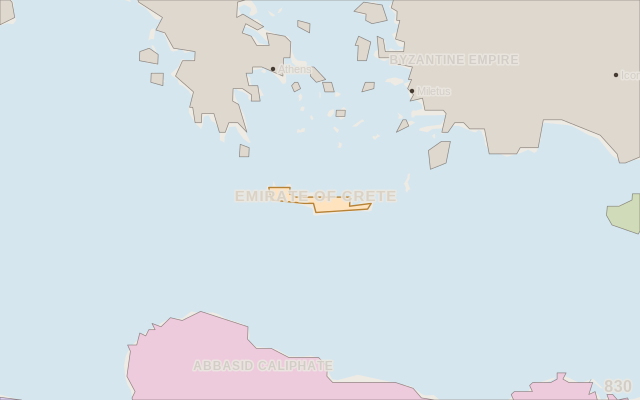
Map: Emirate of Crete in 830, its borders in gold among its neighbours
850900950
Beside it on the map in 830: Byzantine Empire, Abbasid Caliphate, Cyprus and Aghlabid dynasty.How far it reached, year by year: its ground inside the borders Cliopatria draws (CC BY 4.0), measured on an equal-area grid; the map shows it at its largest, with the cities of the year.

The story

Its key moments

Before and after

Before it

Where it sits in time

3000 BCE2000 BCE1000 BCE110002000Byzantine Empire: 330 – 1453Emirate of Crete: 820 – 961

Five thousand years, 3000 BCE to 2026; the state in gold, what it replaced or followed and what replaced or followed it in grey.

How it was governed

2 emirs

2 emirs on record, 820 to 961; a reign lasted 23.5 years at the median. Each bar is a reign, as long as it lasted.

Abu Hafs · 820 – 855 · no death date to read the end againstAbd al-Aziz ibn Shu'ayb · 949 – 961 · no death date to read the end against850900950
How their terms ended, where it is known (0 of 2):Not on record 2
Every term, with how it ended and its source

Rulers

RulerReignLengthHow it ended · sourceTo the ruler before
9th century · 1 reign
Abu Hafs820 – 85535 yearsending not on record
10th century · 1 reign
Abd al-Aziz ibn Shu'ayb949 – 96112 yearsending not on record

2 rulers, 2 with terms dated as terms, covering 820 – 961. Median reign 23.5 years. 0 of 1 handovers irregular - a killing, a deposition, a rival claimant, a rising or a coup beside it. A blank in the last column means no kin on record, which is coverage, never “unrelated”.

Its world

Rivals, and who else stood

Who it fought most

Wars and battles both took part in, on whichever side: the record names who took part, not who fought whom.

Meanwhile, elsewhere

The best-known states of other regions that stood while it did; the band is the Emirate of Crete’s own years.

800850900950

How it compares

Among 3,073 states

Stood longer than 54% of 3,073 states
Emirate of Crete · 141 yearsMaurya EmpireMongol EmpireHow long it stood, among the states with a recorded end or still standing.
Held more ground at its peak than 11% of 1,464 states
Emirate of Crete · 5,500 km²LuxembourgCyprusThe most ground it held, among the states with a border in Cliopatria.

Why it fell

Why did the Emirate of Crete fall?

Historians still argue. Here is what the atlas records about its last century:

1

wars and battles in its last century, more than in any before it

What led to it, and what came of it

Byzantine Empire · Linked · 330 – 1453Byzantine EmpireByzantine Crete · Linked · 750 – 820Byzantine CreteEmirate of Crete · 820 – 961Emirate of Crete5001000
linked

Open the investigation: every row with its evidence, the conditions at the time, the theories condition by condition, and the succession analysed.

Theories that apply to its ending

  • Dynastic cycle and the decay of group feeling

    Ibn Khaldun 1377 · Turchin & Nefedov 2009

    Applies by its own logic: the condition it names held here, and this is the kind of outcome it predicts — adverse regime change or the state's ending.

    • the state 90 to 160 years old — ageBand 141

Its centuries in the record

800 – 899: 0 recorded — 0 wars and battles, 0 risings, regime changes and massacres, 0 other800900 – 999: 2 recorded — 1 wars and battles, 0 risings, regime changes and massacres, 1 other900

Wars and battles in red, risings, coups and massacres beside them, everything else in grey, by the century each began in. A tall bar is partly a fact about Wikipedia: better-documented centuries hold more.

Each century’s own page:800 – 899900 – 999

Keep exploring

Share this page
Copy link
Embed the map
Cite this page

How this page is made

Drawn from Wikidata (Q603771, CC0), borders from Cliopatria (CC BY 4.0), coast and rivers from Natural Earth, cities from Reba, Reitsma & Seto 2016 (CC BY 4.0). Data built 2026-11-26 · Pastlas v2.47.1, by Oleh Voronko; the published atlas and its data are for non-commercial use.

How to read it

Areas are measured on an equal-area grid from borders simplified to about five kilometres. “c.” marks an approximate date, and a date known to the century is never printed to the year. Counts are what the atlas holds, and they follow Wikipedia’s coverage: a busy century is partly a fact about the record.

Something wrong?

Tell us and name the entry. We fix the data, not just this page.

Report a problem