State · Europe

Soviet Union

1922 – 1991 · 69 years

Came after Russian Soviet Federative Socialist Republic and Ukrainian Soviet Socialist Republic · became Russia and Ukraine

The world's flagship communist state, which industrialised by force, helped defeat Nazi Germany and rivalled the United States.

The Soviet Union, the largest country on Earth, spanned much of Eurasia from 1922 to 1991, a federation of national republics ruled from Moscow by the Communist Party. Born of the October Revolution led by Lenin, it was driven by Stalin through industrialisation, collectivisation, famine and purges. It bore around 27 million casualties helping defeat the Axis, then faced the United States as a superpower in the Cold War, until it broke into fifteen states in 1991.

What the record holds

Its record opens in 1922, replacing the Crimean Socialist Soviet Republic and the Russian Socialist Federative Soviet Republic.↓ In 1922, the first year its borders are mapped, it covered 21.10 million km².↓ Over the years of the Winter War, 1939 – 1940, its ground went from 21.35 million km² to 23.38 million km².↓

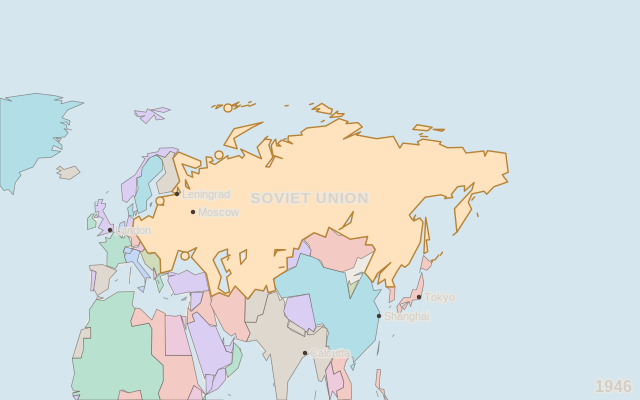
It reached its greatest extent in 1946: 24.49 million km².↓ Its line counts 8 rulers, covering 1922 – 1991, the median reign 4 years; 6 of 7 handovers were irregular.↓ Among them, Vladimir Lenin, Joseph Stalin and Mikhail Gorbachev are the best known.↓ The atlas files 1,070 rows under it, most of them people.↓

In 1991, after 69 years, it was replaced by Russia, Ukraine and the Post-Soviet states.↓ 3 theories of why states fall have every condition present at its end: “Demographic-structural breakdown”, “Elite conflict” and “The five conditions of revolution”.↓

From Wikipedia’s article, retold · CC BY-SA 4.0

69 years

Longer than Bremen, shorter than the Azerbaijan Soviet Socialist Republic

24.5 million km²

At its height in 1946

8 rulers

the Leader of the Soviet Union

96 wars and battles

More per century than 99% of states · 1,070 entries in all

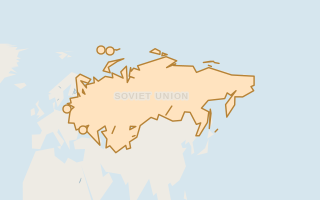
Map: Soviet Union in 1946, its borders in gold among its neighbours
Holodomor, 1932 – 1933Molotov–Ribbentrop Pact, 1939 – 1941Winter War, 1939 – 1940: 21.35 million km² → 23.38 million km²Battle of Stalingrad, 1942 – 1943Soviet–Afghan War, 1979 – 1989: 22.11 million km² → 22.06 million km²194019601980
Beside it on the map in 1946: French Fourth Republic, Republic of China, Denmark, British Raj, British Empire and Mongolian People's Republic.How far it reached, year by year: its ground inside the borders Cliopatria draws (CC BY 4.0), measured on an equal-area grid; the map shows it at its largest, with the cities of the year.

The story

Four acts, 1922 – 1991

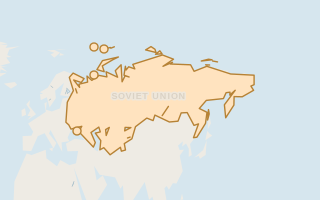
Soviet Union in 1938, at the end of act I
I1922 – 193921.1 million → 21.3 million km²

From revolution to terror

The Russian SFSR and its republics merge into the union in 1922. Lenin dies in 1924, and Stalin wins a six-year struggle for power. Forced collectivisation helps cause a devastating famine, the Holodomor strikes in 1932–1933, the Gulag grows, peoples are uprooted, and the Great Purge ends in executions and the Moscow trials.

Watch this act on the live map, from 1922
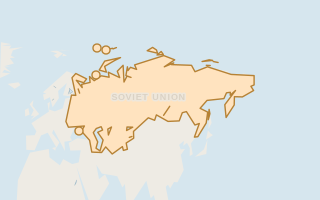
Soviet Union in 1944, at the end of act II
II1939 – 194521.3 million → 21.7 million km²

The war with Germany

Unable to build an anti-Nazi coalition, the Soviet Union signs the Molotov–Ribbentrop Pact in 1939, fights the Winter War, and the Katyn massacre follows in 1940. In 1941 Germany invades, the largest land invasion ever mounted. Moscow, the siege of Leningrad, Stalingrad, Kursk and Operation Bagration follow, and the Red Army helps defeat the Axis.

Watch this act on the live map, from 1939
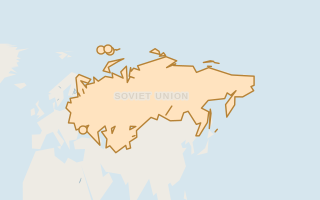
Soviet Union in 1963, at the end of act III
III1945 – 196423 million → 21.9 million km²

A superpower in the Cold War

Lands taken by the Red Army become satellite states, fast economic growth makes the union a superpower, and rivalry with the United States hardens into the Cold War; the Eastern Bloc answers NATO with the Warsaw Pact in 1955. After Stalin's death in 1953, Georgy Malenkov leads briefly, then Nikita Khrushchev from 1955 to 1964.

Watch this act on the live map, from 1945
Soviet Union in 1990, at the end of act IV
IV1964 – 199121.9 million → 21.9 million km²

From Brezhnev to dissolution

Leonid Brezhnev leads from 1964 to 1982, through the Sino-Soviet border conflict of 1969 and the Soviet–Afghan War from 1979. Yuri Andropov and Konstantin Chernenko follow briefly, and Mikhail Gorbachev takes over in 1985. The Baltic Way of 1989, the Nagorno-Karabakh and Transnistrian wars and a failed coup in 1991 precede the union's dissolution that year.

Watch this act on the live map, from 1964

Before and after

Before it

After it

  • Russia · replaced by · 1991 – present
  • Belarus · replaced by · 1991 – present
  • Estonia · replaced by · 1918 – present
  • Latvia · replaced by · 1918 – present
  • Ukraine · replaced by · 1991 – present
  • Moldova · replaced by · 1991 – present
  • Azerbaijan · replaced by · 1991 – present
  • Georgia · replaced by · 1991 – present
  • Kazakhstan · replaced by · 1991 – present
  • Uzbekistan · replaced by · 1991 – present
  • Lithuania · replaced by · 1918 – present
  • Armenia · replaced by · 1991 – present
  • Kyrgyzstan · replaced by · 1991 – present
  • Tajikistan · replaced by · 1991 – present
  • Turkmenistan · replaced by · 1991 – present
  • Post-Soviet states · followed by
  • Commonwealth of Independent States · followed by

Where it sits in time

3000 BCE2000 BCE1000 BCE110002000Ukrainian Soviet Socialist Republic: 1919 – 1991Second Polish Republic: 1918 – 1939Russian Soviet Federative Socialist Republic: 1917 – 1991Russia: 1991 – 2026Belarus: 1991 – 2026Estonia: 1918 – 2026Soviet Union: 1922 – 1991

Five thousand years, 3000 BCE to 2026; the state in gold, what it replaced or followed and what replaced or followed it in grey.

Its people

Lives across the Soviet Union

190019502000
Statesmen and generalsScientists and explorersWriters, artists and thinkersLived on after it endedAll its people on the timeline →

How it was governed

8 leaders

8 leaders on record, 1922 to 1991; a reign lasted 4 years at the median. Each bar is a reign, as long as it lasted.

Vladimir Lenin · 1922 – 1924 · no death date to read the end againstJoseph Stalin · 1924 – 1953 · abdicated, the article saysGeorgy Malenkov · 1953 – 1955 · no death date to read the end againstNikita Khrushchev · 1955 – 1964 · no death date to read the end againstLeonid Brezhnev · 1964 – 1982 · no death date to read the end againstYuri Andropov · 1982 – 1984 · no death date to read the end againstKonstantin Chernenko · 1984 – 1985 · no death date to read the end againstMikhail Gorbachev · 1985 – 1991 · resigned or stood down, the article says194019601980
How their terms ended, where it is known (2 of 8):Deposed or removed 1Left office alive 1Not on record 6
Every term, with how it ended and its source

Rulers

How 8 reigns ended - choose one to show only those

How they died, where the record says: died of natural causes 7.

RulerReignLengthHow it ended · sourceTo the ruler before
20th century · 8 reigns · 1 killed or removed
Vladimir Lenin1922 – 19242 yearsending not on recorddied of natural causes
Joseph Stalin1924 – 195329 yearsabdicatedread from the ruler's own articledied of natural causes
Georgy Malenkov1953 – 19552 yearsending not on record
Nikita Khrushchev1955 – 19649 yearsending not on recorddied of natural causes
Leonid Brezhnev1964 – 198218 yearsending not on recorddied of natural causes
Yuri Andropov1982 – 19842 yearsending not on recorddied of natural causes
Konstantin Chernenko1984 – 19851 yearending not on recorddied of natural causes
Mikhail Gorbachev1985 – 19916 yearsresignedread from the ruler's own articledied of natural causes

8 rulers, 8 with terms dated as terms, covering 1922 – 1991. Median reign 4 years. 6 of 7 handovers irregular - a killing, a deposition, a rival claimant, a rising or a coup beside it. A blank in the last column means no kin on record, which is coverage, never “unrelated”.

Formal heads of state and heads of government

The line of Chairman of the Council of Ministers of the USSR, drawn and never measured: a cabinet is not a reign.

Fayzulla Xoʻjayevlived 1896 – 1938
Nygmet Nurmakov1920 – 1920
Mikhail Kalinin1922 – 1938
Vladimir Lenin1923 – 1924
Alexei Rykov1924 – 1930
Vyacheslav Molotov1930 – 1941
Joseph Stalin1941 – 1946
Joseph Stalin1946 – 1953
Nikolai Shvernik1946 – 1953
Georgy Malenkov1953 – 1955
Kliment Voroshilov1953 – 1960
Nikolai Bulganin1955 – 1958
Nikita Khrushchev1958 – 1964
Leonid Brezhnev1960 – 1964
Alexei Kosygin1964 – 1980
Anastas Mikoyan1964 – 1965
Nikolai Podgorny1965 – 1977
Leonid Brezhnev1977 – 1982
Nikolai Tikhonov1980 – 1985
Vasily Kuznetsov (politician)1982 – 1983
Yuri Andropov1983 – 1984
Konstantin Chernenko1984 – 1985
Vasily Kuznetsov (politician)1984 – 1984
Nikolai Ryzhkov1985 – 1991
Andrei Gromyko1985 – 1988
Mikhail Gorbachev1990 – 1991
Anatoly Lukyanov1990 – 1991
Valentin Pavlov1991 – 1991
Ivan Silayev1991 – 1991
Gennady Yanayev1991 – 1991

Flags and arms, in order

  • Flag of the Soviet Union (1922–1923)
    flag, 1922 – 1923Flag of the Soviet Union (1922–1923) · Public domain
  • Flag of the Soviet Union (1924)
    flag, 1923 – 1924Flag of the Soviet Union (1924) · Public domain
  • Coat of arms of the Soviet Union (1923–1936)
    coat of arms, 1923 – 1929Coat of arms of the Soviet Union (1923–1936) · Public domain
  • Flag of the Soviet Union (1924–1936)
    flag, 1924 – 1936Flag of the Soviet Union (1924–1936) · Public domain
  • Coat of arms of the Soviet Union (1931–1936)
    coat of arms, 1931 – 1936Coat of arms of the Soviet Union (1931–1936) · Public domain
  • Coat of arms of the Soviet Union (1936–1946)
    coat of arms, 1936 – 1946Coat of arms of the Soviet Union (1936–1946) · Public domain
  • Flag of the Soviet Union (1936 – 1955)
    flag, 1936 – 1955Flag of the Soviet Union (1936 – 1955) · Public domain
  • Coat of arms of the Soviet Union (1946–1956)
    coat of arms, 1946 – 1956Coat of arms of the Soviet Union (1946–1956) · Public domain
  • Flag of the Soviet Union (dark version)
    flag, 1955 – 1980Flag of the Soviet Union (dark version) · CC BY-SA 3.0 · Cmapm
  • Flag of the Soviet Union
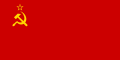
    flag, 1955 – 1991Flag of the Soviet Union · Public domain
  • Coat of arms of the Soviet Union (1956–1991)
    coat of arms, 1956 – 1991Coat of arms of the Soviet Union (1956–1991) · Public domain

Its world

Rivals, and who else stood

Who it fought most

Wars and battles both took part in, on whichever side: the record names who took part, not who fought whom.

Meanwhile, elsewhere

The best-known states of other regions that stood while it did; the band is the Soviet Union’s own years.

19201940196019802000

How it compares

Among 3,073 states

Stood longer than 39% of 3,073 states
Soviet Union · 69 yearsBremenAzerbaijan Soviet Socialist RepublicHow long it stood, among the states with a recorded end or still standing.
Held more ground at its peak than 99% of 1,464 states
Soviet Union · 24,486,700 km²RussiaThe most ground it held, among the states with a border in Cliopatria.
Had more wars on record per century than 99% of 3,073 states
Soviet Union · 14.0Wars recorded per century, among the states, counting the wars the atlas hosts under each.

Why it fell

Why did the Soviet Union fall?

Historians still argue. Here is what the atlas records about its last century:

1953

Joseph Stalin, deposed or removed in office

What led to it, and what came of it

World War I · Recorded · 1914 – 1918World War I1919 Soviet invasion of Ukraine · Linked · 19191919 Soviet invasion of UkraineCrimean Socialist Soviet Republic · Linked · 1919Crimean Socialist Soviet RepublicSoviet-Finnish wars · Linked · 1917 – 1944Soviet-Finnish warsRussian Soviet Federative Socialist Republic · Linked · 1917 – 1991Russian Soviet Federative Social…Russian Socialist Federative Soviet Republic · Linked · 1917 – 1922Russian Socialist Federative Sov…Soviet Union · 1922 – 1991Soviet UnionAzerbaijan · Linked · 1991 – 2026AzerbaijanRussia · Linked · 1991 – 2026RussiaUkraine · Linked · 1991 – 2026UkraineBelarus · Linked · 1991 – 2026BelarusArmenia · Linked · 1991 – 2026ArmeniaKazakhstan · Linked · 1991 – 2026Kazakhstan19502000
recordedlinked

Open the investigation: every row with its evidence, the conditions at the time, the theories condition by condition, and the succession analysed.

Theories that apply to its ending

  • Demographic-structural breakdown

    Goldstone 1991 · Turchin & Nefedov 2009

    Applies by its own logic: 3 of its 3 conditions held here (it needs 2), and this is the kind of outcome it predicts — unrest, adverse regime change or the state's ending.

    • famine, plague or disaster within 30 y in the state, or population up 25% over 50 y — prior; popGrowth 48
    • overlapping reigns — rival claimants — within 20 y, or 3 or more changes of ruler within 20 y, or 2 or more reigns of two years or less within 20 y, or a monarch deposed or killed within 20 y — handovers 3; shortReigns 2
    • a war the state is fighting, still under way, or a war the state fought, ended within 10 y — warOngoing; warEnded
  • Elite conflict

    Lachmann 2000 · Lachmann 2010

    Applies by its own logic: 2 of its 2 conditions held here (it needs all of them), and this is the kind of outcome it predicts — adverse regime change, unrest or the state's ending.

    • 2 or more elite groups in the regime's support, or a parliament met within 100 y — party elites, civil servants (1990)
    • an elite group among the regime's opposition within 5 y, or an elite group left the regime's support over 10 y, or a monarch deposed or killed by others within 20 y, or overlapping reigns — rival claimants — within 20 y — party elites (1986); the military (1991)
  • The five conditions of revolution

    Goldstone 2014 · Goldstone 2001

    Applies by its own logic: 4 of its 5 conditions held here (it needs 4), and this is the kind of outcome it predicts — unrest, adverse regime change or the state's ending.

    • GDP per capita down 5% over 5 y, or a war the state is fighting, still under way, or a war the state fought, ended within 5 y, or famine within 5 y in the state — gdpFall -6; warOngoing; warEnded
    • an elite group among the regime's opposition within 5 y, or an elite group left the regime's support over 10 y, or a monarch deposed or killed within 10 y, or overlapping reigns — rival claimants — within 10 y, or 2 or more reigns of two years or less within 10 y — party elites (1986); the military (1991); shortReigns 2
    • mass mobilisation at 3 or more of 4 within 5 y, or a popular class among the regime's opposition within 5 y, or unrest within 5 y in the state — many large-scale and small-scale events (1990); prior
    • anti-system movements at 3 or more of 4 within 5 y — a high level, a substantial threat (1991)

In the record

1,070 entries the atlas files under it, all in 1900 – 1999.

Keep exploring

Share this page
Copy link
Embed the map
Cite this page

How this page is made

Drawn from Wikidata (Q15180, CC0), the opening and history of its English Wikipedia article retold by the atlas (CC BY-SA 4.0), borders from Cliopatria (CC BY 4.0), coast and rivers from Natural Earth, cities from Reba, Reitsma & Seto 2016 (CC BY 4.0), symbols from Wikimedia Commons, each under its own licence. Data built 2026-11-26 · Pastlas v2.47.1, by Oleh Voronko; the published atlas and its data are for non-commercial use.

How to read it

Areas are measured on an equal-area grid from borders simplified to about five kilometres. “c.” marks an approximate date, and a date known to the century is never printed to the year. Counts are what the atlas holds, and they follow Wikipedia’s coverage: a busy century is partly a fact about the record.

Something wrong?

Tell us and name the entry. We fix the data, not just this page.

Report a problem