State · East and Southeast Asia

Japan

1947 – present · 79 years · still standing

Came after Empire of Japan and Second Shō Dynasty

Post-war Japan: an island monarchy that rose from defeat and occupation to rapid growth, then sank into decades of stagnation.

Japan in its present form dates from 1947, two years after its defeat in the Pacific War and the atomic bombings of Hiroshima and Nagasaki; Allied occupation lasted until 1952. A constitutional monarchy with a two-chamber parliament, the National Diet, it grew rapidly in the following decades and became a close ally of the United States. Since its asset bubble burst in the early 1990s, it has endured a long stagnation known as the Lost Decades.

What the record holds

Its record opens in 1947, replacing the Empire of Japan and the Second Shō Dynasty.↓ In 1953, the first year its borders are mapped, it covered 410,800 km².↓

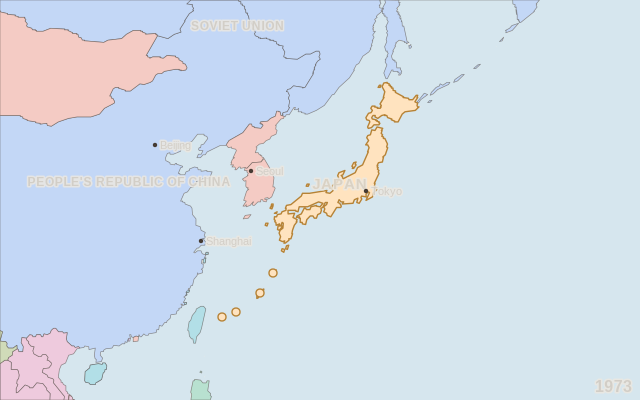
Its ground peaked in 1973 at 413,000 km².↓ Its line counts 9 rulers, covering 1926 – 2019, the median reign 46.5 years; 1 of 2 handovers was irregular.↓ The best known of them are Naruhito, Hirohito and Akihito.↓ Most of the 107 rows the atlas files under it are people.↓

From Wikipedia’s article, retold · CC BY-SA 4.0

79 years

Longer than Yugoslavia, shorter than the Western Roman Empire

413,000 km²

At its height in 1973 · about the size of Uzbekistan

9 rulers

the Emperor of Japan

Map: Japan in 1973, its borders in gold among its neighbours
Minamata Convention on Mercury, 2013Nagoya Protocol, 2014Sagamihara stabbings, 2016196019701980199020002010
Beside it on the map in 1973: People's Republic of China, Soviet Union, Mongolian People's Republic, Kingdom of Laos, North Vietnam and North Korea.How far it reached, year by year: its ground inside the borders Cliopatria draws (CC BY 4.0), measured on an equal-area grid; the map shows it at its largest, with the cities of the year.

The story

Three acts, 1947 – present

I1947 – 1952

Under Allied occupation

After defeat in the Pacific War and the atomic bombs dropped on Hiroshima and Nagasaki, Japan remains under Allied occupation. The new state is a constitutional monarchy, with Hirohito still on the throne and a two-chamber National Diet. An earthquake strikes Fukui in 1948, and the occupation ends in 1952.

Watch this act on the live map, from 1947
III1989 – present

The Lost Decades

Akihito takes the throne in 1989, and the asset bubble bursts in the early 1990s, beginning the long stagnation called the Lost Decades. The Hanshin earthquake strikes in 1995, and the Tōhoku earthquake and tsunami in 2011. Naruhito becomes emperor in 2019, and Shinzo Abe is assassinated in 2022.

Watch this act on the live map, from 1989

Before and after

Before it

  • Second Shō Dynasty · replaces
  • Empire of Japan · replaces · 1868 – 1947

Where it sits in time

3000 BCE2000 BCE1000 BCE110002000Empire of Japan: 1868 – 1947Japan: 1947 – 2026

Five thousand years, 3000 BCE to 2026; the state in gold, what it replaced or followed and what replaced or followed it in grey.

Its people

Lives across Japan

19251950197520002025
Statesmen and generalsWriters, artists and thinkersAll its people on the timeline →

How it was governed

9 emperors

9 emperors on record, 1926 to 2019; a reign lasted 46.5 years at the median. Each bar is a reign, as long as it lasted.

Hirohito · 1926 – 1989 · died in office of natural causesAkihito · 1989 – 2019 · abdicatedNaruhito · 2019 – … · still in office1960198020002020
How their terms ended, where it is known (3 of 3):Deposed or removed 1Died in office 1In office 1
Every term, with how it ended and its source

Rulers

How 3 reigns ended - choose one to show only those

How they died, where the record says: died of natural causes 1.

RulerReignLengthHow it ended · sourceTo the ruler before
20th century · 2 reigns · 1 killed or removed
Hirohito · aged 251926 – 198963 yearsdied in officeWikidata's manner of deathdied of natural causes
Akihito · aged 561989 – 201930 yearsabdicatedWikidata's end cause on the termchild
21st century · 1 reign
Naruhito · aged 592019 – in officein office since 2019still in officechild

9 rulers, 3 with terms dated as terms, covering 1926 – 2019. Median reign 46.5 years. 1 of 2 handovers irregular - a killing, a deposition, a rival claimant, a rising or a coup beside it. A blank in the last column means no kin on record, which is coverage, never “unrelated”.

Heads of government

The line of Prime Minister of Japan, drawn and never measured: a cabinet is not a reign.

Hideki Tojo1941 – 1944
Kuniaki Koiso1944 – 1945
Prince Naruhiko Higashikuni1945 – 1945
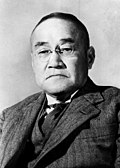
Kijūrō Shidehara1945 – 1946
Kantarō Suzuki1945 – 1945
Shigeru Yoshida1946 – 1947
Tetsu Katayama1947 – 1948
Hitoshi Ashida1948 – 1948
Shigeru Yoshida1949 – 1952
Shigeru Yoshida1953 – 1954
Ichirō Hatoyama1954 – 1955
Tanzan Ishibashi1956 – 1957
Nobusuke Kishi1958 – 1960
Hayato Ikeda1960 – 1960
Hayato Ikeda1963 – 1964
Eisaku Satō1964 – 1967
Eisaku Satō1967 – 1970
Eisaku Satō1970 – 1972
Kakuei Tanaka1972 – 1972
Takeo Miki1974 – 1976
Takeo Fukuda1976 – 1978
Masayoshi Ōhira1979 – 1980
Zenkō Suzuki1980 – 1982
Masayoshi Ito1980 – 1980
Yasuhiro Nakasone1982 – 1983
Yasuhiro Nakasone1986 – 1987
Noboru Takeshita1987 – 1989
Toshiki Kaifu1989 – 1990
Sōsuke Uno1989 – 1989
Kiichi Miyazawa1991 – 1993
Morihiro Hosokawa1993 – 1994
Tomiichi Murayama1994 – 1996
Tsutomu Hata1994 – 1994
Ryutaro Hashimoto1996 – 1996
Keizō Obuchi1998 – 2000
Yoshirō Mori2000 – 2001
Junichiro Koizumi2001 – 2003
Junichiro Koizumi2003 – 2005
Junichiro Koizumi2005 – 2006
Shinzo Abe2006 – 2007
Yasuo Fukuda2007 – 2008
Tarō Asō2008 – 2009
Yukio Hatoyama2009 – 2010
Naoto Kan2010 – 2011
Yoshihiko Noda2011 – 2012
Shinzo Abe2012 – 2014
Shinzo Abe2014 – 2017
Shinzo Abe2017 – 2020
Yoshihide Suga2020 – 2021
Fumio Kishida2021 – 2022
Fumio Kishida2023 – 2024
Shigeru Ishiba2024 – 2024
Sanae Takaichi2025 – …

Flags and arms, in order

  • Kamon of the Imperial House of Japan
    coat of arms, undatedKamon of the Imperial House of Japan · CC BY-SA 4.0 · Fonsecafrancesco04
  • Flag of Japan (1870–1999)
    flag, 1870 – 1999Flag of Japan (1870–1999) · Public domain
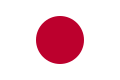
  • Flag of Japan
    flag, from 1999Flag of Japan · Public domain

Its world

Rivals, and who else stood

Who it fought most

Wars and battles both took part in, on whichever side: the record names who took part, not who fought whom.

Meanwhile, elsewhere

The best-known states of other regions that stood while it did; the band is Japan’s own years.

19401960198020002020

How it compares

Among 3,073 states

Stood longer than 42% of 3,073 states
Japan · 79 yearsYugoslaviaWestern Roman EmpireHow long it stood, among the states with a recorded end or still standing.
Held more ground at its peak than 71% of 1,464 states
Japan · 413,000 km²MoroccoUzbekistanThe most ground it held, among the states with a border in Cliopatria.

How it began

How did Japan begin?

What led to it, and what came of it

World War II · Linked · 1939 – 1945World War IIJapanese occupation of British Borneo · Linked · 1941 – 1945Japanese occupation of British B…Bretton Woods system · Linked · 1944Bretton Woods systemBattle of Tjiater Pass · Linked · 1942Battle of Tjiater PassSecond Shō Dynasty · Linked · 1469Second Shō DynastyEmpire of Japan · Linked · 1868 – 1947Empire of JapanJapan · 1947 – 2026Japan160018002000
linked

Open the investigation: every row with its evidence, the conditions at the time, the theories condition by condition, and the succession analysed.

Its centuries in the record

1900 – 1999: 65 recorded — 0 wars and battles, 7 risings, regime changes and massacres, 58 other19002000 – 2099: 35 recorded — 0 wars and battles, 6 risings, regime changes and massacres, 29 other2000

Wars and battles in red, risings, coups and massacres beside them, everything else in grey, by the century each began in. A tall bar is partly a fact about Wikipedia: better-documented centuries hold more.

Each century’s own page:1900 – 19992000 – 2099

Keep exploring

Share this page
Copy link
Embed the map
Cite this page

How this page is made

Drawn from Wikidata (Q17, CC0), the opening and history of its English Wikipedia article retold by the atlas (CC BY-SA 4.0), borders from Cliopatria (CC BY 4.0), coast and rivers from Natural Earth, cities from Reba, Reitsma & Seto 2016 (CC BY 4.0), symbols from Wikimedia Commons, each under its own licence. Data built 2026-11-26 · Pastlas v2.47.1, by Oleh Voronko; the published atlas and its data are for non-commercial use.

How to read it

Areas are measured on an equal-area grid from borders simplified to about five kilometres. “c.” marks an approximate date, and a date known to the century is never printed to the year. Counts are what the atlas holds, and they follow Wikipedia’s coverage: a busy century is partly a fact about the record.

  • Wikidata records foundings in 660 BCE and 1890 and 1947; the atlas draws the present-day state from 660 BCE.
  • Still standing: the span runs to the year of the build, 2026.

Something wrong?

Tell us and name the entry. We fix the data, not just this page.

Report a problem