Orange Revolution
unrest · 2004 – 2005
State · Europe
1991 – present · 35 years · still standing
Came after  Soviet Union and
 Ukrainian Soviet Socialist Republic
Europe's second-largest country, independent since the Soviet collapse, whose Euromaidan revolution was followed by Russia's seizure of Crimea and war.
Ukraine proclaimed its independence on 24 August 1991, after a failed coup in Moscow, and 92 per cent of voters approved it as the Soviet Union dissolved. A constitution followed in 1996, and the country moved toward a market democracy amid deep corruption. The Orange Revolution of 2004–2005 brought reform; after the Euromaidan protests of 2014 Russia seized Crimea and war spread to the Donbas, and from 2022 fighting reached Kyiv, Kharkiv, Mariupol and Kherson.
Ukraine began in 1991, replacing the Soviet Union and the Ukrainian Soviet Socialist Republic.↓ When the borders dataset first draws it, in 1992, it held 588,300 km².↓
Its highest office was held by 7 rulers, covering 1991 – 2019; 2 of 6 handovers were irregular.↓ Among them,  Volodymyr Zelenskyy,
 Petro Poroshenko and
 Viktor Yanukovych are the best known.↓ The atlas files 191 rows under it, most of them wars and battles.↓
From Wikipedia’s article, retold · CC BY-SA 4.0
Best known for
35 years
Longer than Daman and Diu, shorter than East Germany
588,000 km²
At its height in 1992 · about the size of Kenya
7 rulers
the President of Ukraine
112 wars and battles
More per century than 99% of states · 191 entries in all
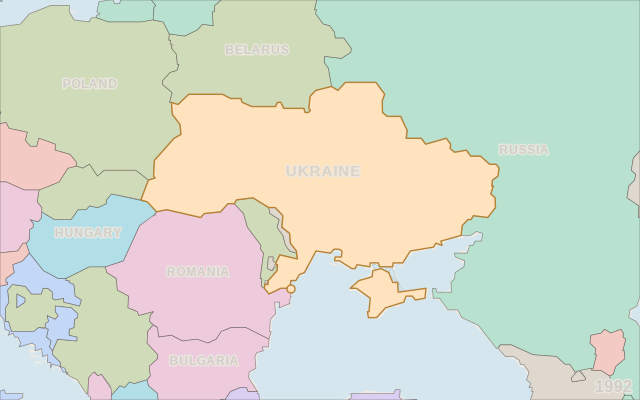
 Russia,
 Poland,
 Romania,
 Belarus,
 Federal Republic of Yugoslavia and
 Bulgaria.How far it reached, year by year: its ground inside the borders Cliopatria draws (CC BY 4.0), measured on an equal-area grid; the map shows it at its largest, with the cities of the year.
The story
The best-known wars, battles, risings and changes of regime the record files under it; a war within a war is folded into it.
unrest · 2004 – 2005
adverse regime change · 2013 – 2014
With Revolution of Dignity within it.
battle · 2014
With 2014 Russian invasion of Crimea, 2014 Simferopol incident and Capture of the Crimean Parliament within it.
war · 2014 – 2022
With Shyrokyne standoff within it.
atrocity · 27 February 2022
The states the record files it as replacing or following, and those that replaced or followed it - Wikidata's own statements, each read from this state's side.
Ukrainian Soviet Socialist Republic · replaces · 1919 – 1991Soviet Union · replaces · 1922 – 1991 Ukrainian People's Republic · replaces · 1917 – 1921
Five thousand years, 3000 BCE to 2026; the state in gold, what it replaced or followed and what replaced or followed it in grey.
Its people
One axis for everyone, so you can see who knew whom: the best-known, ordered by birth.
 Leonid Kravchukpresident1934 – 2022
 Leonid Kuchmapresident1938 – present
 Mykola Azarovstatesperson · engineer1947 – present
 Yuriy Yekhanurovpolitician1948 – present
 Viktor Yanukovychpresident · engineer1950 – present
 Viktor Yushchenkopresident1954 – present
 Yulia Tymoshenkopolitician1960 – present
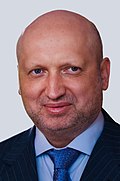 Oleksandr Turchynovpresident · engineer1964 – present
 Petro Poroshenkopresident · diplomat1965 – present
 Arseniy Yatsenyukpolitician · diplomat1974 – present
 Denys Shmyhalpolitician1975 – present
 Volodymyr Zelenskyypresident1978 – present
 Volodymyr Groysmanpolitician1978 – present
 Oleksiy Honcharukpolitician1984 – present
 Yulia Svyrydenkopolitician1985 – present
 Ihor Kostenkowriter1991 – 2014
 Mykhailo Fedorovpolitician1991 – present
How it was governed
7 presidents on record, 1991 to 2019. Each bar is a reign, as long as it lasted.
The line of President of Ukraine - the office this state names as its head of state.
| Ruler | Reign | Length | How it ended · source | To the ruler before |
|---|---|---|---|---|
| 20th century · 2 reigns | ||||
| Leonid Kravchuk · aged 57 | 1991 – 1994 | 3 years | left office aliveread off the dates alone | |
| Leonid Kuchma · aged 56 | 1994 – 2005 | 11 years | ending not on record | |
| 21st century · 5 reigns · 1 killed or removed | ||||
| Viktor Yushchenko · aged 51 | 2005 – 2010 | 5 years | ending not on record | |
| Viktor Yanukovych · aged 60 | 2010 – 2014 | 4 years | deposedWikidata's end cause on the term | |
| Oleksandr Turchynov · aged 50 | 2014 – 2014 | under a year | ending not on record | |
| Petro Poroshenko · aged 49 | 2014 – 2019 | 5 years | resignedread from the ruler's own article | |
| Volodymyr Zelenskyy · aged 41 | 2019 – in office | in office since 2019 | still in office | |
7 rulers, 7 with terms dated as terms, covering 1991 – 2019. Only 28 years of the line are dated - too short for a median. 2 of 6 handovers irregular - a killing, a deposition, a rival claimant, a rising or a coup beside it. The violent-handover count is withheld: power changed hands so often that any rising falls beside one (exposure 0.97, limit 0.6). A blank in the last column means no kin on record, which is coverage, never “unrelated”.
The line of Prime Minister of Ukraine, drawn and never measured: a cabinet is not a reign.
 Vitold Fokin | 1990 – 1992 |
 Valentyn Symonenko | 1992 – 1992 |
 Leonid Kuchma | 1992 – 1993 |
 Yukhym Zvyahilsky | 1993 – 1994 |
 Vitaliy Masol | 1994 – 1995 |
 Yevhen Marchuk | 1995 – 1996 |
 Pavlo Lazarenko | 1996 – 1997 |
 Valeriy Pustovoitenko | 1997 – 1999 |
 Vasyl Durdynets | 1997 – 1997 |
 Viktor Yushchenko | 1999 – 2001 |
 Anatoliy Kinakh | 2001 – 2002 |
| Viktor Yanukovych | 2002 – 2004 |
| Viktor Yanukovych | 2004 – 2005 |
 Mykola Azarov | 2004 – 2004 |
 Yuriy Yekhanurov | 2005 – 2006 |
 Yulia Tymoshenko | 2005 – 2005 |
| Viktor Yanukovych | 2006 – 2007 |
| Yulia Tymoshenko | 2007 – 2010 |
 Oleksandr Turchynov | 2010 – 2010 |
| Mykola Azarov | 2010 – 2014 |
| Oleksandr Turchynov | 2014 – 2014 |
 Serhiy Arbuzov | 2014 – 2014 |
 Volodymyr Groysman | 2014 – 2014 |
 Arseniy Yatsenyuk | 2014 – 2016 |
| Volodymyr Groysman | 2016 – 2019 |
 Oleksiy Honcharuk | 2019 – 2020 |
 Denys Shmyhal | 2020 – 2025 |
 Yulia Svyrydenko | 2025 – 2026 |
 Serhii Koretskyi | 2026 – … |
Each symbol with the years its own statement gives; the timeline flies the one of the year on screen.


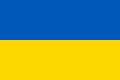 Leonid Kuchma11 yrsPetro Poroshenko5 yrsViktor Yushchenko5 yrsViktor Yanukovych4 yrsLeonid Kravchuk3 yrs
Its world
Wars and battles both took part in, on whichever side: the record names who took part, not who fought whom.
 RussiaRusso-Ukrainian war (2022–present)14
 United KingdomIraq War2
 EstoniaIraq War2
 NorwayIraq War2
 LatviaIraq War2
 Czech RepublicIraq War2
 SlovakiaIraq War2
The best-known states of other regions that stood while it did; the band is Ukraine’s own years.
 United StatesAmericas and Oceania
 MexicoAmericas and Oceania
 TurkeyMiddle East and North Africa
 JapanEast and Southeast Asia
 People's Republic of ChinaEast and Southeast Asia
 IndiaSouth Asia
 EgyptMiddle East and North Africa
 South AfricaSub-Saharan Africa
How it compares
Each column is a share of the states; gold is Ukraine.
How it began
It began on 24 August 1991, when Ukraine proclaimed its independence after the failed coup in Moscow, a step 92 per cent of voters then approved.
The investigation's own picture: 43 causes the record names and 0 results, the strongest six of each at their own years, joined to the state by the kind of claim - a recorded statement solid, the article's sentence dashed, a theory dash-dot.
Open the investigation: every row with its evidence, the conditions at the time, the theories condition by condition, and the succession analysed.
Wars and battles in red, risings, coups and massacres beside them, everything else in grey, by the century each began in. A tall bar is partly a fact about Wikipedia: better-documented centuries hold more.
Each century’s own page:1900 – 19992000 – 2099
“Ukraine”, Pastlas, a historical atlas, 2026-11-26. https://app.pastlas.com/state/ukraine/
Drawn from Wikidata (Q212, CC0), the opening and history of its English Wikipedia article retold by the atlas (CC BY-SA 4.0), borders from Cliopatria (CC BY 4.0), coast and rivers from Natural Earth, cities from Reba, Reitsma & Seto 2016 (CC BY 4.0), symbols from Wikimedia Commons, each under its own licence. Data built 2026-11-26 · Pastlas v2.47.1, by Oleh Voronko; the published atlas and its data are for non-commercial use.
Areas are measured on an equal-area grid from borders simplified to about five kilometres. “c.” marks an approximate date, and a date known to the century is never printed to the year. Counts are what the atlas holds, and they follow Wikipedia’s coverage: a busy century is partly a fact about the record.