Georgian civil war of 1991–1993
war · 1991 – 1993
State · Europe
1991 – present · 35 years · still standing
Came after  Soviet Union and
 Georgian Soviet Socialist Republic
The Black Sea republic that broke from the Soviet Union, turned West after the Rose Revolution, and fought Russia.
Georgia broke away from Soviet rule in April 1991, carried by an independence movement that Zviad Gamsakhurdia helped lead. Its first decade saw economic crisis, political turmoil and breakaway wars in Abkhazia and South Ossetia. After the peaceful Rose Revolution of 2003, Mikheil Saakashvili was elected president and Georgia sought integration with the European Union and NATO; relations with Russia soured into war in 2008, and parts of the country have stayed under Russian occupation since.
It was founded in 1991, replacing the Soviet Union and the Georgian Soviet Socialist Republic.↓ Its borders are first mapped in 1992, around 68,700 km².↓
Its line counts 7 rulers, covering 1991 – 2024; 1 of 8 handovers was irregular.↓ Among them,  Mikheil Saakashvili,
 Eduard Shevardnadze and
 Salomé Zourabichvili are the best known.↓ The atlas files 49 rows under it, people the largest group of them.↓
From Wikipedia’s article, retold · CC BY-SA 4.0
Best known for
35 years
Longer than Daman and Diu, shorter than East Germany
68,700 km²
At its height in 1992 · about the size of Latvia
7 rulers
the President of Georgia
13 wars and battles
More per century than 99% of states · 49 entries in all
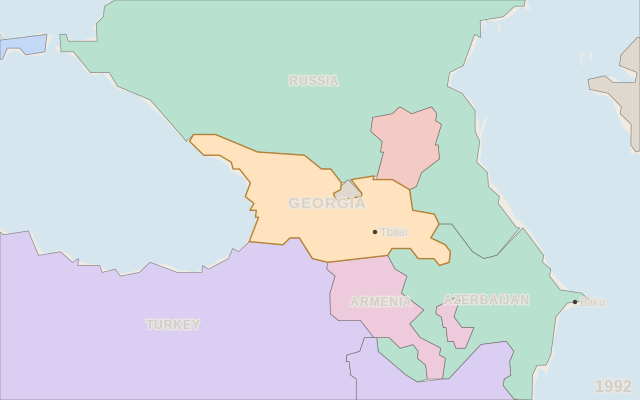
 Russia,
 Turkey,
 Azerbaijan,
 Armenia,
 Iran and
 Chechen Republic of Ichkeria.How far it reached, year by year: its ground inside the borders Cliopatria draws (CC BY 4.0), measured on an equal-area grid; the map shows it at its largest, with the cities of the year.
The story
The best-known wars, battles, risings and changes of regime the record files under it; a war within a war is folded into it.
war · 1991 – 1993
war · 1991 – 1992
war · 1992 – 1993
unrest · 2003
battle · 7 August 2008
With 4 parts of its own kind within it.
The states the record files it as replacing or following, and those that replaced or followed it - Wikidata's own statements, each read from this state's side.
Georgian Soviet Socialist Republic · replaces · 1921 – 1991Soviet Union · replaces · 1922 – 1991 Kingdom of the Iberians · follows · 888 – 1008
Five thousand years, 3000 BCE to 2026; the state in gold, what it replaced or followed and what replaced or followed it in grey.
Its people
One axis for everyone, so you can see who knew whom: the best-known, ordered by birth.
 Eduard Shevardnadzepresident · diplomat1928 – 2014
 Zviad Gamsakhurdiapresident · writer1939 – 1993
 Salomé Zourabichvilipresident · statesperson1952 – present
 Bidzina Ivanishvilipolitician1956 – present
 Zurab Zhvaniabiologist · politician1963 – 2005
 Nino Burjanadzepresident1964 – present
 Zurab Nogaideliphysicist · politician1964 – present
 Mikheil Saakashvilipresident1967 – present
 Giorgi Kvirikashviliphysician · politician1967 – present
 Vano Merabishvilipolitician1968 – present
 Giorgi Margvelashvilipresident · philosopher1969 – present
 Mikheil Kavelashvilipresident1971 – present
 Giorgi Gakhariapolitician1975 – present
 Nika Gilauripolitician1975 – present
 Irakli Kobakhidzepolitician1978 – present
 Irakli Garibashvilipolitician1982 – present
 Mamuka Bakhtadzepolitician1982 – present
How it was governed
7 presidents on record, 1991 to 2024. Each bar is a reign, as long as it lasted.
The line of President of Georgia - the office this state names as its head of state.
| Ruler | Reign | Length | How it ended · source | To the ruler before |
|---|---|---|---|---|
| 20th century · 2 reigns · 1 killed or removed | ||||
| Zviad Gamsakhurdia · aged 52 | 1991 – 1992 | 1 year | deposedWikidata's end cause on the termdied by suicide | |
| Eduard Shevardnadze · aged 67 | 1995 – 2003 | 8 years | resignedWikidata's end cause on the term | |
| 21st century · 7 reigns | ||||
| Nino Burjanadze · aged 39 | 2003 – 2004 | 1 year | ending not on record | |
| Mikheil Saakashvili · aged 37 | 2004 – 2007 | 3 years | resignedWikidata's end cause on the term | |
| Nino Burjanadze · aged 43 | 2007 – 2008 | 1 year | ending not on record | |
| Mikheil Saakashvili · aged 41 | 2008 – 2013 | 5 years | ending not on record | |
| Giorgi Margvelashvili · aged 44 | 2013 – 2018 | 5 years | ending not on record | |
| Salomé Zourabichvili · aged 66 | 2018 – 2024 | 6 years | ending not on record | |
| Mikheil Kavelashvili · aged 53 | 2024 – in office | in office since 2024 | still in office | |
7 rulers, 7 with terms dated as terms, covering 1991 – 2024. Only 33 years of the line are dated - too short for a median. 1 of 8 handovers irregular - a killing, a deposition, a rival claimant, a rising or a coup beside it. The violent-handover count is withheld: power changed hands so often that any rising falls beside one (exposure 1.00, limit 0.6). A blank in the last column means no kin on record, which is coverage, never “unrelated”.
The line of Prime Minister of Georgia, drawn and never measured: a cabinet is not a reign.
 Besarion Gugushvili | 1991 – 1992 |
 Tengiz Sigua | 1992 – 1993 |
| Eduard Shevardnadze | 1993 – 1993 |
| Otar Patsatsia | 1993 – 1995 |
 Zurab Zhvania | 2004 – 2005 |
 Zurab Nogaideli | 2005 – 2007 |
| Mikheil Saakashvili | 2005 – 2005 |
 Giorgi Baramidze | 2007 – 2007 |
 Lado Gurgenidze | 2007 – 2008 |
 Grigol Mgaloblishvili | 2008 – 2009 |
 Nika Gilauri | 2009 – 2012 |
 Vano Merabishvili | 2012 – 2012 |
 Bidzina Ivanishvili | 2012 – 2013 |
 Irakli Garibashvili | 2013 – 2015 |
 Giorgi Kvirikashvili | 2015 – 2018 |
| Irakli Garibashvili | 2015 – 2015 |
 Mamuka Bakhtadze | 2018 – 2019 |
 Giorgi Gakharia | 2019 – 2021 |
 Maya Tskitishvili | 2021 – 2021 |
| Irakli Garibashvili | 2021 – 2024 |
 Irakli Kobakhidze | 2024 – … |
Each symbol with the years its own statement gives; the timeline flies the one of the year on screen.


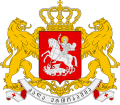
 Eduard Shevardnadze8 yrsMikheil Saakashvili8 yrsSalomé Zourabichvili6 yrsGiorgi Margvelashvili5 yrsNino Burjanadze2 yrs
Its world
Wars and battles both took part in, on whichever side: the record names who took part, not who fought whom.
 United KingdomIraq War4
 United StatesIraq War4
 ItalyIraq War4
 AustraliaIraq War4
 NorwayIraq War3
 Czech RepublicIraq War3
 RomaniaIraq War3
The best-known states of other regions that stood while it did; the band is Georgia’s own years.
United StatesAmericas and Oceania MexicoAmericas and OceaniaTurkeyMiddle East and North Africa
 JapanEast and Southeast Asia
 People's Republic of ChinaEast and Southeast Asia
 IndiaSouth Asia
 EgyptMiddle East and North Africa
 South AfricaSub-Saharan Africa
How it compares
Each column is a share of the states; gold is Georgia.
How it began
Georgia left the Soviet Union in April 1991, two years after Soviet forces brutally broke up a peaceful mass demonstration in Tbilisi.
The investigation's own picture: 17 causes the record names and 0 results, the strongest six of each at their own years, joined to the state by the kind of claim - a recorded statement solid, the article's sentence dashed, a theory dash-dot.
Open the investigation: every row with its evidence, the conditions at the time, the theories condition by condition, and the succession analysed.
Wars and battles in red, risings, coups and massacres beside them, everything else in grey, by the century each began in. A tall bar is partly a fact about Wikipedia: better-documented centuries hold more.
Each century’s own page:1900 – 19992000 – 2099
“Georgia”, Pastlas, a historical atlas, 2026-11-26. https://app.pastlas.com/state/georgia/
Drawn from Wikidata (Q230, CC0), the opening and history of its English Wikipedia article retold by the atlas (CC BY-SA 4.0), borders from Cliopatria (CC BY 4.0), coast and rivers from Natural Earth, cities from Reba, Reitsma & Seto 2016 (CC BY 4.0), symbols from Wikimedia Commons, each under its own licence. Data built 2026-11-26 · Pastlas v2.47.1, by Oleh Voronko; the published atlas and its data are for non-commercial use.
Areas are measured on an equal-area grid from borders simplified to about five kilometres. “c.” marks an approximate date, and a date known to the century is never printed to the year. Counts are what the atlas holds, and they follow Wikipedia’s coverage: a busy century is partly a fact about the record.