State · Americas and Oceania

Cuba

1959 – present · 67 years · still standing

Came after Republic of Cuba and Captaincy General of Cuba

The Caribbean island where Fidel Castro's revolution built a communist state, defied the United States and brought the world near nuclear war.

Cuba, the largest island country of the Caribbean, with its capital at Havana, entered its revolutionary age in January 1959, when the 26th of July Movement overthrew Fulgencio Batista. Fidel Castro's communist government soon broke with the United States, and the Cuban Missile Crisis of 1962 brought the world close to nuclear war. Backed by Soviet aid, Cuba sent troops across Africa; after the Soviet collapse it endured the Special Period, and Castro gave way to Raúl Castro.

What the record holds

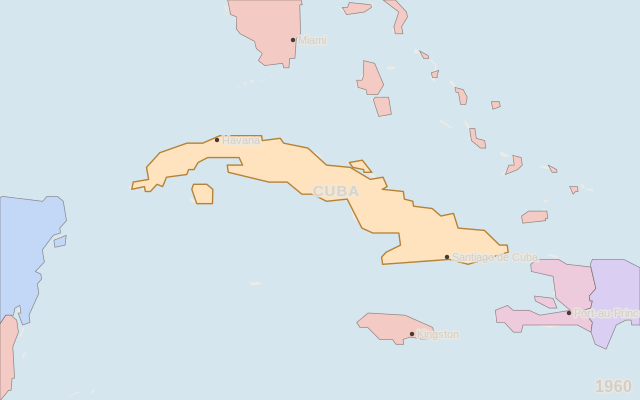
It was founded in 1959, replacing the Republic of Cuba.↓ Its borders are first mapped in 1960, around 124,800 km².↓

Its line counts 3 rulers, covering 1961 – 2021, the median reign 30 years; 1 of 2 handovers was irregular.↓ Among them, Fidel Castro, Raúl Castro and Miguel Díaz-Canel are the best known.↓ The atlas files 25 rows under it, most of them people.↓

From Wikipedia’s article, retold · CC BY-SA 4.0

67 years

Longer than Bremen, shorter than the Soviet Union

125,000 km²

At its height in 1960 · about the size of North Korea

3 rulers

the First Secretary of the Communist Party of Cuba

5 wars and battles

More per century than 96% of states · 25 entries in all

Map: Cuba in 1960, its borders in gold among its neighbours
Angolan Civil War, 1975 – 200219701980199020002010
Beside it on the map in 1960: Mexico, British Empire, Haiti, Dominican Republic and United States.How far it reached, year by year: its ground inside the borders Cliopatria draws (CC BY 4.0), measured on an equal-area grid; the map shows it at its largest, with the cities of the year.

The story

Three acts, 1959 – present

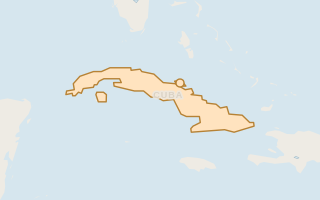
Cuba in 1969, at the end of act I
I1959 – 1970

Revolution and confrontation

Castro legalises the Communist Party, executes hundreds of Batista's men and expropriates farmland, some of it American-owned. The United States answers with sanctions that end in a total trade ban. The Bay of Pigs Invasion follows in 1961, and in 1962 the missile crisis sets the Soviet Union and the United States face to face.

Watch this act on the live map, from 1959
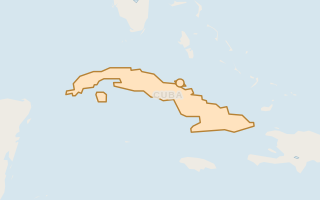
Cuba in 1990, at the end of act II
II1970 – 1991125,000 → 125,000 km²

Soviet aid, African wars

Soviet aid, $33 billion in all, sustains the island, and Soviet pilots and technicians take over its defence. Cuban forces fight across Africa: in November 1975 more than 65,000 troops and 400 tanks reach Angola in one of history's fastest mobilisations, and they fight there again in 1988.

Watch this act on the live map, from 1970
III1991 – present

The Special Period and after

Soviet troops leave in 1991, and the loss of Soviet subsidies plunges Cuba into the Special Period of food and fuel shortages; by 1995 output has shrunk by 35%. Fidel Castro retires in 2008 after 49 years, and Raúl Castro succeeds him. Miguel Díaz-Canel follows, taking charge of the party in 2021, as protests break out.

Watch this act on the live map, from 1991

Before and after

Before it

  • Republic of Cuba · replaces · 1902 – 1959
  • Captaincy General of Cuba · follows

Where it sits in time

3000 BCE2000 BCE1000 BCE110002000Republic of Cuba: 1902 – 1959Cuba: 1959 – 2026

Five thousand years, 3000 BCE to 2026; the state in gold, what it replaced or followed and what replaced or followed it in grey.

Its people

Lives across Cuba

190019502000
Statesmen and generalsScientists and explorersAll its people on the timeline →

How it was governed

3 secretaries

3 secretaries on record, 1961 to 2021; a reign lasted 30 years at the median. Each bar is a reign, as long as it lasted.

Fidel Castro · 1961 – 2011 · left office aliveRaúl Castro · 2011 – 2021 · resigned or stood down, the article saysMiguel Díaz-Canel · 2021 – … · still in office1960198020002020
How their terms ended, where it is known (3 of 3):Left office alive 2In office 1
Every term, with how it ended and its source

Rulers

How 3 reigns ended - choose one to show only those
RulerReignLengthHow it ended · sourceTo the ruler before
20th century · 1 reign
Fidel Castro · aged 351961 – 201150 yearsleft office aliveread off the dates alone
21st century · 2 reigns
Raúl Castro · aged 802011 – 202110 yearsresignedread from the ruler's own articlesibling
Miguel Díaz-Canel · aged 612021 – in officein office since 2021still in office

3 rulers, 3 with terms dated as terms, covering 1961 – 2021. Median reign 30 years. 1 of 2 handovers irregular - a killing, a deposition, a rival claimant, a rising or a coup beside it. A blank in the last column means no kin on record, which is coverage, never “unrelated”.

Formal heads of state and heads of government

The line of Prime Minister of Cuba, drawn and never measured: a cabinet is not a reign.

Carlos Mendietalived 1873 – 1960
Alberto Herrera Franchilived 1874 – 1954
Ramón Graulived 1881 – 1969
Andrés Domingo y Morales del Castillolived 1892 – 1979
Carlos Hevialived 1900 – 1964
Andrés Rivero Agüerolived 1905 – 1996
Fulgencio Batista1952 – 1959
Jorge García Montes1955 – 1957
Emilio Núñez Portuondo1958 – 1958
Gonzalo Güell1958 – 1959
Fidel Castro1959 – 2008
Anselmo Alliegro y Milá1959 – 1959
Carlos Manuel Piedra1959 – 1959
Manuel Urrutia Lleó1959 – 1959
Osvaldo Dorticós Torrado1959 – 1976
Fidel Castro1976 – 2008
Raúl Castro2006 – 2008
Raúl Castro2008 – 2018
Miguel Díaz-Canel2018 – 2019
Miguel Díaz-Canel2018 – …
Manuel Marrero Cruz2019 – …

Flags and arms, in order

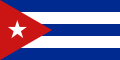
  • Flag of Cuba
    flag, from 1849Flag of Cuba · Public domain
  • Coat of arms of Cuba
    coat of arms, from 1906Coat of arms of Cuba · Public domain

Its world

Rivals, and who else stood

Who it fought most

Wars and battles both took part in, on whichever side: the record names who took part, not who fought whom.

Meanwhile, elsewhere

The best-known states of other regions that stood while it did; the band is Cuba’s own years.

1960198020002020

How it compares

Among 3,073 states

Stood longer than 38% of 3,073 states
Cuba · 67 yearsBremenSoviet UnionHow long it stood, among the states with a recorded end or still standing.
Held more ground at its peak than 50% of 1,464 states
Cuba · 124,800 km²GreeceNorth KoreaThe most ground it held, among the states with a border in Cliopatria.
Had more wars on record per century than 96% of 3,073 states
Cuba · 2.0Wars recorded per century, among the states, counting the wars the atlas hosts under each.

How it began

How did Cuba begin?

What led to it, and what came of it

Captaincy General of Cuba · Linked · 1607 – 1898Captaincy General of CubaRepublic of Cuba · Linked · 1902 – 1959Republic of CubaSoviet Union · In the article · 1922 · “Following the dissolution of the Soviet Union, Cuba faced a severe economic downturn in the 1990s, known as the Special Period.”Soviet UnionAnaïs Nin · Coincidence · 1903 – 1977Anaïs NinCarlos Prío Socarrás · Coincidence · 1903 – 1977Carlos Prío SocarrásRamón Castro Ruz · Coincidence · 1924 – 2016Ramón Castro RuzCuba · 1959 – 2026Cuba16001700180019002000
in the articlelinkedcoincidence

Open the investigation: every row with its evidence, the conditions at the time, the theories condition by condition, and the succession analysed.

Its centuries in the record

1900 – 1999: 18 recorded — 5 wars and battles, 1 risings, regime changes and massacres, 12 other19002000 – 2099: 2 recorded — 0 wars and battles, 1 risings, regime changes and massacres, 1 other2000

Wars and battles in red, risings, coups and massacres beside them, everything else in grey, by the century each began in. A tall bar is partly a fact about Wikipedia: better-documented centuries hold more.

Each century’s own page:1900 – 19992000 – 2099

Keep exploring

Share this page
Copy link
Embed the map
Cite this page

How this page is made

Drawn from Wikidata (Q241, CC0), the opening and history of its English Wikipedia article retold by the atlas (CC BY-SA 4.0), borders from Cliopatria (CC BY 4.0), coast and rivers from Natural Earth, cities from Reba, Reitsma & Seto 2016 (CC BY 4.0), symbols from Wikimedia Commons, each under its own licence. Data built 2026-11-26 · Pastlas v2.47.1, by Oleh Voronko; the published atlas and its data are for non-commercial use.

How to read it

Areas are measured on an equal-area grid from borders simplified to about five kilometres. “c.” marks an approximate date, and a date known to the century is never printed to the year. Counts are what the atlas holds, and they follow Wikipedia’s coverage: a busy century is partly a fact about the record.

  • Still standing: the span runs to the year of the build, 2026.

Something wrong?

Tell us and name the entry. We fix the data, not just this page.

Report a problem