Malagasy Uprising
unrest · 1947 – 1949 · put down
Ground held: 12.40 million km² → 12.40 million km²
State · Europe
1946 – 1958 · 12 years
Came after  Provisional Government of the French Republic · became French Fifth Republic
It was founded in 1946, replacing the Provisional Government of the French Republic.↓ When the borders dataset first draws it, in 1946, it held 11.70 million km².↓
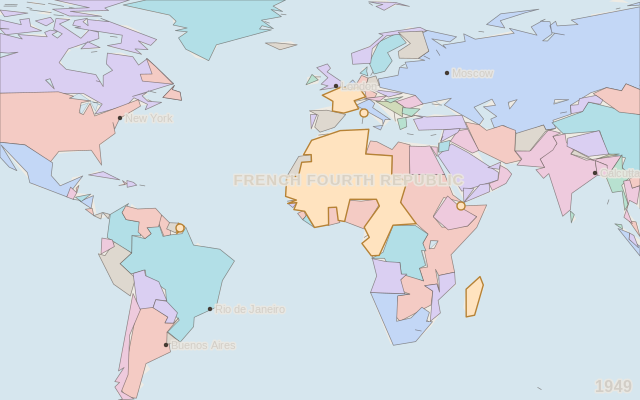
Its ground peaked in 1949 at 12.40 million km².↓ Its line counts 3 rulers, covering 1946 – 1958; none of its 2 handovers was irregular.↓ The best known of them are  Vincent Auriol,
 René Coty and
 Georges Bidault.↓ Most of the 40 rows the atlas files under it are people.↓
Its own article says it was dissolved, in 1958.↓ The French Fifth Republic replaced it in 1958, after 12 years.↓ Its end fits “Elite conflict”, every condition present.↓
Best known for
12 years
Longer than Freetown, shorter than the Weimar Republic
12.4 million km²
At its height in 1949 · a little larger than Canada
3 rulers
the President
2 wars and battles
More per century than 96% of states · 40 entries in all
 Soviet Union,
 Canada,
 British Empire,
 United States,
 Brazil and
 Denmark.How far it reached, year by year: its ground inside the borders Cliopatria draws (CC BY 4.0), measured on an equal-area grid; the map shows it at its largest, with the cities of the year.
The story
The best-known wars, battles, risings and changes of regime the record files under it; a war within a war is folded into it.
unrest · 1947 – 1949 · put down
Ground held: 12.40 million km² → 12.40 million km²
treaty · 10 February 1947
With Treaty of Paris between Italy and the Allied Powers within it.
treaty · 9 December 1948
war · 1954 – 1962
treaty · 23 October 1954
The states the record files it as replacing or following, and those that replaced or followed it - Wikidata's own statements, each read from this state's side.
Provisional Government of the French Republic · replaces · 1944 – 1946French Fifth Republic · replaced by · 1958 – presentFive thousand years, 3000 BCE to 2026; the state in gold, what it replaced or followed and what replaced or followed it in grey.
Its people
One axis for everyone, so you can see who knew whom: the best-known, ordered by birth.
 René Cotypresident
 Vincent Auriolpresident
 Georges Bidaultpresident · diplomat
 Renaud Camusphilosopher · writer
 Françoise Barré-Sinoussibiologist · physician
 Jean-Yves Le Drianpolitician
 Pascal Lamypolitician
 Stéphane Courtoiswriter
 Guillaume Fayephilosopher
 Ségolène Royalpolitician
 Brigitte Macronwriter
 Emir Kusturicacomposer
 Ante Gotovinamilitary officer · military personnel
 Gilles Kepelscientist
 Christine Lagardepolitician · diplomat
 Michel Houellebecqpoet · writer
 Éric Zemmourpolitician · writer
How it was governed
3 presidents on record, 1946 to 1958. Each bar is a reign, as long as it lasted.
Read from the state’s own English article and its rulers’ articles, where Wikidata names no ruler.
1 term is shared from France.
| Ruler | Reign | Length | How it ended · source | To the ruler before |
|---|---|---|---|---|
| 20th century · 3 reigns | ||||
| Georges Bidault · from the line of France · aged 47 | 1946 – 1946 | under a year | left office aliveread off the dates alone | |
| Vincent Auriol | 1947 – 1954 | 7 years | ending not on record | |
| René Coty | 1954 – 1958 | 4 years | ending not on recorddied of natural causes | |
3 rulers, 3 with terms dated as terms, covering 1946 – 1958. Only 12 years of the line are dated - too short for a median. 0 of 2 handovers irregular - a killing, a deposition, a rival claimant, a rising or a coup beside it. The violent-handover count is withheld: power changed hands so often that any rising falls beside one (exposure 1.00, limit 0.6). A blank in the last column means no kin on record, which is coverage, never “unrelated”.
Each symbol with the years its own statement gives; the timeline flies the one of the year on screen.

 Vincent Auriol7 yrsRené Coty4 yrsGeorges Bidault0 yrs
Its world
Wars and battles both took part in, on whichever side: the record names who took part, not who fought whom.
 Kingdom of CambodiaFirst Indochina War2
 Kingdom of LaosFirst Indochina War2
The best-known states of other regions that stood while it did; the band is the French Fourth Republic’s own years.
United StatesAmericas and Oceania MexicoAmericas and Oceania
 LiberiaSub-Saharan Africa
 TurkeyMiddle East and North Africa
 IndonesiaEast and Southeast Asia
 JapanEast and Southeast Asia
 Jammu and Kashmir (state)South Asia
 IsraelMiddle East and North Africa
How it compares
Each column is a share of the states; gold is the French Fourth Republic.
Why it fell
Historians still argue. Here is what the atlas records about its last century:
Dissolved, 1958. Read from the article's section “lead” by its grammar; the claim is only that the article says so.
After a series of crises culminating in the Algerian crisis of 1958, the French Fourth Republic collapsed.
One sentence of the English Wikipedia article, CC BY-SA 4.0.
The investigation's own picture: 1 cause the record names and 1 result, the strongest six of each at their own years, joined to the state by the kind of claim - a recorded statement solid, the article's sentence dashed, a theory dash-dot.
Open the investigation: every row with its evidence, the conditions at the time, the theories condition by condition, and the succession analysed.
Of 5 theories of why states fall, 1 has every condition present at this ending and 2 some of them; each is applied by its own logic, condition by condition, and whether its authors named this case is a footnote.
Lachmann 2000 · Lachmann 2010
Applies by its own logic: 2 of its 2 conditions held here (it needs all of them), and this is the kind of outcome it predicts — adverse regime change, unrest or the state's ending.
40 entries the atlas files under it, all in 1900 – 1999.
“French Fourth Republic”, Pastlas, a historical atlas, 2026-11-26. https://app.pastlas.com/state/french-fourth-republic/
Drawn from Wikidata (Q69829, CC0), borders from Cliopatria (CC BY 4.0), coast and rivers from Natural Earth, cities from Reba, Reitsma & Seto 2016 (CC BY 4.0), symbols from Wikimedia Commons, each under its own licence, and one sentence of the article, quoted. Data built 2026-11-26 · Pastlas v2.47.1, by Oleh Voronko; the published atlas and its data are for non-commercial use.
Areas are measured on an equal-area grid from borders simplified to about five kilometres. “c.” marks an approximate date, and a date known to the century is never printed to the year. Counts are what the atlas holds, and they follow Wikipedia’s coverage: a busy century is partly a fact about the record.