Anti-Comintern Pact
treaty · 25 November 1936
State · Europe
1933 – 1945 · 12 years
Came after  Prussia and
 Weimar Republic · became Soviet occupation zone of Germany and American occupation zone in Germany
Hitler's one-party dictatorship, which conquered most of Europe, murdered Jews, Slavs, Romani people and others, and was defeated by the Allies.
Nazi Germany was the German Reich under Adolf Hitler and the Nazi Party from 1933 to 1945. Appointed chancellor by Paul von Hindenburg, Hitler crushed political opposition, rearmed in secret and in 1938 took Austria and the Sudetenland. His invasion of Poland in 1939 began World War II in Europe. The regime imprisoned, deported or killed Jews, Slavs, Romani people and many others it branded undesirable, until Allied armies beat Germany and reached Berlin in May 1945.
Nazi Germany began in 1933, replacing Prussia and the Weimar Republic.↓ Its borders are first mapped in 1936, around 495,200 km².↓
At its largest, in 1943, it held 3.30 million km².↓ The record names 3 rulers in its line, covering 1925 – 1945; none of its 2 handovers was irregular.↓ Among them,  Adolf Hitler,
 Paul von Hindenburg and
 Karl Dönitz are the best known.↓ The atlas files 137 rows under it, most of them wars and battles.↓
In 1945, after 12 years, it was replaced by the Soviet occupation zone of Germany and American occupation zone in Germany.↓
From Wikipedia’s article, retold · CC BY-SA 4.0
Best known for
12 years
Longer than Freetown, shorter than the Weimar Republic
3.3 million km²
At its height in 1943 · about the size of India
3 rulers
the president of Germany
81 wars and battles
More per century than 96% of states · 137 entries in all
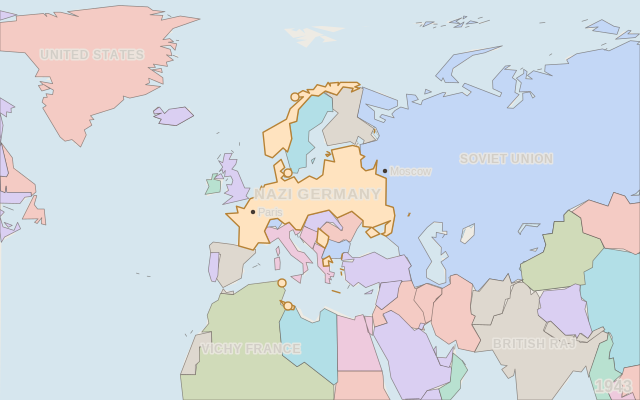
 Soviet Union,
 United States,
 Vichy France,
 Republic of China,
 British Raj and
 British Empire.How far it reached, year by year: its ground inside the borders Cliopatria draws (CC BY 4.0), measured on an equal-area grid; the map shows it at its largest, with the cities of the year.
The story
The best-known wars, battles, risings and changes of regime the record files under it; a war within a war is folded into it.
treaty · 25 November 1936
treaty · 30 September 1938
unrest · 1 August 1944
battle · 1944 – 1945
battle · 6 June 1944
The states the record files it as replacing or following, and those that replaced or followed it - Wikidata's own statements, each read from this state's side.
 Free City of Danzig · replaces · 1920 – 1939Prussia · replaces · 1525 – 1947Weimar Republic · replaces · 1918 – 1933
 Federal State of Austria · replaces · 1934 – 1938
Five thousand years, 3000 BCE to 2026; the state in gold, what it replaced or followed and what replaced or followed it in grey.
Its people
One axis for everyone, so you can see who knew whom: the best-known, ordered by birth.
 Lutz Graf Schwerin von Krosigkpolitician · diplomat
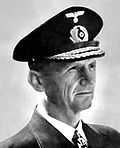 Karl Dönitzpresident · military officer
 Tatiana Markuscommander1921 – 1943
 Heinrich August Winklerwriter
 Roman Jackiwphysicist
 Rudi Dutschkepolitician · writer
 Anita Shapirawriter
 Wolfgang Benzwriter
 Mustafa Dzhemilevpolitician
 Michael Witzelscientist
 Ibrahim Rugovapolitician · writer
 Ján Čarnogurskýpolitician
 Zianon Pazniakpolitician · poet
 Momčilo Perišićmilitary personnel
How it was governed
3 presidents on record, 1925 to 1945. Each bar is a reign, as long as it lasted.
The line of president of Germany.
| Ruler | Reign | Length | How it ended · source | To the ruler before |
|---|---|---|---|---|
| 20th century · 3 reigns | ||||
 Paul von Hindenburg · aged 78 | 1925 – 1934 | 9 years | died in officeWikidata's manner of deathdied of natural causes | |
 Adolf Hitler · aged 45 | 1934 – 1945 | 11 years | died by suicideWikidata's manner of deathdied by suicide | |
| Karl Dönitz · aged 54 | 1945 – 1945 | under a year | left office aliveread off the dates alonedied of natural causes | |
3 rulers, 3 with terms dated as terms, covering 1925 – 1945. Only 20 years of the line are dated - too short for a median. 0 of 2 handovers irregular - a killing, a deposition, a rival claimant, a rising or a coup beside it. The violent-handover count is withheld: power changed hands so often that any rising falls beside one (exposure 0.67, limit 0.6). A blank in the last column means no kin on record, which is coverage, never “unrelated”.
The line of Chancellor of Germany, drawn and never measured: a cabinet is not a reign.
 Wilhelm Marx | 1926 – 1928 |
 Franz von Papen | 1932 – 1932 |
 Lutz Graf Schwerin von Krosigk | 1945 – 1945 |
Each symbol with the years its own statement gives; the timeline flies the one of the year on screen.


 Adolf Hitler11 yrsPaul von Hindenburg9 yrsKarl Dönitz0 yrs
Its world
Wars and battles both took part in, on whichever side: the record names who took part, not who fought whom.
 United KingdomWorld War II44Soviet UnionOperation Barbarossa22United StatesWorld War II16
 Kingdom of ItalyBattle of Britain14
 NorwayNormandy landings11
 CanadaBattle of Britain10Provisional Government of the French RepublicBattle of Berlin8
The best-known states of other regions that stood while it did; the band is Nazi Germany’s own years.
United StatesAmericas and Oceania MexicoAmericas and Oceania
 LiberiaSub-Saharan AfricaBritish RajSouth Asia
 MongoliaEast and Southeast Asia
 TurkeyMiddle East and North Africa
 ThailandEast and Southeast Asia
 IraqMiddle East and North Africa
How it compares
Each column is a share of the states; gold is Nazi Germany.
Why it fell
The Allies defeated Germany and entered Berlin in May 1945, ending the Reich; its territory was divided into American, British, French and Soviet occupation zones.
Historians still argue. Here is what the atlas records about its last century:
The investigation's own picture: 31 causes the record names and 4 results, the strongest six of each at their own years, joined to the state by the kind of claim - a recorded statement solid, the article's sentence dashed, a theory dash-dot.
Open the investigation: every row with its evidence, the conditions at the time, the theories condition by condition, and the succession analysed.
137 entries the atlas files under it, all in 1900 – 1999.
“Nazi Germany”, Pastlas, a historical atlas, 2026-11-26. https://app.pastlas.com/state/nazi-germany/
Drawn from Wikidata (Q7318, CC0), the opening and history of its English Wikipedia article retold by the atlas (CC BY-SA 4.0), borders from Cliopatria (CC BY 4.0), coast and rivers from Natural Earth, cities from Reba, Reitsma & Seto 2016 (CC BY 4.0), symbols from Wikimedia Commons, each under its own licence. Data built 2026-11-26 · Pastlas v2.47.1, by Oleh Voronko; the published atlas and its data are for non-commercial use.
Areas are measured on an equal-area grid from borders simplified to about five kilometres. “c.” marks an approximate date, and a date known to the century is never printed to the year. Counts are what the atlas holds, and they follow Wikipedia’s coverage: a busy century is partly a fact about the record.