State · Europe

Latvia

1918 – present · 108 years · still standing

Came after Soviet Union and United Baltic Duchy

A Baltic republic, independent between the world wars, occupied by Soviet and Nazi armies, and free again after the Singing Revolution.

Latvia broke from the Russian Empire after the First World War, proclaiming independence on 18 November 1918 and defending it in a war that ran until 1920. A coup in 1934 made Kārlis Ulmanis dictator. The Soviet Union seized Latvia in 1940; Nazi Germany occupied it in 1941, and the Soviets returned in 1944 to rule it as the Latvian SSR for forty-five years. The peaceful Singing Revolution won back independence on 21 August 1991.

What the record holds

It was founded in 1918, replacing the Soviet Union and the United Baltic Duchy.↓ Its borders are first mapped in 1920, around 67,500 km².↓

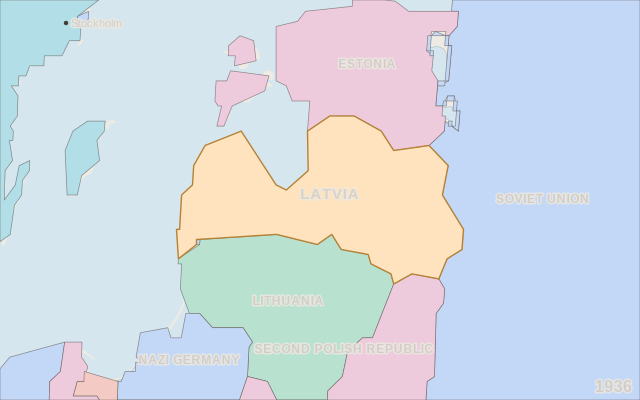
At its largest, in 1936, it held 67,800 km².↓ Its highest office was held by 12 rulers, covering 1922 – 2023, the median reign 4 years; 2 of 11 handovers were irregular.↓ The best known of them are Valdis Zatlers, Edgars Rinkēvičs and Vaira Vīķe-Freiberga.↓ Most of the 50 rows the atlas files under it are people.↓

From Wikipedia’s article, retold · CC BY-SA 4.0

108 years

Longer than Nizhny Novgorod, shorter than the Maurya Empire

67,800 km²

At its height in 1936 · about the size of Georgia

12 rulers

the President of Latvia

7 wars and battles

More per century than 95% of states · 50 entries in all

Map: Latvia in 1936, its borders in gold among its neighbours
1934 Latvian coup d'état, 1934Rumbula massacre, 1941Courland Pocket, 1944 – 19451940196019802000
Beside it on the map in 1936: Soviet Union, Lithuania, Estonia, Nazi Germany, Second Polish Republic and Sweden.How far it reached, year by year: its ground inside the borders Cliopatria draws (CC BY 4.0), measured on an equal-area grid; the map shows it at its largest, with the cities of the year.

The story

Five acts, 1918 – present

I1918 – 1920

A state won in war

The People's Council declares independence and entrusts Kārlis Ulmanis with forming a government; on 26 November Germany's envoy August Winnig hands power to it. Latvia then fights its War of Independence, at Cēsis in 1919 and Daugavpils in 1920, and makes peace with the Soviets in 1920.

Watch this act on the live map, from 1918
Latvia in 1939, at the end of act II
II1920 – 194067,500 → 67,500 km²

Republic, then dictatorship

Latvia governs itself as a parliamentary republic until the coup of 1934, after which it grows ever more autocratic under Kārlis Ulmanis, president from 1936. In August 1939 the Molotov–Ribbentrop Pact's secret protocol places Latvia in the Soviet sphere, and most Baltic Germans leave under the Heim ins Reich programme.

Watch this act on the live map, from 1920
IV1945 – 1991

Soviet Latvia and the Singing Revolution

Latvia is held as the Latvian SSR, and immigration under Soviet rule makes Russians its largest minority. The peaceful Singing Revolution begins in 1987, and the Supreme Council declares independence restored on 4 May 1990. Soviet forces fail to overthrow the Latvian authorities in January 1991, and full independence returns on 21 August.

Watch this act on the live map, from 1945

Before and after

Before it

Where it sits in time

3000 BCE2000 BCE1000 BCE110002000Soviet Union: 1922 – 1991Latvian Socialist Soviet Republic: 1918 – 1920United Baltic Duchy: 1918 – 1918Latvia: 1918 – 2026

Five thousand years, 3000 BCE to 2026; the state in gold, what it replaced or followed and what replaced or followed it in grey.

Its people

Lives across Latvia

190019502000
Statesmen and generalsWriters, artists and thinkersAll its people on the timeline →

How it was governed

12 presidents

12 presidents on record, 1922 to 2023; a reign lasted 4 years at the median. Each bar is a reign, as long as it lasted.

Jānis Čakste · 1922 – 1927 · died in office, manner not recordedPauls Kalniņš · 1927 – 1927 · left office aliveGustavs Zemgals · 1927 – 1930 · left office aliveAlberts Kviesis · 1930 – 1936 · left office aliveKārlis Ulmanis · 1936 – 1940 · exiled, imprisoned or confined, the article saysGuntis Ulmanis · 1993 – 1999 · no death date to read the end againstVaira Vīķe-Freiberga · 1999 – 2007 · no death date to read the end againstValdis Zatlers · 2007 – 2011 · resigned or stood down, the article saysAndris Bērziņš (president) · 2011 – 2015 · no death date to read the end againstRaimonds Vējonis · 2015 – 2019 · no death date to read the end againstEgils Levits · 2019 – 2023 · no death date to read the end againstEdgars Rinkēvičs · 2023 – … · still in office192019401960198020002020
How their terms ended, where it is known (7 of 12):Deposed or removed 1Died in office 1Left office alive 4In office 1Not on record 5
Every term, with how it ended and its source

Rulers

How 12 reigns ended - choose one to show only those

How they died, where the record says: died of natural causes 2.

RulerReignLengthHow it ended · sourceTo the ruler before
20th century · 7 reigns · 1 killed or removed
Jānis Čakste · aged 631922 – 19275 yearsdied in officeread off the dates alone
Pauls Kalniņš · aged 551927 – 1927under a yearleft office aliveread off the dates alone
Gustavs Zemgals · aged 561927 – 19303 yearsleft office aliveread off the dates alone
Alberts Kviesis · aged 491930 – 19366 yearsleft office aliveread off the dates alonedied of natural causes
Kārlis Ulmanis · aged 591936 – 19404 yearsexiledread from the ruler's own articledied of natural causes
Guntis Ulmanis · aged 541993 – 19996 yearsending not on record
Vaira Vīķe-Freiberga · aged 621999 – 20078 yearsending not on record
21st century · 5 reigns
Valdis Zatlers · aged 522007 – 20114 yearsresignedread from the ruler's own article
Andris Bērziņš (president) · aged 672011 – 20154 yearsending not on record
Raimonds Vējonis · aged 492015 – 20194 yearsending not on record
Egils Levits · aged 642019 – 20234 yearsending not on record
Edgars Rinkēvičs · aged 502023 – in officein office since 2023still in office

12 rulers, 12 with terms dated as terms, covering 1922 – 2023. Median reign 4 years. 2 of 11 handovers irregular - a killing, a deposition, a rival claimant, a rising or a coup beside it. A blank in the last column means no kin on record, which is coverage, never “unrelated”.

Heads of government

The line of Prime Minister of Latvia, drawn and never measured: a cabinet is not a reign.

Kārlis Ulmanis1918 – 1921
Zigfrīds Anna Meierovics1921 – 1923
Jānis Pauļuks1923 – 1923
Zigfrīds Anna Meierovics1923 – 1924
Hugo Celmiņš1924 – 1925
Voldemārs Zāmuēls1924 – 1924
Kārlis Ulmanis1925 – 1926
Arturs Alberings1926 – 1926
Marģers Skujenieks1926 – 1928
Hugo Celmiņš1928 – 1931
Pēteris Juraševskis1928 – 1928
Marģers Skujenieks1931 – 1933
Kārlis Ulmanis1931 – 1931
Ādolfs Bļodnieks1933 – 1934
Kārlis Ulmanis1934 – 1940
Augusts Kirhenšteins1940 – 1940
Ivars Godmanis1990 – 1993
Valdis Birkavs1993 – 1994
Māris Gailis1994 – 1995
Andris Šķēle1995 – 1997
Guntars Krasts1997 – 1998
Vilis Krištopans1998 – 1999
Andris Šķēle1999 – 2000
Andris Bērziņš (prime minister)2000 – 2002
Einars Repše2002 – 2004
Aigars Kalvītis2004 – 2007
Indulis Emsis2004 – 2004
Ivars Godmanis2007 – 2009
Valdis Dombrovskis2009 – 2014
Laimdota Straujuma2014 – 2016
Māris Kučinskis2016 – 2019
Krišjānis Kariņš2019 – 2023
Evika Siliņa2023 – 2026
Andris Kulbergs2026 – …

Flags and arms, in order

  • Coat of arms of Latvia
    coat of arms, from 1921Coat of arms of Latvia · Public domain
  • Flag of Latvia
    flag, from 1923Flag of Latvia · Public domain

Its world

Rivals, and who else stood

Who it fought most

Wars and battles both took part in, on whichever side: the record names who took part, not who fought whom.

Meanwhile, elsewhere

The best-known states of other regions that stood while it did; the band is Latvia’s own years.

19251950197520002025

How it compares

Among 3,073 states

Stood longer than 48% of 3,073 states
Latvia · 108 yearsNizhny NovgorodMaurya EmpireHow long it stood, among the states with a recorded end or still standing.
Held more ground at its peak than 38% of 1,464 states
Latvia · 67,800 km²LithuaniaGeorgiaThe most ground it held, among the states with a border in Cliopatria.
Had more wars on record per century than 95% of 3,073 states
Latvia · 1.9Wars recorded per century, among the states, counting the wars the atlas hosts under each.

How it began

How did Latvia begin?

What led to it, and what came of it

Pskov Governorate · Linked · 1772 – 1927Pskov GovernorateUnited Baltic Duchy · Linked · 1918United Baltic DuchyLatvian Socialist Soviet Republic · Linked · 1918 – 1920Latvian Socialist Soviet RepublicHerberts Cukurs · Coincidence · 1900 – 1965Herberts CukursĀdolfs Skulte · Coincidence · 1909 – 2000Ādolfs SkulteViktors Arājs · Coincidence · 1910 – 1988Viktors ArājsLatvia · 1918 – 2026Latvia18001850190019502000
linkedcoincidence

Open the investigation: every row with its evidence, the conditions at the time, the theories condition by condition, and the succession analysed.

Its centuries in the record

1900 – 1999: 35 recorded — 7 wars and battles, 3 risings, regime changes and massacres, 25 other19002000 – 2099: 1 recorded — 0 wars and battles, 0 risings, regime changes and massacres, 1 other2000

Wars and battles in red, risings, coups and massacres beside them, everything else in grey, by the century each began in. A tall bar is partly a fact about Wikipedia: better-documented centuries hold more.

Each century’s own page:1900 – 19992000 – 2099

Keep exploring

Share this page
Copy link
Embed the map
Cite this page

How this page is made

Drawn from Wikidata (Q211, CC0), the opening and history of its English Wikipedia article retold by the atlas (CC BY-SA 4.0), borders from Cliopatria (CC BY 4.0), coast and rivers from Natural Earth, cities from Reba, Reitsma & Seto 2016 (CC BY 4.0), symbols from Wikimedia Commons, each under its own licence. Data built 2026-11-26 · Pastlas v2.47.1, by Oleh Voronko; the published atlas and its data are for non-commercial use.

How to read it

Areas are measured on an equal-area grid from borders simplified to about five kilometres. “c.” marks an approximate date, and a date known to the century is never printed to the year. Counts are what the atlas holds, and they follow Wikipedia’s coverage: a busy century is partly a fact about the record.

  • Still standing: the span runs to the year of the build, 2026.

Something wrong?

Tell us and name the entry. We fix the data, not just this page.

Report a problem