State · East and Southeast Asia

Russian Soviet Federative Socialist Republic

1917 – 1991 · 74 years

Came after Russian Republic and Far Eastern Republic · became Russia and Soviet Union

Russia under the soviets: the first communist state, then the Soviet Union's largest republic, whose own bid for sovereignty helped dissolve it.

The Russian Soviet Federative Socialist Republic began as the world's first communist state, proclaimed on 7 November 1917 out of the October Revolution. From 1922 it was the largest and most populous republic of the Soviet Union, ruled from Moscow. It declared its sovereignty in 1990, elected Boris Yeltsin president in 1991 and, after the failed August coup, left the Union, becoming the Russian Federation on 25 December.

What the record holds

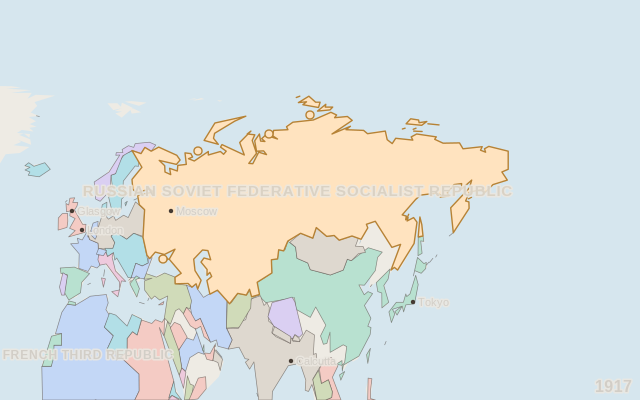
Its record opens in 1917, replacing the Russian Republic and South Russia.↓ In 1917, the first year its borders are mapped, it covered 22.17 million km².↓

The record names 3 rulers in its line, covering 1917 – 1999, the median reign under a year; 2 of 2 handovers were irregular.↓ Among them, Boris Yeltsin, Viktor Chernomyrdin and Lev Kamenev are the best known.↓ The atlas files 46 rows under it, most of them people.↓

Russia, the Soviet Union and the Soviet Republic of Naissaar replaced it in 1991, after 74 years.↓ One theory of why states fall has every condition present at its end: “Elite conflict”.↓

From Wikipedia’s article, retold · CC BY-SA 4.0

74 years

Longer than Jammu and Kashmir, shorter than the Empire of Japan

22.2 million km²

At its height in 1917 · a little larger than Russia

3 rulers

the President of Russia

11 wars and battles

More per century than 99% of states · 46 entries in all

Map: Russian Soviet Federative Socialist Republic in 1917, its borders in gold among its neighbours
Beside it on the map in 1917: French Third Republic, Republic of China, British Raj, British Empire, Mongolia and Qajar Iran.How far it reached, year by year: its ground inside the borders Cliopatria draws (CC BY 4.0), measured on an equal-area grid; the map shows it at its largest, with the cities of the year.

The story

Four acts, 1917 – 1991

I1917 – 1922

Revolution, civil war and famine

Soviet power replaces Alexander Kerensky's Provisional Government on 7 November 1917, and a first constitution follows in 1918. Civil war wrecks the economy: the ruble collapses, barter replaces money, and the Povolzhye famine kills some 5 million along the Volga and in the Urals. In 1922 the republic signs the treaty creating the USSR.

Watch this act on the live map, from 1917
IV1990 – 1991

Sovereignty and the Union's end

Boris Yeltsin takes the chair of the republic's Supreme Soviet on 29 May 1990, and on 12 June its Congress of People's Deputies declares sovereignty, opening a war of laws with the Union. Yeltsin wins the new presidency in June 1991 and eclipses Gorbachev after the failed August coup. In December the republic renounces the Union treaty.

Watch this act on the live map, from 1990

Before and after

Before it

After it

  • Soviet Union · followed by · 1922 – 1991
  • Russia · replaced by · 1991 – present
  • Soviet Republic of Naissaar · followed by

Where it sits in time

3000 BCE2000 BCE1000 BCE110002000Russian Republic: 1917 – 1917South Russia: 1919 – 1920Far Eastern Republic: 1920 – 1922Soviet Union: 1922 – 1991Russia: 1991 – 2026Russian Soviet Federative Socialist Republic: 1917 – 1991

Five thousand years, 3000 BCE to 2026; the state in gold, what it replaced or followed and what replaced or followed it in grey.

Its people

Lives across the Russian Soviet Federative Socialist Republic

190019502000
Statesmen and generalsWriters, artists and thinkersScientists and explorersLived on after it endedAll its people on the timeline →

How it was governed

3 presidents

3 presidents on record, 1917 to 1999; a reign lasted 0 years at the median. Each bar is a reign, as long as it lasted.

Lev Kamenev · 1917 – 1917 · no death date to read the end againstBoris Yeltsin · 1991 – 1999 · resigned or stood down, the article saysViktor Chernomyrdin · 1996 – 1996 · left office alive1920194019601980
a second row: a reign that began before the last had ended — rival claimants, or a shared throne
How their terms ended, where it is known (2 of 3):Left office alive 2Not on record 1
Every term, with how it ended and its source

Rulers

How 3 reigns ended - choose one to show only those

How they died, where the record says: died of natural causes 2 · executed 1.

RulerReignLengthHow it ended · sourceTo the ruler before
20th century · 3 reigns
Lev Kamenev1917 – 1917under a yearending not on recordexecuted
Boris Yeltsin · aged 601991 – 19998 yearsresignedread from the ruler's own articledied of natural causes
Viktor Chernomyrdin · aged 581996 – 1996under a yearleft office aliveread off the dates alonedied of natural causes

3 rulers, 3 with terms dated as terms, covering 1917 – 1999. Median reign 0 years. 2 of 2 handovers irregular - a killing, a deposition, a rival claimant, a rising or a coup beside it. A blank in the last column means no kin on record, which is coverage, never “unrelated”.

Heads of government

The line of head of government, drawn and never measured: a cabinet is not a reign.

Vladimir Lenin1922 – 1924
Alexei Rykov1924 – 1929
Sergey Syrtsov1929 – 1930
Daniil Sulimov1930 – 1937
Nikolai Bulganin1937 – 1938
Vasily Vakhrushev1939 – 1940
Ivan Khokhlov1940 – 1943
Alexei Kosygin1943 – 1949
Boris Chernousov1949 – 1952
Alexander Puzanov1952 – 1956
Mikhail Yasnov1956 – 1957
Frol Kozlov1957 – 1958
Dmitry Polyansky1958 – 1962
Gennady Voronov1962 – 1971
Mikhail Solomentsev1971 – 1983
Vitaly Vorotnikov1983 – 1988
Aleksandr Vlasov1988 – 1990
Ivan Silayev1990 – 1991
Boris Yeltsin1991 – 1992

Flags and arms, in order

  • Flag of the Russian Soviet Federative Socialist Republic (1918–1925)
    flag, 1918 – 1937Flag of the Russian Soviet Federative Socialist Republic (1918–1925) · Public domain
  • Emblem of the Russian Soviet Federative Socialist Republic (1978–1991), Emblem of the Russian Federation (1991–1992)
    coat of arms, from 1918Emblem of the Russian Soviet Federative Socialist Republic (1978–1991), Emblem of the Russian Federation (1991–1992) · Public domain
  • Emblem of the Russian Soviet Federative Socialist Republic (1920–1954)
    coat of arms, 1920 – 1954Emblem of the Russian Soviet Federative Socialist Republic (1920–1954) · Public domain
  • Flag of the Russian Soviet Federative Socialist Republic (1937–1954)
    flag, 1937 – 1954Flag of the Russian Soviet Federative Socialist Republic (1937–1954) · Public domain
  • Flag of the Russian Soviet Federative Socialist Republic (1954–1991)
    flag, 1954 – 1991Flag of the Russian Soviet Federative Socialist Republic (1954–1991) · Public domain
  • Emblem of the Russian Soviet Federative Socialist Republic (1954–1978)
    coat of arms, 1954 – 1978Emblem of the Russian Soviet Federative Socialist Republic (1954–1978) · Public domain

Its world

Rivals, and who else stood

Who it fought most

Wars and battles both took part in, on whichever side: the record names who took part, not who fought whom.

Meanwhile, elsewhere

The best-known states of other regions that stood while it did; the band is the Russian Soviet Federative Socialist Republic’s own years.

19201940196019802000

How it compares

Among 3,073 states

Stood longer than 41% of 3,073 states
Russian Soviet Federative Socialist Republic · 74 yearsJammu and KashmirEmpire of JapanHow long it stood, among the states with a recorded end or still standing.
Held more ground at its peak than 99% of 1,464 states
Russian Soviet Federative Socialist Republic · 22,169,800 km²RussiaThe most ground it held, among the states with a border in Cliopatria.
Had more wars on record per century than 99% of 3,073 states
Russian Soviet Federative Socialist Republic · 5.0Wars recorded per century, among the states, counting the wars the atlas hosts under each.

Why it fell

Why did the Russian Soviet Federative Socialist Republic fall?

Historians still argue. Here is what the atlas records about its last century:

What led to it, and what came of it

Russian Socialist Federative Soviet Republic · Linked · 1917 – 1922Russian Socialist Federative Sov…Russian Republic · Linked · 1917Russian RepublicPeter Kropotkin · Coincidence · 1842 – 1921Peter KropotkinAchilles Alferaki · Coincidence · 1846 – 1919Achilles AlferakiLeonid Pozen · Coincidence · 1849 – 1921Leonid PozenSemyon Vengerov · Coincidence · 1855 – 1920Semyon VengerovRussian Soviet Federative Socialist Republic · 1917 – 1991Russian Soviet Federative Socialist RepublicRussia · Linked · 1991 – 2026RussiaSoviet Union · Linked · 1922 – 1991Soviet Union1850190019502000
linkedcoincidence

Open the investigation: every row with its evidence, the conditions at the time, the theories condition by condition, and the succession analysed.

Theories that apply to its ending

  • Elite conflict

    Lachmann 2000 · Lachmann 2010

    Applies by its own logic: 2 of its 2 conditions held here (it needs all of them), and this is the kind of outcome it predicts — adverse regime change, unrest or the state's ending.

    • 2 or more elite groups in the regime's support, or a parliament met within 100 y — party elites, civil servants (1990)
    • an elite group among the regime's opposition within 5 y, or an elite group left the regime's support over 10 y, or a monarch deposed or killed by others within 20 y, or overlapping reigns — rival claimants — within 20 y — party elites (1986); the military (1991)

In the record

46 entries the atlas files under it, all in 1900 – 1999.

Keep exploring

Share this page
Copy link
Embed the map
Cite this page

How this page is made

Drawn from Wikidata (Q2184, CC0), the opening and history of its English Wikipedia article retold by the atlas (CC BY-SA 4.0), borders from Cliopatria (CC BY 4.0), coast and rivers from Natural Earth, cities from Reba, Reitsma & Seto 2016 (CC BY 4.0), symbols from Wikimedia Commons, each under its own licence. Data built 2026-11-26 · Pastlas v2.47.1, by Oleh Voronko; the published atlas and its data are for non-commercial use.

How to read it

Areas are measured on an equal-area grid from borders simplified to about five kilometres. “c.” marks an approximate date, and a date known to the century is never printed to the year. Counts are what the atlas holds, and they follow Wikipedia’s coverage: a busy century is partly a fact about the record.

Something wrong?

Tell us and name the entry. We fix the data, not just this page.

Report a problem