State · East and Southeast Asia

Mongolian People's Republic

1924 – 1992 · 68 years

Came after Republic of China and Bogd Khanate of Mongolia

Outer Mongolia as the world's second communist state: the first Soviet satellite and the longest-lived, set between the Soviet Union and China.

The Mongolian People's Republic was founded in 1924, after the Soviet-backed Mongolian Revolution of 1921, and ruled Outer Mongolia under the Mongolian People's Revolutionary Party. Under Khorloogiin Choibalsan, Stalinist repressions from 1937 to 1939 killed over twenty thousand people; under Yumjaagiin Tsedenbal, Soviet-guided industry and collectivised farming remade a nomadic society. The 1990 Mongolian Revolution brought multi-party politics, and a new constitution ended the communist state in 1992.

What the record holds

It was founded in 1924, replacing the Republic of China.↓ Its borders are first mapped in 1926, around 1.57 million km².↓ Over the years of the Soviet–Japanese border conflicts, 1932 – 1939, its ground went from 1.57 million km² to 1.56 million km².↓

Its ground peaked in 1946 at 1.57 million km².↓ Its line counts 4 rulers, covering 1939 – 1990, the median reign 6 years; none of its 4 handovers was irregular.↓ The best known of them are Khorloogiin Choibalsan, Yumjaagiin Tsedenbal and Jambyn Batmönkh.↓ Most of the 5 rows the atlas files under it are wars and battles.↓

Its record closes in 1992, after 68 years.↑ Its end fits “Elite conflict” and “The five conditions of revolution”, every condition present.↓

From Wikipedia’s article, retold · CC BY-SA 4.0

68 years

Longer than Bremen, shorter than the Soviet Union

1.57 million km²

At its height in 1946 · about the size of Mongolia

4 rulers

the De facto leader

3 wars and battles

More per century than 92% of states · 5 entries in all

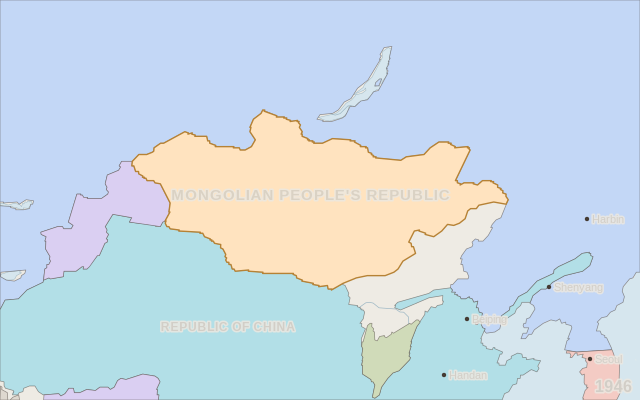
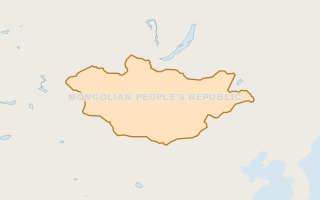
Map: Mongolian People's Republic in 1946, its borders in gold among its neighbours
Soviet–Japanese border conflicts, 1932 – 1939: 1.57 million km² → 1.56 million km²Battles of Khalkhin Gol, 1939Operation Matterhorn, 194419401950196019701980
Beside it on the map in 1946: Soviet Union, Republic of China, East Turkestan, United States, Tibet and British Raj.How far it reached, year by year: its ground inside the borders Cliopatria draws (CC BY 4.0), measured on an equal-area grid; the map shows it at its largest, with the cities of the year.

The story

Four acts, 1924 – 1992

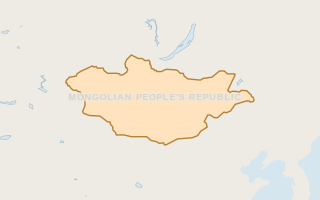
Mongolian People's Republic in 1938, at the end of act I
I1924 – 1939

Revolution and terror

Chinese troops topple the Bogd Khan in 1919; revolutionaries found the Mongolian People's Party at Kyakhta in 1920, and the revolution of 1921 succeeds with Red Army help. Proclaimed in 1924, the republic follows Soviet policy; under Choibalsan, Stalinist repressions from 1937 to 1939 kill over twenty thousand, as Soviet–Japanese border clashes flare from 1932.

Watch this act on the live map, from 1924
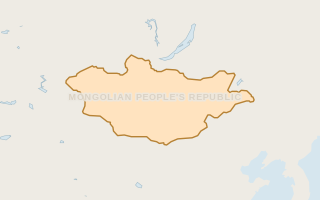
Mongolian People's Republic in 1951, at the end of act II
II1939 – 19521.56 million → 1.57 million km²

Khalkhin Gol and independence

In 1939 Soviet and Mongolian troops under Georgy Zhukov encircle and destroy the Japanese at Khalkhin Gol. After a referendum in 1945 China formally recognises Mongolia's independence, and in 1949 Mongolia shifts its recognition to the People's Republic of China. The Sino-Soviet Treaty of 1950 secures independence but ends Choibalsan's hope of union with Inner Mongolia.

Watch this act on the live map, from 1939
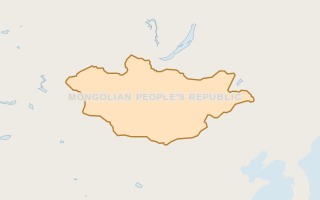
Mongolian People's Republic in 1983, at the end of act III
III1952 – 19841.57 million → 1.57 million km²

Tsedenbal's Soviet model

After Choibalsan's death in 1952 Yumjaagiin Tsedenbal takes power and keeps close to the Soviet Union, above all through the Sino-Soviet split of the 1960s. Soviet leaders rebuff Mao Zedong's hopes of regaining Outer Mongolia. Soviet-guided industry and the full collectivisation of farming turn a nomadic society into an agricultural-industrial economy.

Watch this act on the live map, from 1952
Mongolian People's Republic in 1991, at the end of act IV
IV1984 – 19921.57 million → 1.57 million km²

Reform and the end

Jambyn Batmönkh, leader from 1984, answers Gorbachev's perestroika and glasnost with Mongolian versions and agrees with the Soviet leaders on normalising relations with China; Soviet troops leave between 1987 and 1992. The 1990 Mongolian Revolution forces the party leadership out, legalises opposition parties and brings multi-party politics. The constitution of 1992 ends the communist state.

Watch this act on the live map, from 1984

Before and after

Before it

Where it sits in time

3000 BCE2000 BCE1000 BCE110002000Republic of China: 1912 – 1949Bogd Khanate of Mongolia: 1911 – 1924Mongolian People's Republic: 1924 – 1992

Five thousand years, 3000 BCE to 2026; the state in gold, what it replaced or followed and what replaced or followed it in grey.

How it was governed

4 leaders

4 leaders on record, 1939 to 1990; a reign lasted 6 years at the median. Each bar is a reign, as long as it lasted.

Khorloogiin Choibalsan · 1939 – 1952 · no death date to read the end againstYumjaagiin Tsedenbal · 1952 – 1954 · no death date to read the end againstYumjaagiin Tsedenbal · 1958 – 1984 · no death date to read the end againstJambyn Batmönkh · 1984 – 1990 · no death date to read the end againstGombojavyn Ochirbat · 1990 – 1990 · no death date to read the end against194019601980
How their terms ended, where it is known (0 of 5):Not on record 5
Every term, with how it ended and its source

Rulers

RulerReignLengthHow it ended · sourceTo the ruler before
20th century · 5 reigns
Khorloogiin Choibalsan1939 – 195213 yearsending not on recorddied of natural causes
Yumjaagiin Tsedenbal1952 – 19542 yearsending not on recorddied of natural causes
Yumjaagiin Tsedenbal1958 – 198426 yearsending not on recorddied of natural causes
Jambyn Batmönkh1984 – 19906 yearsending not on record
Gombojavyn Ochirbat1990 – 1990under a yearending not on record

4 rulers, 4 with terms dated as terms, covering 1939 – 1990. Median reign 6 years. 0 of 4 handovers irregular - a killing, a deposition, a rival claimant, a rising or a coup beside it. A blank in the last column means no kin on record, which is coverage, never “unrelated”.

Flags and arms, in order

  • Flag of Mongolia (1924–1940)
    flag, undatedFlag of Mongolia (1924–1940) · Public domain
  • Soyombo yellow
    coat of arms, 1924 – 1939Soyombo yellow · Public domain
  • Soyombo yellow1939
    coat of arms, 1939 – 1940Soyombo yellow1939 · Public domain
  • State emblem of the People's Republic of Mongolia (1940 - 1941)
    coat of arms, 1940 – 1941State emblem of the People's Republic of Mongolia (1940 - 1941) · Public domain
  • Flag of the Mongolian People's Republic (1945–1992)
    flag, 1940 – 1992Flag of the Mongolian People's Republic (1945–1992) · Public domain
  • State emblem of the People's Republic of Mongolia (1941 - 1960)
    coat of arms, 1941 – 1960State emblem of the People's Republic of Mongolia (1941 - 1960) · Public domain
  • State emblem of the People's republic of Mongolia (1960–1992)
    coat of arms, 1960 – 1992State emblem of the People's republic of Mongolia (1960–1992) · CC0

Its world

Rivals, and who else stood

Who it fought most

Wars and battles both took part in, on whichever side: the record names who took part, not who fought whom.

Meanwhile, elsewhere

The best-known states of other regions that stood while it did; the band is the Mongolian People's Republic’s own years.

19201940196019802000

How it compares

Among 3,073 states

Stood longer than 39% of 3,073 states
Mongolian People's Republic · 68 yearsBremenSoviet UnionHow long it stood, among the states with a recorded end or still standing.
Held more ground at its peak than 89% of 1,464 states
Mongolian People's Republic · 1,568,500 km²MongoliaLibyaThe most ground it held, among the states with a border in Cliopatria.
Had more wars on record per century than 92% of 3,073 states
Mongolian People's Republic · 1.0Wars recorded per century, among the states, counting the wars the atlas hosts under each.

Why it fell

Why did the Mongolian People's Republic fall?

Historians still argue. Here is what the atlas records about its last century:

What led to it, and what came of it

Bogd Khanate of Mongolia · Linked · 1911 – 1924Bogd Khanate of MongoliaRepublic of China · Linked · 1912 – 1949Republic of ChinaNavaandorjiin Jadambaa · Coincidence · 1900 – 1939Navaandorjiin JadambaaMongolian People's Republic · 1924 – 1992Mongolian People's Republic190019201940196019802000
linkedcoincidence

Open the investigation: every row with its evidence, the conditions at the time, the theories condition by condition, and the succession analysed.

Theories that apply to its ending

  • Elite conflict

    Lachmann 2000 · Lachmann 2010

    Applies by its own logic: 2 of its 2 conditions held here (it needs all of them), and this is the kind of outcome it predicts — adverse regime change, unrest or the state's ending.

    • 2 or more elite groups in the regime's support, or a parliament met within 100 y — party elites, business elites, civil servants (1991)
    • an elite group among the regime's opposition within 5 y, or an elite group left the regime's support over 10 y, or a monarch deposed or killed by others within 20 y, or overlapping reigns — rival claimants — within 20 y — party elites, business elites (1992); the military (1992)
  • The five conditions of revolution

    Goldstone 2014 · Goldstone 2001

    Applies by its own logic: 4 of its 5 conditions held here (it needs 4), and this is the kind of outcome it predicts — unrest, adverse regime change or the state's ending.

    • an elite group among the regime's opposition within 5 y, or an elite group left the regime's support over 10 y, or a monarch deposed or killed within 10 y, or overlapping reigns — rival claimants — within 10 y, or 2 or more reigns of two years or less within 10 y — party elites, business elites (1992); the military (1992)
    • mass mobilisation at 3 or more of 4 within 5 y, or a popular class among the regime's opposition within 5 y, or unrest within 5 y in the state — many large-scale and small-scale events (1990)
    • anti-system movements at 3 or more of 4 within 5 y — a very high level, a real and present threat (1989)
    • a foreign patron left the regime's support, or its foreign policy became its own, within 5 y — a foreign patron left the regime's support (1992)

In the record

5 entries the atlas files under it, all in 1900 – 1999.

Keep exploring

Share this page
Copy link
Embed the map
Cite this page

How this page is made

Drawn from Wikidata (Q212056, CC0), the opening and history of its English Wikipedia article retold by the atlas (CC BY-SA 4.0), borders from Cliopatria (CC BY 4.0), coast and rivers from Natural Earth, cities from Reba, Reitsma & Seto 2016 (CC BY 4.0), symbols from Wikimedia Commons, each under its own licence. Data built 2026-11-26 · Pastlas v2.47.1, by Oleh Voronko; the published atlas and its data are for non-commercial use.

How to read it

Areas are measured on an equal-area grid from borders simplified to about five kilometres. “c.” marks an approximate date, and a date known to the century is never printed to the year. Counts are what the atlas holds, and they follow Wikipedia’s coverage: a busy century is partly a fact about the record.

Something wrong?

Tell us and name the entry. We fix the data, not just this page.

Report a problem