State · Europe

A Hohenzollern kingdom that doubled in size after World War I, fell to dictatorship and Axis war, and ended under Soviet influence.

The Kingdom of Romania began in 1881, when Prince Karl of Hohenzollern-Sigmaringen was crowned King Carol I, a few years after Romania won independence from the Ottoman Empire in the Russo-Turkish War of 1877–1878. After World War I it gained Bessarabia, Banat, Bukovina and Transylvania. Carol II made himself absolute in 1938, and in 1940, stripped of territory, the kingdom fell under Ion Antonescu's military dictatorship. Communist-dominated governments and Soviet influence ended the monarchy in 1947.

What the record holds

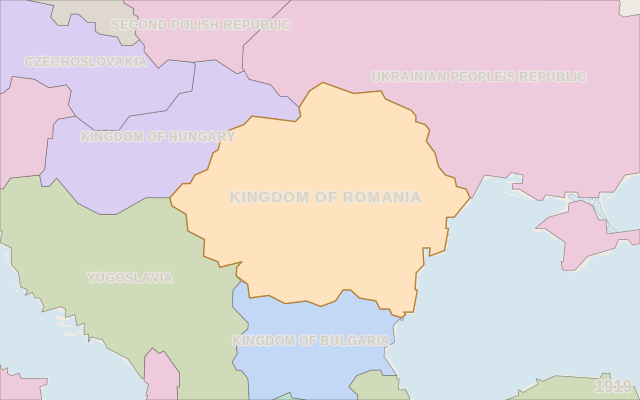
It was founded in 1881, replacing Austria-Hungary and the United Principalities of Moldavia and Wallachia.↓ Its borders are first mapped in 1919, around 302,000 km².↓

Its line counts 4 rulers, covering 1881 – 1947, the median reign 10 years; 2 of 4 handovers were irregular.↓ Among them, Michael I of Romania, Carol I of Romania and Ferdinand I of Romania are the best known.↓ The atlas files 64 rows under it, most of them people.↓

Fascist Romania, the Romanian People's Republic and the Ukrainian Soviet Socialist Republic replaced it in 1947, after 66 years.↓ 2 theories of why states fall have every condition present at its end: “Demographic-structural breakdown” and “Elite conflict”.↓

From Wikipedia’s article, retold · CC BY-SA 4.0

66 years

Longer than Bremen, shorter than the Soviet Union

302,000 km²

At its height in 1919 · about the size of New Zealand

4 rulers

the King of Romania

4 wars and battles

64 entries in all

Map: Kingdom of Romania in 1919, its borders in gold among its neighbours
Treaty of Craiova, 1940Iași pogrom, 1941Legionnaires' rebellion and Bucharest pogrom, 1941Operation Tidal Wave, 19431944 Romanian coup d'état, 194419251930193519401945
Beside it on the map in 1919: Ukrainian People's Republic, Yugoslavia, Kingdom of Hungary, Czechoslovakia, Kingdom of Bulgaria and Second Polish Republic.How far it reached, year by year: its ground inside the borders Cliopatria draws (CC BY 4.0), measured on an equal-area grid; the map shows it at its largest, with the cities of the year.

The story

Four acts, 1881 – 1947

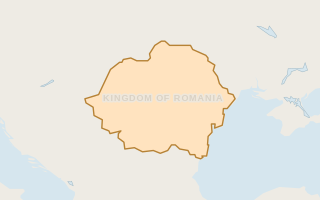
Kingdom of Romania in 1926, at the end of act II
II1914 – 1927

War and the Great Union

Ferdinand I's Romania enters World War I against the Central Powers in 1916, but by year's end they hold Wallachia, Dobruja and Bucharest. Despite resistance at Mărășești, Russia's exit forces Romania out of the war in 1917. At the Paris Peace Conference it gains Transylvania, part of Banat, Bessarabia and Bukovina, more than doubling its size by 1920.

Watch this act on the live map, from 1914
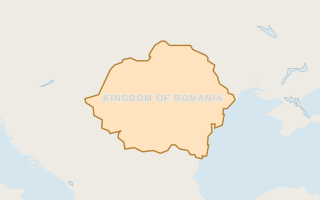
Kingdom of Romania in 1939, at the end of act III
III1927 – 1940300,000 → 300,000 km²

Unstable crowns, rising Iron Guard

When Ferdinand dies in 1927, Prince Carol is kept from the throne and the boy Michael I reigns until Carol II takes over in 1930. More than two dozen governments rise and fall by 1940, and the fascist Iron Guard's feud with its rivals nears civil war. In 1938 Carol II scraps the 1923 constitution and makes himself absolute.

Watch this act on the live map, from 1927
IV1940 – 1947

Dictatorship, war and the end

In 1940, under German and Soviet pressure, Romania cedes most of its post-war gains; Carol II is forced to abdicate and Ion Antonescu rules as military dictator, with Michael I a figurehead. The Axis war goes disastrously, and in 1944 Michael's coup topples Antonescu and takes Romania over to the Allies. Soviet influence ends the monarchy in 1947.

Watch this act on the live map, from 1940

Before and after

Before it

After it

Where it sits in time

3000 BCE2000 BCE1000 BCE110002000Banat Republic: 1918 – 1918National Legionary State: 1940 – 1941Austria-Hungary: 1867 – 1918Ukrainian Soviet Socialist Republic: 1919 – 1991Kingdom of Bulgaria: 1908 – 1946Kingdom of Romania: 1881 – 1947

Five thousand years, 3000 BCE to 2026; the state in gold, what it replaced or followed and what replaced or followed it in grey.

Its people

Lives across the Kingdom of Romania

1850190019502000
Statesmen and generalsScientists and explorersWriters, artists and thinkersLived on after it endedAll its people on the timeline →

How it was governed

4 kings

4 kings on record, 1881 to 1947; a reign lasted 10 years at the median. Each bar is a reign, as long as it lasted.

Carol I of Romania · 1881 – 1914 · died in office, manner not recordedFerdinand I of Romania · 1914 – 1927 · died in office, manner not recordedMichael I of Romania · 1927 – 1930 · left office aliveCarol II of Romania · 1930 – 1940 · abdicatedMichael I of Romania · 1940 – 1947 · removed by a coup190019201940
How their terms ended, where it is known (5 of 5):Deposed or removed 2Died in office 2Left office alive 1
Every term, with how it ended and its source

Rulers

How 5 reigns ended - choose one to show only those

How they died, where the record says: died of natural causes 3.

RulerReignLengthHow it ended · sourceTo the ruler before
19th century · 1 reign
Carol I of Romania · aged 421881 – 191433 yearsdied in officeread off the dates alone
20th century · 4 reigns · 2 killed or removed
Ferdinand I of Romania · aged 491914 – 192713 yearsdied in officeread off the dates alonenephew or niece
Michael I of Romania · aged 61927 – 19303 yearsleft office aliveread off the dates alonedied of natural causesgrandchild
Carol II of Romania · aged 371930 – 194010 yearsabdicatedWikidata's end cause on the termdied of natural causesparent
Michael I of Romania · aged 191940 – 19477 yearsremoved by a coupWikidata's end cause on the termdied of natural causeschild

4 rulers, 4 with terms dated as terms, covering 1881 – 1947. Median reign 10 years. 2 of 4 handovers irregular - a killing, a deposition, a rival claimant, a rising or a coup beside it. A blank in the last column means no kin on record, which is coverage, never “unrelated”.

Heads of government

The line of Prime Minister of Romania, drawn and never measured: a cabinet is not a reign.

Ion C. Brătianu1881 – 1881
Dumitru Brătianu1881 – 1881
Theodor Rosetti1888 – 1889
Gheorghe Manu1889 – 1891
Dimitrie Sturdza1895 – 1896
Petre S. Aurelian1896 – 1897
Dimitrie Sturdza1897 – 1899
Gheorghe Grigore Cantacuzino1899 – 1900
Petre P. Carp1900 – 1901
Dimitrie Sturdza1901 – 1906
Gheorghe Grigore Cantacuzino1904 – 1907
Dimitrie Sturdza1907 – 1908
Ion I. C. Brătianu1909 – 1911
Petre P. Carp1911 – 1912
Titu Maiorescu1912 – 1913
Ion I. C. Brătianu1914 – 1918
Ion I. C. Brătianu1918 – 1919
Constantin Coandă1918 – 1918
Alexandru Averescu1918 – 1918
Alexandru Marghiloman1918 – 1918
Artur Văitoianu1919 – 1919
Alexandru Vaida-Voevod1919 – 1920
Alexandru Averescu1920 – 1921
Take Ionescu1921 – 1922
Ion I. C. Brătianu1922 – 1926
Alexandru Averescu1926 – 1927
Vintilă Brătianu1927 – 1928
Ion I. C. Brătianu1927 – 1927
Iuliu Maniu1928 – 1930
Iuliu Maniu1930 – 1930
Gheorghe Mironescu1930 – 1930
Nicolae Iorga1931 – 1932
Iuliu Maniu1932 – 1933
Alexandru Vaida-Voevod1932 – 1932
Ion G. Duca1933 – 1933
Alexandru Vaida-Voevod1933 – 1933
Constantin Angelescu1933 – 1934
Gheorghe Tătărescu1934 – 1937
Octavian Goga1937 – 1938
Patriarch Miron of Romania1938 – 1939
Constantin Argetoianu1939 – 1939
Gheorghe Tătărescu1939 – 1940
Gheorghe Argeșanu1939 – 1939
Armand Călinescu1939 – 1939
Ion Antonescu1940 – 1944
Ion Gigurtu1940 – 1940
Nicolae Rădescu1944 – 1945
Constantin Sănătescu1944 – 1944
Iuliu Maniu1944 – 1944
Petru Groza1945 – 1952

Flags and arms, in order

  • Kingdom of Romania - Big CoA
    coat of arms, undatedKingdom of Romania - Big CoA · CC BY 3.0 · Răzvan Pala, with suggestions and corrections by Alex Daneş
  • Flag of Romania
    flag, from 1848Flag of Romania · Public domain

Its world

Rivals, and who else stood

Who it fought most

Wars and battles both took part in, on whichever side: the record names who took part, not who fought whom.

Meanwhile, elsewhere

The best-known states of other regions that stood while it did; the band is the Kingdom of Romania’s own years.

1880190019201940

How it compares

Among 3,073 states

Stood longer than 38% of 3,073 states
Kingdom of Romania · 66 yearsBremenSoviet UnionHow long it stood, among the states with a recorded end or still standing.
Held more ground at its peak than 66% of 1,464 states
Kingdom of Romania · 302,000 km²New ZealandPolandThe most ground it held, among the states with a border in Cliopatria.

Why it fell

Why did the Kingdom of Romania fall?

Historians still argue. Here is what the atlas records about its last century:

4

wars and battles in its last century, more than in any before it

1947

Michael I of Romania, deposed or removed in office

What led to it, and what came of it

Duchy of Bukovina · Linked · 1849 – 1918Duchy of BukovinaUnited Principalities of Moldavia and Wallachia · Linked · 1859 – 1881United Principalities of Moldavi…Austria-Hungary · Linked · 1867 – 1918Austria-HungaryLands of the Crown of Saint Stephen · Linked · 1867 – 1918Lands of the Crown of Saint Step…Mihail Kogălniceanu · Coincidence · 1817 – 1891Mihail KogălniceanuIon C. Brătianu · Coincidence · 1821 – 1891Ion C. BrătianuKingdom of Romania · 1881 – 1947Kingdom of RomaniaRomanian People's Republic · Linked · 1947 – 1965Romanian People's RepublicMoldavian Soviet Socialist Republic · Linked · 1940 – 1991Moldavian Soviet Socialist Repub…1850190019502000
linkedcoincidence

Open the investigation: every row with its evidence, the conditions at the time, the theories condition by condition, and the succession analysed.

Theories that apply to its ending

  • Demographic-structural breakdown

    Goldstone 1991 · Turchin & Nefedov 2009

    Applies by its own logic: 3 of its 3 conditions held here (it needs 2), and this is the kind of outcome it predicts — unrest, adverse regime change or the state's ending.

    • famine, plague or disaster within 30 y in the state, or population up 25% over 50 y — prior
    • overlapping reigns — rival claimants — within 20 y, or 3 or more changes of ruler within 20 y, or 2 or more reigns of two years or less within 20 y, or a monarch deposed or killed within 20 y — handovers 3
    • a war the state is fighting, still under way, or a war the state fought, ended within 10 y — warEnded
  • Elite conflict

    Lachmann 2000 · Lachmann 2010

    Applies by its own logic: 2 of its 2 conditions held here (it needs all of them), and this is the kind of outcome it predicts — adverse regime change, unrest or the state's ending.

    • 2 or more elite groups in the regime's support, or a parliament met within 100 y — party elites, the military (1945)
    • an elite group among the regime's opposition within 5 y, or an elite group left the regime's support over 10 y, or a monarch deposed or killed by others within 20 y, or overlapping reigns — rival claimants — within 20 y — the military (1942); the aristocracy, agrarian elites (1947)

Its centuries in the record

1800 – 1899: 32 recorded — 0 wars and battles, 0 risings, regime changes and massacres, 32 other18001900 – 1999: 32 recorded — 4 wars and battles, 5 risings, regime changes and massacres, 23 other1900

Wars and battles in red, risings, coups and massacres beside them, everything else in grey, by the century each began in. A tall bar is partly a fact about Wikipedia: better-documented centuries hold more.

Each century’s own page:1800 – 18991900 – 1999

Keep exploring

Share this page
Copy link
Embed the map
Cite this page

How this page is made

Drawn from Wikidata (Q203493, CC0), the opening and history of its English Wikipedia article retold by the atlas (CC BY-SA 4.0), borders from Cliopatria (CC BY 4.0), coast and rivers from Natural Earth, cities from Reba, Reitsma & Seto 2016 (CC BY 4.0), symbols from Wikimedia Commons, each under its own licence. Data built 2026-11-26 · Pastlas v2.47.1, by Oleh Voronko; the published atlas and its data are for non-commercial use.

How to read it

Areas are measured on an equal-area grid from borders simplified to about five kilometres. “c.” marks an approximate date, and a date known to the century is never printed to the year. Counts are what the atlas holds, and they follow Wikipedia’s coverage: a busy century is partly a fact about the record.

Something wrong?

Tell us and name the entry. We fix the data, not just this page.

Report a problem