Chinese Civil War
war · 1927 – 1950
State · East and Southeast Asia
1912 – 1949 · 37 years
Came after  Qing dynasty and
 Manchukuo · became
 People's Republic of China and
 Taiwan
The republic that replaced China's last dynasty, torn by warlords, Japanese invasion and civil war with the Communists.
The Republic of China took over Mainland China in 1912, after the Xinhai Revolution toppled the Qing dynasty. Sun Yat-sen soon passed the presidency to Yuan Shikai, whose death in 1916 opened the Warlord Era. Chiang Kai-shek's Kuomintang reunified the country by 1928 and ruled it from Nanjing as a one-party state, but Japanese invasion and civil war with the Chinese Communist Party followed, and in 1949 the government retreated to Taiwan.
Its record opens in 1912, replacing the Qing dynasty and Manchukuo.↓ In 1912, the first year its borders are mapped, it covered 8.44 million km².↓ Over the years of the Second Sino-Japanese War, 1937 – 1945, its ground went from 7.07 million km² to 5.44 million km².↓
Its line counts 5 rulers, covering 1912 – 1948; 3 of 4 handovers were irregular.↓ Among them,  Sun Yat-sen,
 Chiang Kai-shek and
 Yuan Shikai are the best known.↓ The atlas files 101 rows under it, most of them wars and battles.↓
The People's Republic of China and Taiwan replaced it in 1949, after 37 years.↓ 3 theories of why states fall have every condition present at its end: “Demographic-structural breakdown”, “Elite conflict” and “The five conditions of revolution”.↓
From Wikipedia’s article, retold · CC BY-SA 4.0
Best known for
37 years
Longer than Daman and Diu, shorter than East Germany
8.44 million km²
At its height in 1912 · about the size of Brazil
5 rulers
the Great President of the Republic of China
51 wars and battles
More per century than 99% of states · 101 entries in all
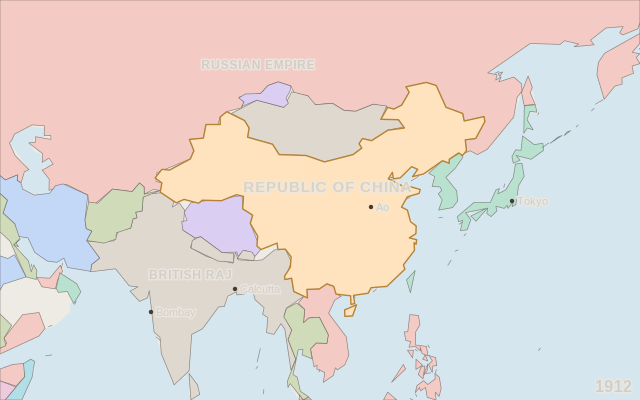
 Russian Empire,
 British Raj,
 Mongolia,
 Qajar Iran,
 Tibet and
 Empire of Japan.How far it reached, year by year: its ground inside the borders Cliopatria draws (CC BY 4.0), measured on an equal-area grid; the map shows it at its largest, with the cities of the year.
The story
The best-known wars, battles, risings and changes of regime the record files under it; a war within a war is folded into it.
war · 1927 – 1950
battle · 1934 – 1935
war · 1937 – 1945
With Japanese invasion of Manchuria, Mukden incident and Counterinsurgency in Manchuria within it.
Ground held: 7.07 million km² → 5.44 million km²
atrocity · 1937 – 1938
Ground held: 7.07 million km² → 4.47 million km²
battle · 7 July 1937
The states the record files it as replacing or following, and those that replaced or followed it - Wikidata's own statements, each read from this state's side.
Chinese Empire · replaces · 220 BCE – 1912 CEManchukuo · replaces · 1932 – 1945Qing dynasty · replaces · 1644 – 1912 Empire of China · replaces · 1915 – 1916People's Republic of China · replaced by · 1949 – present
 Mongolian People's Republic · replaced by · 1924 – 1992Taiwan · replaced by · 1912 – present
Five thousand years, 3000 BCE to 2026; the state in gold, what it replaced or followed and what replaced or followed it in grey.
Its people
One axis for everyone, so you can see who knew whom: the best-known, ordered by birth.
 Yuan Shikaipresident · military leader1859 – 1916
 Tang Shaoyipolitician · diplomat1862 – 1938
 Duan Qiruipolitician1865 – 1936
 Sun Yat-senpresident · revolutionary1866 – 1925
 Lu Zhengxiangpolitician · diplomat1871 – 1949
 Hu Hanminpolitician1879 – 1936
 Chen Gongbopresident1892 – 1946
 Xi Zhongxunpolitician
 Jiang Qingpolitician
 Hu Yaobangpolitician
 Zhang Chunqiaopolitician · writer
 Yang Chen-Ningphysicist
 Tu Youyouinventor · chemist
 Yao Wenyuanpolitician
 Benedict Andersonphilosopher · writer
 Zhong Nanshanphysician · politician
 Choekyi Gyaltsen, 10th Panchen Lamapolitician · writer
How it was governed
5 presidents on record, 1912 to 1948. Each bar is a reign, as long as it lasted.
The line of Great President of the Republic of China.
| Ruler | Reign | Length | How it ended · source | To the ruler before |
|---|---|---|---|---|
| 20th century · 5 reigns · 1 killed or removed | ||||
| Sun Yat-sen · aged 46 | 1912 – 1912 | under a year | left office aliveread off the dates alonedied of natural causes | |
| Yuan Shikai · aged 53 | 1912 – 1916 | 4 years | died in officeWikidata's manner of deathdied of natural causes | |
 Chiang Kai-shek · aged 41 | 1928 – 1931 | 3 years | left office aliveread off the dates alonedied of natural causes | |
| Chiang Kai-shek · aged 56 | 1943 – 1948 | 5 years | left office aliveread off the dates alonedied of natural causes | |
| Chen Gongbo · aged 52 | 1944 – 1945 | 1 year | executedWikidata's manner of death | |
5 rulers, 4 with terms dated as terms, covering 1912 – 1948. Only 36 years of the line are dated - too short for a median. 3 of 4 handovers irregular - a killing, a deposition, a rival claimant, a rising or a coup beside it. A blank in the last column means no kin on record, which is coverage, never “unrelated”.
The line also names one holder with a page of their own whose term the record gives no first year, so the table cannot place it: Hu Hanmin.
The line of Premier of the Cabinet, drawn and never measured: a cabinet is not a reign.
 Lu Zhengxiang | 1912 – 1912 |
 Tang Shaoyi | 1912 – 1912 |
 Zhao Bingjun | 1912 – 1913 |
 Duan Qirui | 1913 – 1913 |
Each symbol with the years its own statement gives; the timeline flies the one of the year on screen.

 Chiang Kai-shek8 yrsYuan Shikai4 yrsChen Gongbo1 yrsSun Yat-sen0 yrs
Its world
Wars and battles both took part in, on whichever side: the record names who took part, not who fought whom.
Empire of JapanWorld War I9 United StatesWorld War II5
 AustraliaWorld War II4
 United KingdomWorld War II3
 MexicoWorld War II3TaiwanWorld War II2
 United Kingdom of Great Britain and IrelandWorld War I2
The best-known states of other regions that stood while it did; the band is the Republic of China’s own years.
 SpainEuropeUnited StatesAmericas and Oceania
 MexicoAmericas and Oceania
 LiberiaSub-Saharan AfricaBritish RajSouth Asia
 FinlandEurope
 SyriaMiddle East and North Africa
 TurkeyMiddle East and North Africa
How it compares
Each column is a share of the states; gold is the Republic of China.
Why it fell
Weakened by war with Japan, inflation and hunger, it lost the civil war to the Chinese Communist Party, and in 1949 its government retreated to Taiwan.
Historians still argue. Here is what the atlas records about its last century:
1945
Chen Gongbo, killed in office
The investigation's own picture: 49 causes the record names and 6 results, the strongest six of each at their own years, joined to the state by the kind of claim - a recorded statement solid, the article's sentence dashed, a theory dash-dot.
Open the investigation: every row with its evidence, the conditions at the time, the theories condition by condition, and the succession analysed.
Of 5 theories of why states fall, 3 have every condition present at this ending; each is applied by its own logic, condition by condition, and whether its authors named this case is a footnote.
Goldstone 1991 · Turchin & Nefedov 2009
Applies by its own logic: 3 of its 3 conditions held here (it needs 2), and this is the kind of outcome it predicts — unrest, adverse regime change or the state's ending.
Lachmann 2000 · Lachmann 2010
Applies by its own logic: 2 of its 2 conditions held here (it needs all of them), and this is the kind of outcome it predicts — adverse regime change, unrest or the state's ending.
Goldstone 2014 · Goldstone 2001
Applies by its own logic: 5 of its 5 conditions held here (it needs 4), and this is the kind of outcome it predicts — unrest, adverse regime change or the state's ending.
101 entries the atlas files under it, all in 1900 – 1999.
“Republic of China”, Pastlas, a historical atlas, 2026-11-26. https://app.pastlas.com/state/republic-of-china/
Drawn from Wikidata (Q13426199, CC0), the opening and history of its English Wikipedia article retold by the atlas (CC BY-SA 4.0), borders from Cliopatria (CC BY 4.0), coast and rivers from Natural Earth, cities from Reba, Reitsma & Seto 2016 (CC BY 4.0), symbols from Wikimedia Commons, each under its own licence. Data built 2026-11-26 · Pastlas v2.47.1, by Oleh Voronko; the published atlas and its data are for non-commercial use.
Areas are measured on an equal-area grid from borders simplified to about five kilometres. “c.” marks an approximate date, and a date known to the century is never printed to the year. Counts are what the atlas holds, and they follow Wikipedia’s coverage: a busy century is partly a fact about the record.