State · Middle East and North Africa

Israel

1948 – present · 78 years · still standing

Came after Israeli Military Governorate and Mandatory Palestine

A Jewish state born in war amid the Palestinian exodus, at peace with Egypt and Jordan but in conflict with the Palestinians.

Israel declared its independence on 14 May 1948, before the British mandate over Palestine ended, amid a civil war that followed the UN plan to partition the country. Arab states intervened, and the 1949 armistice left Israel holding more land than the plan had allotted, while most Palestinian Arabs fled or were driven out. In 1967 it occupied the West Bank, Gaza and Sinai; later it made peace with Egypt and Jordan, but its conflict with the Palestinians persists.

What the record holds

Its record opens in 1948, replacing Israeli Military Governorate and Mandatory Palestine.↓ When the borders dataset first draws it, in 1948, it held 22,900 km².↓

It reached its greatest extent in 1967: 90,500 km².↓ Its line counts 16 rulers, covering 1948 – 2021, the median reign 5 years; none of its 15 handovers was irregular.↓ Among them, David Ben-Gurion, Shimon Peres and Isaac Herzog are the best known.↓ The atlas files 212 rows under it, most of them people.↓

From Wikipedia’s article, retold · CC BY-SA 4.0

78 years

Longer than Yugoslavia, shorter than the Empire of Japan

90,500 km²

At its height in 1967 · about the size of Jordan

16 rulers

the President of Israel

60 wars and battles

More per century than 99% of states · 212 entries in all

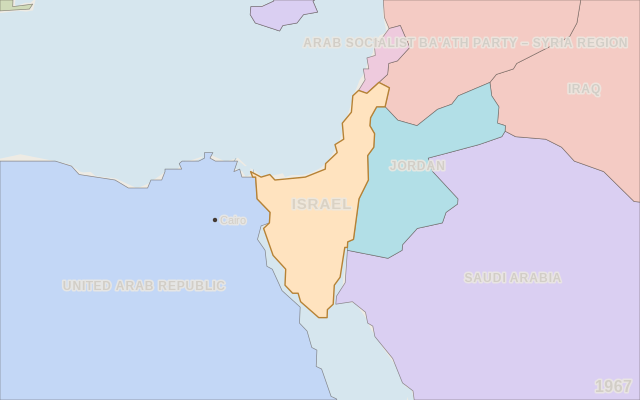
Map: Israel in 1967, its borders in gold among its neighbours
First Intifada, 1987 – 1993Israeli–Lebanese conflict, 20002014 Gaza War, 2014196019802000
Beside it on the map in 1967: United Arab Republic, Saudi Arabia, Iraq, Jordan, Lebanon and United Kingdom.How far it reached, year by year: its ground inside the borders Cliopatria draws (CC BY 4.0), measured on an equal-area grid; the map shows it at its largest, with the cities of the year.

The story

Four acts, 1948 – present

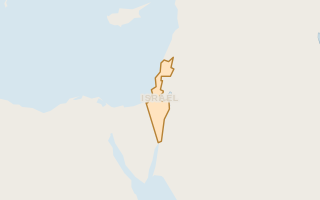
Israel in 1966, at the end of act I
I1948 – 196722,900 → 21,800 km²

Independence and war

Israel declares independence on 14 May 1948; Arab states join the fighting, and the 1949 armistice leaves Israel with more land than the UN plan allotted. Most Palestinian Arabs flee or are expelled, while Jews leaving the Arab world arrive. The Deir Yassin massacre of 1948 and the Kafr Qasim massacre of 1956 mark these years.

Watch this act on the live map, from 1948
Israel in 2022, at the end of act III
III1993 – 202328,800 → 28,700 km²

Oslo and the intifadas

The Oslo Accords of 1993 bring limited Palestinian self-rule, and peace with Jordan follows in 1994. Ariel Sharon's Temple Mount visit in 2000 precedes the Second Intifada; as prime minister he leaves Gaza and builds the West Bank barrier. War in Lebanon follows in 2006, Gaza wars in 2012 and 2014, and the Abraham Accords in 2020.

Watch this act on the live map, from 1993
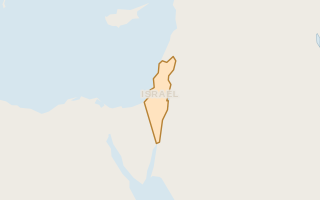
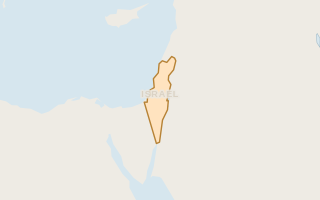
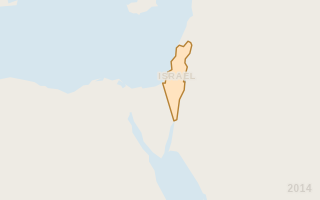
Israel in 2014, last mappedIsrael in 1967, at its largest
The rise and the fall in one frame: drag across it from 1967, at its largest at 90,500 km², to 2014, last mapped at 28,700 km². Open the live map in 1967 or 2014.

Before and after

Before it

Where it sits in time

3000 BCE2000 BCE1000 BCE110002000Israeli Military Governorate: 1967 – 1982Israel: 1948 – 2026

Five thousand years, 3000 BCE to 2026; the state in gold, what it replaced or followed and what replaced or followed it in grey.

Its people

Lives across Israel

190019502000
Statesmen and generalsWriters, artists and thinkersAll its people on the timeline →

How it was governed

16 presidents

16 presidents on record, 1948 to 2021; a reign lasted 5 years at the median. Each bar is a reign, as long as it lasted.

David Ben-Gurion · 1948 – 1948 · left office aliveChaim Weizmann · 1949 – 1952 · died in office, manner not recordedYosef Sprinzak · 1952 – 1952 · left office aliveYitzhak Ben-Zvi · 1952 – 1963 · died in office, manner not recordedKadish Luz · 1963 – 1963 · left office aliveZalman Shazar · 1963 – 1973 · left office aliveEphraim Katzir · 1973 – 1978 · left office aliveYitzhak Navon · 1978 – 1983 · left office aliveChaim Herzog · 1983 – 1993 · left office aliveEzer Weizman · 1993 – 2000 · left office aliveAvraham Burg · 2000 – 2000 · no death date to read the end againstMoshe Katsav · 2000 – 2007 · resignedDalia Itzik · 2007 – 2007 · no death date to read the end againstShimon Peres · 2007 – 2014 · left office aliveReuven Rivlin · 2014 – 2021 · served out the term, the article saysIsaac Herzog · 2021 – … · resigned or stood down, the article says1960198020002020
How their terms ended, where it is known (14 of 16):Died in office 2Left office alive 12Not on record 2
Every term, with how it ended and its source

Rulers

How 16 reigns ended - choose one to show only those

How they died, where the record says: died of natural causes 3.

RulerReignLengthHow it ended · sourceTo the ruler before
20th century · 12 reigns
David Ben-Gurion · aged 621948 – 1948under a yearleft office aliveread off the dates alonedied of natural causes
Chaim Weizmann · aged 751949 – 19523 yearsdied in officeread off the dates alone
Yosef Sprinzak · aged 671952 – 1952under a yearleft office aliveread off the dates alone
Yitzhak Ben-Zvi · aged 681952 – 196311 yearsdied in officeread off the dates alone
Kadish Luz · aged 681963 – 1963under a yearleft office aliveread off the dates alone
Zalman Shazar · aged 741963 – 197310 yearsleft office aliveread off the dates alone
Ephraim Katzir · aged 571973 – 19785 yearsleft office aliveread off the dates alone
Yitzhak Navon · aged 571978 – 19835 yearsleft office aliveread off the dates alone
Chaim Herzog · aged 651983 – 199310 yearsleft office aliveread off the dates alone
Ezer Weizman · aged 691993 – 20007 yearsleft office aliveread off the dates alonedied of natural causes
Avraham Burg · aged 452000 – 2000under a yearending not on record
Moshe Katsav · aged 552000 – 20077 yearsresignedWikidata's end cause on the term
21st century · 4 reigns
Dalia Itzik · aged 552007 – 2007under a yearending not on record
Shimon Peres · aged 842007 – 20147 yearsleft office aliveread off the dates alonedied of natural causes
Reuven Rivlin · aged 752014 – 20217 yearsserved out the termread from the ruler's own article
Isaac Herzog · aged 612021 – in officein office since 2021resignedread from the ruler's own article

16 rulers, 16 with terms dated as terms, covering 1948 – 2021. Median reign 5 years. 0 of 15 handovers irregular - a killing, a deposition, a rival claimant, a rising or a coup beside it. The violent-handover count is withheld: power changed hands so often that any rising falls beside one (exposure 0.93, limit 0.6). A blank in the last column means no kin on record, which is coverage, never “unrelated”.

Heads of government

The line of Prime Minister of Israel, drawn and never measured: a cabinet is not a reign.

David Ben-Gurion1948 – 1954
Moshe Sharett1954 – 1955
David Ben-Gurion1955 – 1963
Levi Eshkol1963 – 1969
Yigal Allon1969 – 1969
Golda Meir1969 – 1974
Yitzhak Rabin1974 – 1977
Menachem Begin1977 – 1983
Shimon Peres1977 – 1977
Yitzhak Shamir1983 – 1984
Shimon Peres1984 – 1986
Yitzhak Shamir1986 – 1992
Yitzhak Rabin1992 – 1995
Shimon Peres1995 – 1996
Benjamin Netanyahu1996 – 1999
Ehud Barak1999 – 2001
Ariel Sharon2001 – 2006
Ehud Olmert2006 – 2009
Benjamin Netanyahu2009 – 2021
Naftali Bennett2021 – 2022
Yair Lapid2022 – 2022
Benjamin Netanyahu2022 – …

Flags and arms, in order

  • Flag of Israel
    flag, from 1948Flag of Israel · Public domain
  • Emblem of Israel
    coat of arms, from 1949Emblem of Israel · Public domain

Its world

Rivals, and who else stood

Who it fought most

Wars and battles both took part in, on whichever side: the record names who took part, not who fought whom.

Meanwhile, elsewhere

The best-known states of other regions that stood while it did; the band is Israel’s own years.

19401960198020002020

How it compares

Among 3,073 states

Stood longer than 41% of 3,073 states
Israel · 78 yearsYugoslaviaEmpire of JapanHow long it stood, among the states with a recorded end or still standing.
Held more ground at its peak than 43% of 1,464 states
Israel · 90,500 km²JordanHungaryThe most ground it held, among the states with a border in Cliopatria.
Had more wars on record per century than 99% of 3,073 states
Israel · 16.0Wars recorded per century, among the states, counting the wars the atlas hosts under each.

How it began

How did Israel begin?

What led to it, and what came of it

Mandatory Palestine · Linked · 1920 – 1948Mandatory Palestine1948 Palestine war · Linked · 1947 – 19491948 Palestine warShmuel Yosef Agnon · Coincidence · 1888 – 1970Shmuel Yosef AgnonAvigdor Hameiri · Coincidence · 1890 – 1970Avigdor HameiriMoshe Sharett · Coincidence · 1894 – 1965Moshe SharettLevi Eshkol · Coincidence · 1895 – 1969Levi EshkolIsrael · 1948 – 2026Israel190019502000
linkedcoincidence

Open the investigation: every row with its evidence, the conditions at the time, the theories condition by condition, and the succession analysed.

Its centuries in the record

1900 – 1999: 147 recorded — 27 wars and battles, 17 risings, regime changes and massacres, 103 other19002000 – 2099: 56 recorded — 33 wars and battles, 21 risings, regime changes and massacres, 2 other2000

Wars and battles in red, risings, coups and massacres beside them, everything else in grey, by the century each began in. A tall bar is partly a fact about Wikipedia: better-documented centuries hold more.

Each century’s own page:1900 – 19992000 – 2099

Keep exploring

Share this page
Copy link
Embed the map
Cite this page

How this page is made

Drawn from Wikidata (Q801, CC0), the opening and history of its English Wikipedia article retold by the atlas (CC BY-SA 4.0), borders from Cliopatria (CC BY 4.0), coast and rivers from Natural Earth, cities from Reba, Reitsma & Seto 2016 (CC BY 4.0), symbols from Wikimedia Commons, each under its own licence. Data built 2026-11-26 · Pastlas v2.47.1, by Oleh Voronko; the published atlas and its data are for non-commercial use.

How to read it

Areas are measured on an equal-area grid from borders simplified to about five kilometres. “c.” marks an approximate date, and a date known to the century is never printed to the year. Counts are what the atlas holds, and they follow Wikipedia’s coverage: a busy century is partly a fact about the record.

  • Still standing: the span runs to the year of the build, 2026.

Something wrong?

Tell us and name the entry. We fix the data, not just this page.

Report a problem