State · South Asia

Bhutan

1949 – present · 77 years · still standing

Came after princely state

A Himalayan kingdom of Vajrayana Buddhism between Tibet and India, whose Wangchuck kings led it from absolute to constitutional monarchy.

Bhutan is a landlocked kingdom in the Eastern Himalayas, between China's Tibet Autonomous Region and India, with Thimphu its capital and Vajrayana Buddhism its state religion. Its Wangchuck kings, who had drawn close to Britain, signed a treaty with India at Darjeeling in 1949 in which each recognised the other's sovereignty. It entered the United Nations in 1971, and the 2008 Constitution gave it an elected parliament under a constitutional monarch.

What the record holds

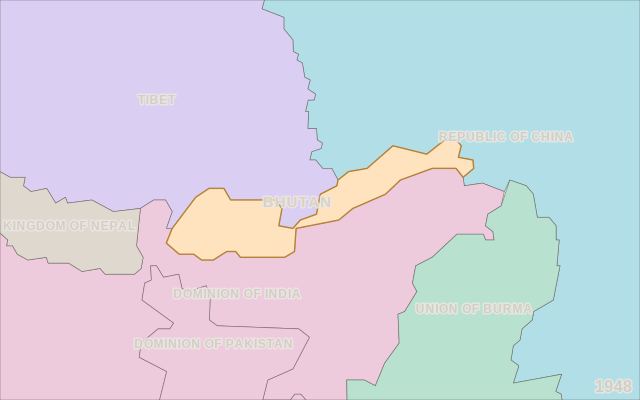
Bhutan began in 1949, replacing princely state.↓ Its borders are first mapped in 1948, around 71,300 km².↓

The record names 4 rulers in its line, covering 1926 – 2006, the median reign 26 years; none of its 3 handovers was irregular.↓ Among them, Jigme Khesar Namgyel Wangchuck, Jigme Singye Wangchuck and Jigme Dorji Wangchuck are the best known.↓ The atlas files 16 rows under it, most of them people.↓

From Wikipedia’s article, retold · CC BY-SA 4.0

77 years

Longer than Yugoslavia, shorter than the Empire of Japan

71,300 km²

At its height in 1948 · about the size of Azerbaijan

4 rulers

the King of Bhutan

1 war or battle

More per century than 92% of states · 16 entries in all

Map: Bhutan in 1948, its borders in gold among its neighbours
196019802000
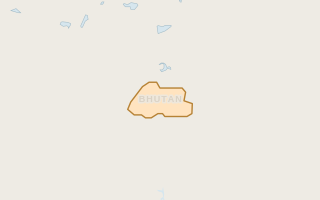
Beside it on the map in 1948: Republic of China, Tibet, Dominion of India, Union of Burma, Dominion of Pakistan and Kingdom of Nepal.How far it reached, year by year: its ground inside the borders Cliopatria draws (CC BY 4.0), measured on an equal-area grid; the map shows it at its largest, with the cities of the year.

The story

Three acts, 1949 – present

III2006 – present

A constitutional monarchy

Jigme Khesar Namgyel Wangchuck becomes king in 2006. Under the 2008 Constitution the people elect a National Assembly, a National Council sits beside it, and a prime minister leads the government while the king remains head of state. Bhutan lives through a 2009 earthquake, the 2017 China–India border standoff and the COVID-19 pandemic.

Watch this act on the live map, from 2006

Before and after

Before it

  • princely state · replaces

Where it sits in time

3000 BCE2000 BCE1000 BCE110002000Bhutan: 1949 – 2026

Five thousand years, 3000 BCE to 2026; the state in gold.

Its people

Lives across Bhutan

192019401960198020002020
Statesmen and generalsAll its people on the timeline →

How it was governed

4 kings

4 kings on record, 1926 to 2006; a reign lasted 26 years at the median. Each bar is a reign, as long as it lasted.

Jigme Wangchuck · 1926 – 1952 · died in office, manner not recordedJigme Dorji Wangchuck · 1952 – 1972 · died in office of natural causesJigme Singye Wangchuck · 1972 – 2006 · abdicated, the article saysJigme Khesar Namgyel Wangchuck · 2006 – … · still in office1960198020002020
How their terms ended, where it is known (4 of 4):Deposed or removed 1Died in office 2In office 1
Every term, with how it ended and its source

Rulers

How 4 reigns ended - choose one to show only those

How they died, where the record says: died of natural causes 1.

RulerReignLengthHow it ended · sourceTo the ruler before
20th century · 3 reigns · 1 killed or removed
Jigme Wangchuck · aged 211926 – 195226 yearsdied in officeread off the dates alone
Jigme Dorji Wangchuck · aged 231952 – 197220 yearsdied in officeWikidata's manner of deathdied of natural causeschild
Jigme Singye Wangchuck · aged 171972 – 200634 yearsabdicatedread from the ruler's own articlechild
21st century · 1 reign
Jigme Khesar Namgyel Wangchuck · aged 262006 – in officein office since 2006still in officechild

4 rulers, 4 with terms dated as terms, covering 1926 – 2006. Median reign 26 years. 0 of 3 handovers irregular - a killing, a deposition, a rival claimant, a rising or a coup beside it. A blank in the last column means no kin on record, which is coverage, never “unrelated”.

Heads of government

The line of Prime Minister of Bhutan, drawn and never measured: a cabinet is not a reign.

Jigme Palden Dorji1952 – 1964
Lhendup Dorji1964 – 1964
Jigme Thinley1998 – 1999
Sangay Ngedup1999 – 2000
Yeshey Zimba2000 – 2001
Khandu Wangchuk2001 – 2002
Kinzang Dorji2002 – 2003
Jigme Thinley2003 – 2004
Yeshey Zimba2004 – 2005
Sangay Ngedup2005 – 2006
Khandu Wangchuk2006 – 2007
Kinzang Dorji2007 – 2008
Jigme Thinley2008 – 2013
Tshering Tobgay2013 – 2018
Lotay Tshering2018 – 2023
Tshering Tobgay2024 – …

Flags and arms, in order

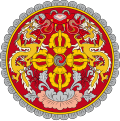
  • Emblem of Bhutan
    coat of arms, undatedEmblem of Bhutan · Public domain
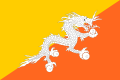
  • Flag of Bhutan
    flag, from 1969Flag of Bhutan · Public domain

Its world

Who else stood

Meanwhile, elsewhere

The best-known states of other regions that stood while it did; the band is Bhutan’s own years.

19401960198020002020

How it compares

Among 3,073 states

Stood longer than 41% of 3,073 states
Bhutan · 77 yearsYugoslaviaEmpire of JapanHow long it stood, among the states with a recorded end or still standing.
Held more ground at its peak than 39% of 1,464 states
Bhutan · 71,300 km²AzerbaijanSri LankaThe most ground it held, among the states with a border in Cliopatria.
Had more wars on record per century than 92% of 3,073 states
Bhutan · 1.0Wars recorded per century, among the states, counting the wars the atlas hosts under each.

How it began

How did Bhutan begin?

Its centuries in the record

1900 – 1999: 13 recorded — 0 wars and battles, 0 risings, regime changes and massacres, 13 other19002000 – 2099: 3 recorded — 1 wars and battles, 0 risings, regime changes and massacres, 2 other2000

Wars and battles in red, risings, coups and massacres beside them, everything else in grey, by the century each began in. A tall bar is partly a fact about Wikipedia: better-documented centuries hold more.

Each century’s own page:1900 – 19992000 – 2099

Keep exploring

Share this page
Copy link
Embed the map
Cite this page

How this page is made

Drawn from Wikidata (Q917, CC0), the opening and history of its English Wikipedia article retold by the atlas (CC BY-SA 4.0), borders from Cliopatria (CC BY 4.0), coast and rivers from Natural Earth, cities from Reba, Reitsma & Seto 2016 (CC BY 4.0), symbols from Wikimedia Commons, each under its own licence. Data built 2026-11-26 · Pastlas v2.47.1, by Oleh Voronko; the published atlas and its data are for non-commercial use.

How to read it

Areas are measured on an equal-area grid from borders simplified to about five kilometres. “c.” marks an approximate date, and a date known to the century is never printed to the year. Counts are what the atlas holds, and they follow Wikipedia’s coverage: a busy century is partly a fact about the record.

  • Wikidata records foundings in 1907 and 1949; the atlas draws the present-day state from 1949.
  • Still standing: the span runs to the year of the build, 2026.

Something wrong?

Tell us and name the entry. We fix the data, not just this page.

Report a problem