State · Europe

Republic of Venice

697 – 1797 · 1,100 years

Came after Kingdom of Italy (Holy Roman Empire) and Patria del Friuli · became Ottoman Empire and Austrian Empire

La Serenissima: a lagoon republic of doges and merchants that ruled the Adriatic and traded across the eastern Mediterranean for eleven centuries.

Founded, by tradition, in 697 CE under its first doge, Paolo Lucio Anafesto, the Republic of Venice grew from a Byzantine duchy in the lagoon into a leading commercial and naval power of Europe. From its capital at Venice it ruled much of northeastern Italy, Istria and Dalmatia, and at its height Crete, Cyprus and the Peloponnese. Wars with Genoa, the League of Cambrai and the Ottoman Empire wore it down, and in 1797 it fell.

What the record holds

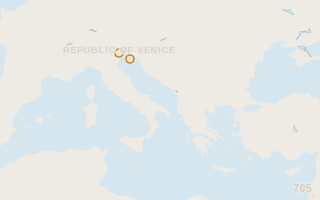
It was founded in 697, replacing Patria del Friuli and the Signoria of Verona.↓ In 705, the first year its borders are mapped, it covered 2,600 km².↓ Over the years of the Morean War, 1684 – 1699, its ground went from 43,900 km² to 64,700 km².↓

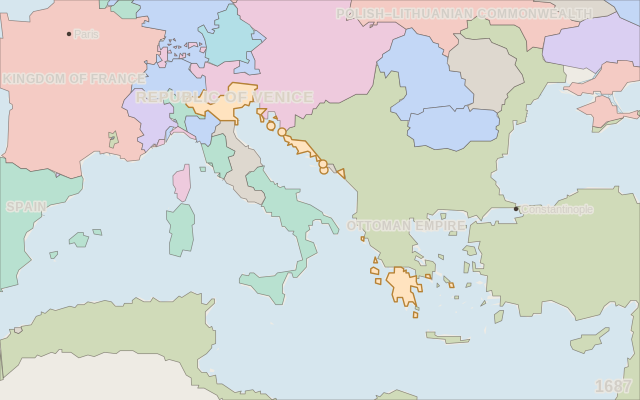
Its ground peaked in 1687 at 65,100 km².↓ Its highest office was held by 123 rulers, covering 717 – 1797, the median reign 7 years; 10 of 120 handovers were irregular.↓ Among them, Enrico Dandolo, Francesco Morosini and Pietro II Orseolo are the best known.↓ The atlas files 179 rows under it, most of them people.↓

It was replaced by the Cisalpine Republic, the Republic of Brescia and the Ottoman Empire in 1797, 1,100 years after it began.↓

From Wikipedia’s article, retold · CC BY-SA 4.0

1,100 years

Longer than the Holy Roman Empire, shorter than the Byzantine Empire

65,100 km²

At its height in 1687 · about the size of Lithuania

123 rulers

the Doge of Venice

30 wars and battles

More per century than 94% of states · 179 entries in all

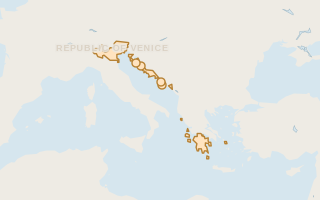
Map: Republic of Venice in 1687, its borders in gold among its neighbours
Ottoman–Venetian War (1570–1573), 1570 – 1573: 62,400 km² → 50,300 km²Cretan War (1645–1669), 1645 – 1669: 49,500 km² → 44,600 km²Morean War, 1684 – 1699: 43,900 km² → 64,700 km²Ottoman–Venetian War (1714–1718), 1714 – 1718: 64,700 km² → 45,100 km²8001000120014001600
Beside it on the map in 1687: Ottoman Empire, Kingdom of France, Habsburg monarchy, Spain, Polish–Lithuanian Commonwealth and Holy Roman Empire.How far it reached, year by year: its ground inside the borders Cliopatria draws (CC BY 4.0), measured on an equal-area grid; the map shows it at its largest, with the cities of the year.

The story

Five acts, 697 – 1797

Republic of Venice in 999, at the end of act I
I697 – 1000

A duchy in the lagoon

The lagoon islands form a Byzantine duchy under the Exarchate of Ravenna; its first doge, chosen by tradition in 697 CE, may be legendary. As the exarchate falls and Byzantine power weakens, the Duchy of Venice settles on Rialto, grows rich on trade with the east and fights for mastery of the Adriatic.

Watch this act on the live map, from 697
Republic of Venice in 1380, at the end of act II
II1000 – 13817,000 → 12,400 km²

Crusade and rivalry with Genoa

In 1000 Pietro II Orseolo brings the coast of Istria and Dalmatia under Venice. Its fleet aids Byzantium against the Normans, and in 1202–1204 Doge Enrico Dandolo turns the Fourth Crusade against Zara and then Constantinople. Over a century of war with Genoa follows, and at Chioggia, with the Genoese in the lagoon, Venice nearly collapses.

Watch this act on the live map, from 1000
Republic of Venice in 1508, at the end of act III
III1381 – 150912,400 → 63,800 km²

Mastery at sea and mainland

Venice recovers quickly and expands on the mainland. Victory over Genoa at Modon in 1403 secures the eastern trade routes, and Pietro Loredan routs the Turks off Gallipoli in 1416. Dalmatia from Istria to Albania is acquired, but a new Ottoman war from 1499 costs Lepanto, Durazzo, Modon and Coron.

Watch this act on the live map, from 1381
Republic of Venice in 1698, at the end of act IV
IV1509 – 169963,800 → 64,700 km²

Cambrai, Cyprus and Crete

At Agnadello in 1509 the League of Cambrai defeats Venice, though it keeps most of its mainland. Ottoman wars cost it Cyprus, after the siege of Famagusta, and most of Crete after the long siege of Candia. The lost spice trade and a fading textile industry drain its wealth, though the Morean War brings fresh gains.

Watch this act on the live map, from 1509
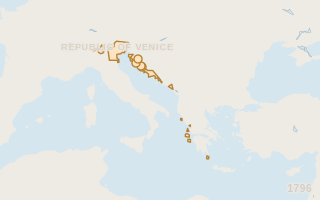
Republic of Venice in 1796, at the end of act V
V1699 – 179764,700 → 38,700 km²

Decline and fall

From December 1714 the Turks overrun the Morea, and the Treaty of Passarowitz of 1718 closes the long Ottoman wars. Venice's government still serves Enlightenment thinkers such as Rousseau as a model. In 1796 Napoleon's army chases the Austrians across neutral Venetian land, and by the next year the Republic is gone.

Watch this act on the live map, from 1699
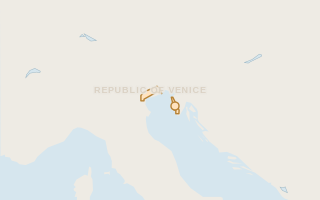
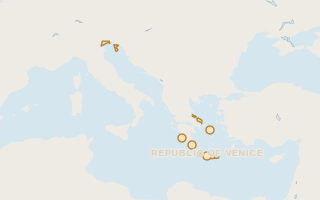
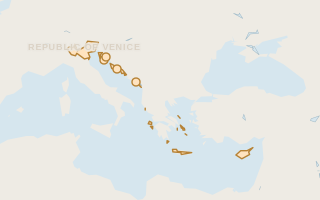
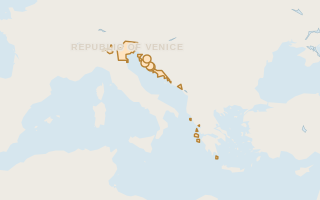
Republic of Venice in 1796, last mappedRepublic of Venice in 705, first mapped
The rise and the fall in one frame: drag across it from 705, first mapped at 2,600 km², to 1796, last mapped at 38,700 km². Open the live map in 705 or 1796.

Before and after

Before it

After it

Where it sits in time

3000 BCE2000 BCE1000 BCE110002000Patria del Friuli: 1077 – 1433Kingdom of Italy (Holy Roman Empire): 774 – 1806Austrian Empire: 1804 – 1867Cisalpine Republic: 1797 – 1802Republic of Brescia: 1797 – 1797Republic of Venice: 697 – 1797

Five thousand years, 3000 BCE to 2026; the state in gold, what it replaced or followed and what replaced or followed it in grey.

Its people

Lives across the Republic of Venice

1200140016001800
Statesmen and generalsScientists and explorersWriters, artists and thinkersLived on after it endedAll its people on the timeline →

How it was governed

123 doges

123 doges on record, 717 to 1797; a reign lasted 7 years at the median. Each bar is a reign, as long as it lasted.

8001000120014001600
a second row: a reign that began before the last had ended — rival claimants, or a shared throne
How their terms ended, where it is known (116 of 121):Killed 3Deposed or removed 8Died in office 95Left office alive 10Not on record 5
Every term, with how it ended and its source

Rulers

How 121 reigns ended - choose one to show only those among the 72 printed

How they died, where the record says: died of natural causes 6 · killed 2 · executed 2.

RulerReignLengthHow it ended · sourceTo the ruler before
8th century · 7 reigns · 1 killed or removed
Marcello Tegalliano · aged 17717 – 7269 yearsdied in officeread off the dates alone
Orso Ipato726 – 73711 yearskilled in officeWikidata's manner of death
Teodato Ipato742 – 75513 yearsleft office aliveread off the dates alonechild
Galla Gaulo · aged 5755 – 7561 yeardied in officeread off the dates alone
Domenico Monegario · aged 6756 – 7648 yearsending not on record
Maurizio Galbaio764 – 79733 yearsdied in officeread off the dates alone
Giovanni Galbaio797 – 8036 yearsleft office aliveread off the dates alonechild
9th century · 9 reigns · 1 killed or removed
Obelerio degli Antenori · aged 4804 – 8106 yearsleft office aliveread off the dates aloneexecuted
Agnello Participazio · aged 10810 – 82717 yearsdied in officeread off the dates alone
Giustiniano Participazio · aged 27827 – 8292 yearsdied in officeread off the dates alone
Giovanni I Participazio · aged 79829 – 8367 yearsdied in officeread off the dates alone
Pietro Tradonico · aged 86836 – 86428 yearskilled in officeWikidata's manner of death
Orso I Participazio864 – 88117 yearsdied in officeread off the dates alone
Giovanni II Participazio881 – 8876 yearsdied in officeread off the dates alone
Pietro I Candiano · aged 45887 – 8881 yeardates disagreeread off the dates alone
Pietro Tribuno887 – 91124 yearsdied in officeread off the dates alone
10th century · 9 reigns · 3 killed or removed
Orso II Participazio · aged 62912 – 93220 yearsabdicatedread from the ruler's own article
Pietro II Candiano · aged 60932 – 9397 yearsdied in officeread off the dates alone
Pietro Participazio · aged 39939 – 9423 yearsdied in officeread off the dates alone
Pietro III Candiano · aged 41942 – 95917 yearsdied in officeread off the dates alone
Pietro IV Candiano · aged 58959 – 97617 yearsdied in officeread off the dates alonechild
Pietro I Orseolo · aged 48976 – 9782 yearsabdicatedread from the ruler's own article
Vitale Candiano · aged 77978 – 9791 yearabdicatedread from the ruler's own article
Tribuno Memmo979 – 99112 yearsdied in officeread off the dates alone
Pietro II Orseolo · aged 30991 – 100918 yearsdied in officeread off the dates alone
11th century · 7 reigns · 2 killed or removed
Otto Orseolo · aged 161009 – 102617 yearsexiledread from the ruler's own articledied of natural causeschild
Pietro Barbolano · aged 761026 – 10326 yearsdeposedread from the ruler's own article
Domenico Flabanico · aged 821032 – 10419 yearsleft office aliveread off the dates alone
Domenico I Contarini · aged 931043 – 107128 yearsdied in officeread off the dates alone
Domenico Selvo1071 – 108413 yearsending not on record
Vitale Faliero1084 – 109511 yearsdied in officeread off the dates alone
Vitale I Michiel1096 – 11026 yearsdied in officeread off the dates alone
12th century · 4 reigns
Ordelafo Faliero · aged 321102 – 111715 yearsdied in officeread off the dates alone
Domenico Michiel · aged 671117 – 112912 yearsdied in officeread off the dates alone
Pietro Polani · aged 321130 – 114717 yearsleft office aliveread off the dates alonein-law
Domenico Morosini · aged 681148 – 11568 yearsdied in officeread off the dates alone
49 reigns between, from 1155 to 1577: the whole line in the atlas
48 of their holders have a page of their own

Vitale II Michiel 1155 · Sebastiano Ziani 1172 · Orio Mastropiero 1178 · Enrico Dandolo 1192 · Pietro Ziani 1205 · Jacopo Tiepolo 1229 · Marino Morosini 1249 · Reniero Zeno 1253 · Lorenzo Tiepolo 1268 · Jacopo Contarini 1275 · Giovanni Dandolo 1280 · Pietro Gradenigo 1289 · Marino Zorzi 1311 · Giovanni Soranzo 1312 · Francesco Dandolo 1329 · Bartolomeo Gradenigo 1339 · Andrea Dandolo 1343 · Marino Faliero 1354 · Giovanni Gradenigo 1355 · Giovanni Dolfin 1356 · Lorenzo Celsi 1361 · Marco Cornaro 1365 · Andrea Contarini 1368 · Michele Morosini 1382 · Antonio Venier 1382 · Michele Steno 1400 · Tommaso Mocenigo 1414 · Francesco Foscari 1423 · Pasquale Malipiero 1457 · Cristoforo Moro 1462 · Nicolò Tron 1471 · Nicolò Marcello 1473 · Pietro Mocenigo 1474 · Andrea Vendramin 1476 · Giovanni Mocenigo 1478 · Marco Barbarigo 1485 · Agostino Barbarigo 1486 · Leonardo Loredan 1501 · Antonio Grimani 1521 · Andrea Gritti 1523 · Pietro Lando 1538 · Francesco Donato 1545 · Marcantonio Trivisan 1553 · Francesco Venier 1554 · Lorenzo Priuli 1556 · Pietro Loredan 1567 · Alvise I Mocenigo 1570 · Sebastiano Venier 1577

16th century · 4 reigns
Nicolò da Ponte · aged 871578 – 15857 yearsdied in officeread off the dates alone
Pasquale Cicogna · aged 761585 – 159510 yearsdied in officeread off the dates alone
Morosina Morosini · aged 501595 – 160510 yearsleft office aliveread off the dates alone
Marino Grimani · aged 631595 – 160510 yearsdied in officeread off the dates alonespouse
17th century · 22 reigns
Leonardo Donato · aged 701606 – 16126 yearsdied in officeread off the dates alone
Marcantonio Memmo · aged 761612 – 16153 yearsdied in officeread off the dates alone
Giovanni Bembo · aged 721615 – 16183 yearsdied in officeread off the dates alone
Nicolò Donato · aged 791618 – 1618under a yeardied in officeread off the dates alone
Antonio Priuli · aged 701618 – 16235 yearsdied in officeread off the dates alone
Francesco Contarini · aged 571623 – 16241 yeardied in officeread off the dates alone
Giovanni I Cornaro · aged 741625 – 16294 yearsdied in officeread off the dates alone
Nicolò Contarini · aged 771630 – 16311 yeardied in officeread off the dates alone
Francesco Erizzo · aged 651631 – 164615 yearsdied in officeread off the dates alone
Francesco Molin · aged 711646 – 16559 yearsdied in officeread off the dates alone
Carlo Contarini · aged 751655 – 16561 yeardied in officeread off the dates alone
Francesco Cornaro · aged 711656 – 1656under a yeardied in officeread off the dates alone
Bertuccio Valier · aged 601656 – 16582 yearslost an electionread from the ruler's own article
Giovanni Pesaro · aged 691658 – 16591 yeardied in officeread off the dates alone
Domenico II Contarini · aged 741659 – 167516 yearsdied in officeread off the dates alone
Nicolò Sagredo · aged 691675 – 16761 yeardied in officeread off the dates alone
Giovanni Sagredo · aged 601676 – 1676under a yearleft office aliveread off the dates alonesibling
Alvise Contarini · aged 751676 – 16848 yearsdied in officeread off the dates alone
Marcantonio Giustinian · aged 651684 – 16884 yearsdied in officeread off the dates alone
Francesco Morosini · aged 691688 – 16946 yearsdied in officeread off the dates alone
Silvestro Valier · aged 641694 – 17006 yearsdied in officeread off the dates alone
Alvise II Mocenigo · aged 721700 – 17099 yearsdied in officeread off the dates alone
18th century · 10 reigns
Giovanni II Cornaro · aged 621709 – 172213 yearsdied in officeread off the dates alone
Alvise III Mocenigo · aged 601722 – 173210 yearsdied in officeread off the dates alone
Carlo Ruzzini · aged 791732 – 17353 yearsdied in officeread off the dates alone
Alvise Pisani · aged 711735 – 17416 yearsdied in officeread off the dates alone
Pietro Grimani · aged 641741 – 175211 yearsdied in officeread off the dates alone
Francesco Loredan · aged 671752 – 176210 yearsdied in officeread off the dates alone
Marco Foscarini · aged 661762 – 17631 yeardied in officeread off the dates alone
Alvise Giovanni Mocenigo · aged 621763 – 177815 yearsdied in officeread off the dates alone
Paolo Renier · aged 691779 – 178910 yearsdied in officeread off the dates alone
Ludovico Manin · aged 641789 – 17978 yearsleft office aliveread off the dates alonedied of natural causes

123 rulers, 121 with terms dated as terms, covering 717 – 1797. Median reign 7 years. 10 of 120 handovers irregular - a killing, a deposition, a rival claimant, a rising or a coup beside it. A blank in the last column means no kin on record, which is coverage, never “unrelated”.

The line also names one holder with a page of their own whose term the record gives no first year, so the table cannot place it: Paolo Lucio Anafesto.

Flags and arms, in order

  • Coat of Arms of the Republic of Venice
    coat of arms, undatedCoat of Arms of the Republic of Venice · CC BY-SA 3.0 · Sodacan
  • Flag of the Serene Republic of Venice
    flag, undatedFlag of the Serene Republic of Venice · CC BY-SA 3.0 · Samhanin
  • Flag of Most Serene Republic of Venice
    flag, undatedFlag of Most Serene Republic of Venice · Public domain
  • Coat of arms of Republic of Venice
    coat of arms, undatedCoat of arms of Republic of Venice · CC BY-SA 4.0 · Facquis
  • Greater coat of arms of the Republic of Venice, 1706
    coat of arms, undatedGreater coat of arms of the Republic of Venice, 1706 · CC BY-SA 4.0 · Constantine Plakidas
  • Flag of Republic of Venice (1659-1675)
    flag, from 1659Flag of Republic of Venice (1659-1675) · CC BY-SA 4.0 · Facquis i The source code of this SVG is invalid due to 268 errors. This W3C- invalid fla…

Its world

Rivals, and who else stood

Who it fought most

Wars and battles both took part in, on whichever side: the record names who took part, not who fought whom.

Meanwhile, elsewhere

The best-known states of other regions that stood while it did; the band is the Republic of Venice’s own years.

7501000125015001750

How it compares

Among 3,073 states

Stood longer than 98% of 3,073 states
Republic of Venice · 1,100 yearsHoly Roman EmpireByzantine EmpireHow long it stood, among the states with a recorded end or still standing.
Held more ground at its peak than 37% of 1,464 states
Republic of Venice · 65,100 km²LithuaniaLatviaThe most ground it held, among the states with a border in Cliopatria.
Had more wars on record per century than 94% of 3,073 states
Republic of Venice · 1.1Wars recorded per century, among the states, counting the wars the atlas hosts under each.

Why it fell

Why did the Republic of Venice fall?

Historians still argue. Here is what the atlas records about its last century:

10

wars and battles in its last century, more than in any before it

÷1.7

its land, between 1697 and 1796

What led to it, and what came of it

Croatian-Venetian Wars · Linked · 650 – 1358Croatian-Venetian WarsRepublic of Venice · 697 – 1797Republic of VeniceFirst French rule in the Ionian Islands · Linked · 1797 – 1799First French rule in the Ionian …Cisalpine Republic · Linked · 1797 – 1802Cisalpine RepublicRepublic of Bergamo · Linked · 1797Republic of BergamoRepublic of Brescia · Linked · 1797Republic of BresciaFrench occupation of the Republic of Venice · Linked · 1797 – 1798French occupation of the Republi…Austrian Empire · Linked · 1804 – 1867Austrian Empire10001500
linked

Open the investigation: every row with its evidence, the conditions at the time, the theories condition by condition, and the succession analysed.

Its centuries in the record

600 – 699: 0 recorded — 0 wars and battles, 0 risings, regime changes and massacres, 0 other600700 – 799: 8 recorded — 0 wars and battles, 0 risings, regime changes and massacres, 8 other700800 – 899: 9 recorded — 0 wars and battles, 0 risings, regime changes and massacres, 9 other800900 – 999: 13 recorded — 0 wars and battles, 0 risings, regime changes and massacres, 13 other9001000 – 1099: 5 recorded — 0 wars and battles, 0 risings, regime changes and massacres, 5 other10001100 – 1199: 9 recorded — 0 wars and battles, 0 risings, regime changes and massacres, 9 other11001200 – 1299: 20 recorded — 4 wars and battles, 0 risings, regime changes and massacres, 16 other12001300 – 1399: 18 recorded — 1 wars and battles, 1 risings, regime changes and massacres, 16 other13001400 – 1499: 25 recorded — 3 wars and battles, 0 risings, regime changes and massacres, 22 other14001500 – 1599: 29 recorded — 5 wars and battles, 0 risings, regime changes and massacres, 24 other15001600 – 1699: 22 recorded — 7 wars and battles, 0 risings, regime changes and massacres, 15 other16001700 – 1799: 20 recorded — 10 wars and battles, 0 risings, regime changes and massacres, 10 other1700

Wars and battles in red, risings, coups and massacres beside them, everything else in grey, by the century each began in. A tall bar is partly a fact about Wikipedia: better-documented centuries hold more.

Each century’s own page:600 – 699700 – 799800 – 899900 – 9991000 – 10991100 – 11991200 – 12991300 – 13991400 – 14991500 – 15991600 – 16991700 – 1799

Keep exploring

Share this page
Copy link
Embed the map
Cite this page

How this page is made

Drawn from Wikidata (Q4948, CC0), the opening and history of its English Wikipedia article retold by the atlas (CC BY-SA 4.0), borders from Cliopatria (CC BY 4.0), coast and rivers from Natural Earth, cities from Reba, Reitsma & Seto 2016 (CC BY 4.0), symbols from Wikimedia Commons, each under its own licence. Data built 2026-11-26 · Pastlas v2.47.1, by Oleh Voronko; the published atlas and its data are for non-commercial use.

How to read it

Areas are measured on an equal-area grid from borders simplified to about five kilometres. “c.” marks an approximate date, and a date known to the century is never printed to the year. Counts are what the atlas holds, and they follow Wikipedia’s coverage: a busy century is partly a fact about the record.

Something wrong?

Tell us and name the entry. We fix the data, not just this page.

Report a problem