State · Europe

Austrian Empire

1804 – 1867 · 63 years

Came after Holy Roman Empire and Republic of Venice · became Austria-Hungary and Kingdom of Italy

The Habsburg lands under one emperor: Napoleon's long foe, Metternich's bulwark against revolution, recast as Austria-Hungary after a lost war.

Francis II proclaimed the Austrian Empire in 1804, answering Napoleon's First French Empire by joining every Habsburg possession under a single government. It fought Napoleon through most of the Napoleonic Wars and came out of the Congress of Vienna a great power, the third most populous in Europe. The Kingdom of Hungary kept its own institutions. After losing the Austro-Prussian War in 1866, the empire joined with Hungary in 1867 to form Austria-Hungary.

What the record holds

The Austrian Empire began in 1804, replacing the Holy Roman Empire and Habsburg monarchy.↓ When the borders dataset first draws it, in 1806, it held 655,700 km².↓ The First Italian War of Independence, 1848 – 1849, began with it holding 625,800 km² and ended with 693,400 km².↓

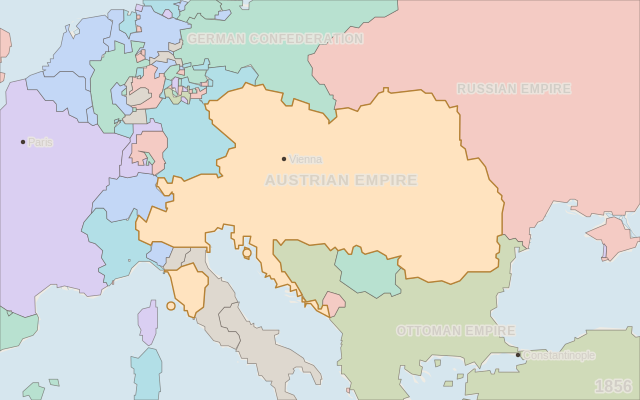
It reached its greatest extent in 1856: 808,800 km².↓ The record names 3 rulers in its line, covering 1804 – 1916, the median reign 31 years; 1 of 2 handovers was irregular.↓ The best known of them are Franz Joseph I, Francis II, Holy Roman Emperor and Ferdinand I of Austria.↓ Most of the 187 rows the atlas files under it are people.↓

It was replaced by Austria-Hungary and the Kingdom of Italy in 1867, 63 years after it began.↓

From Wikipedia’s article, retold · CC BY-SA 4.0

63 years

Longer than Hamburg, shorter than Bremen

809,000 km²

At its height in 1856 · about the size of Chile

3 rulers

the Emperor of Austria

27 wars and battles

More per century than 98% of states · 187 entries in all

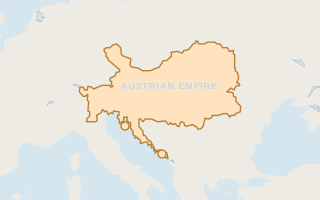
Map: Austrian Empire in 1856, its borders in gold among its neighbours
Congress of Vienna, 1814 – 1815First Italian War of Independence, 1848 – 1849: 625,800 km² → 693,400 km²Battle of Solferino, 1859Second Italian War of Independence, 185918201830184018501860
Beside it on the map in 1856: Russian Empire, Ottoman Empire, Second French Empire, German Confederation, Kingdom of Bavaria and Kingdom of Sardinia (1720–1861).How far it reached, year by year: its ground inside the borders Cliopatria draws (CC BY 4.0), measured on an equal-area grid; the map shows it at its largest, with the cities of the year.

The story

Four acts, 1804 – 1867

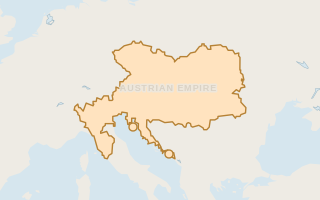
Austrian Empire in 1814, at the end of act I
I1804 – 1815

Proclaimed against Napoleon

Francis II proclaims the empire in 1804, and it stays within the Holy Roman Empire until that body is dissolved in 1806. Austria fights Napoleon through the Napoleonic Wars, save from 1809 to 1813, when it first sides with him in the invasion of Russia and then stands neutral. Victory with its allies leads to the Congress of Vienna.

Watch this act on the live map, from 1804
Austrian Empire in 1847, at the end of act II
II1815 – 1848690,000 → 692,000 km²

The age of Metternich

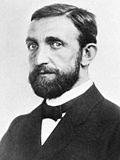
Klemens von Metternich, foreign minister since 1809 and chancellor of state from 1821, steers Habsburg foreign policy under Francis I and his son Ferdinand I and weighs heavily in Europe. A firm conservative, he sees liberalism as legalised revolution and absolute monarchy as the only proper government, and sets his policy against revolution and liberalism alike.

Watch this act on the live map, from 1815
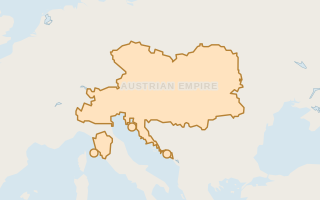
Austrian Empire in 1858, at the end of act III
III1848 – 1859626,000 → 693,000 km²

Revolution and neo-absolutism

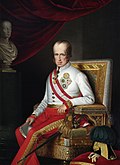
From March 1848 to November 1849 revolts, mostly nationalist, shake the empire. Most fail, yet serfdom and censorship are abolished and Ferdinand I promises a constitution; Franz Joseph I takes the throne in 1848. From 1852 Bach centralizes power and curbs the press, and the concordat of August 1855 gives the Catholic Church charge of schools and family life.

Watch this act on the live map, from 1848
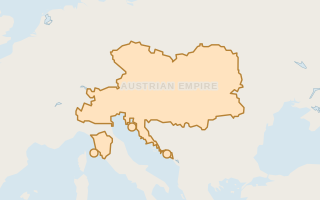
Austrian Empire in 1866, at the end of act IV
IV1859 – 1867650,000 → 587,000 km²

Defeat and the Compromise

The February Patent of 1861 creates a House of Lords and a House of Deputies, yet most nationalities stay discontented. Once the second war with Denmark ends in 1864, Holstein passes to Austrian administration, while the Hungarians press for autonomy and Venetia looks to Italy. Defeat in the Austro-Prussian War of 1866 brings the Compromise of 1867.

Watch this act on the live map, from 1859

Before and after

Before it

After it

Where it sits in time

3000 BCE2000 BCE1000 BCE110002000Holy Roman Empire: 962 – 1806Habsburg monarchy: 1526 – 1918Archduchy of Austria: 1358 – 1918Austria-Hungary: 1867 – 1918Kingdom of Italy: 1861 – 1946Austrian Empire: 1804 – 1867

Five thousand years, 3000 BCE to 2026; the state in gold, what it replaced or followed and what replaced or followed it in grey.

Its people

Lives across the Austrian Empire

18251850187519001925
Writers, artists and thinkersScientists and explorersStatesmen and generalsLived on after it endedAll its people on the timeline →

How it was governed

3 emperors

3 emperors on record, 1804 to 1916; a reign lasted 31 years at the median. Each bar is a reign, as long as it lasted.

Francis II, Holy Roman Emperor · 1804 – 1835 · died in office, manner not recordedFerdinand I of Austria · 1835 – 1848 · left office aliveFranz Joseph I · 1848 – 1916 · died in office of natural causes182018401860
How their terms ended, where it is known (3 of 3):Died in office 2Left office alive 1
Every term, with how it ended and its source

Rulers

How 3 reigns ended - choose one to show only those

How they died, where the record says: died of natural causes 1.

RulerReignLengthHow it ended · sourceTo the ruler before
19th century · 3 reigns
Francis II, Holy Roman Emperor · aged 361804 – 183531 yearsdied in officeread off the dates alone
Ferdinand I of Austria · aged 421835 – 184813 yearsleft office aliveread off the dates alonechild
Franz Joseph I · aged 181848 – 191668 yearsdied in officeWikidata's manner of deathdied of natural causesnephew or niece

3 rulers, 3 with terms dated as terms, covering 1804 – 1916. Median reign 31 years. 1 of 2 handovers irregular - a killing, a deposition, a rival claimant, a rising or a coup beside it. A blank in the last column means no kin on record, which is coverage, never “unrelated”.

Flags and arms, in order

  • Imperial Coat of Arms of the Empire of Austria (1815)
    coat of arms, undatedImperial Coat of Arms of the Empire of Austria (1815) · CC BY-SA 3.0 · Sodacan
  • Flag of the Habsburg Monarchy
    flag, undatedFlag of the Habsburg Monarchy · Public domain

Its world

Rivals, and who else stood

Who it fought most

Wars and battles both took part in, on whichever side: the record names who took part, not who fought whom.

Meanwhile, elsewhere

The best-known states of other regions that stood while it did; the band is the Austrian Empire’s own years.

1800182018401860

How it compares

Among 3,073 states

Stood longer than 37% of 3,073 states
Austrian Empire · 63 yearsHamburgBremenHow long it stood, among the states with a recorded end or still standing.
Held more ground at its peak than 82% of 1,464 states
Austrian Empire · 808,800 km²ChileNamibiaThe most ground it held, among the states with a border in Cliopatria.
Had more wars on record per century than 98% of 3,073 states
Austrian Empire · 3.0Wars recorded per century, among the states, counting the wars the atlas hosts under each.

Why it fell

Why did the Austrian Empire fall?

Historians still argue. Here is what the atlas records about its last century:

What led to it, and what came of it

Republic of Venice · Linked · 697 – 1797Republic of VeniceBattle of Karánsebes · Linked · 1788Battle of KaránsebesKingdom of Italy (Holy Roman Empire) · Linked · 774 – 1806Kingdom of Italy (Holy Roman Emp…Holy Roman Empire · Linked · 962 – 1806Holy Roman EmpireKingdom of Bohemia · Linked · 1198 – 1918Kingdom of BohemiaArchduchy of Austria · Linked · 1358 – 1918Archduchy of AustriaAustrian Empire · 1804 – 1867Austrian EmpireAustria-Hungary · Linked · 1867 – 1918Austria-HungaryKingdom of Italy · Linked · 1861 – 1946Kingdom of Italy10001500
linked

Open the investigation: every row with its evidence, the conditions at the time, the theories condition by condition, and the succession analysed.

In the record

187 entries the atlas files under it, all in 1800 – 1899.

Keep exploring

Share this page
Copy link
Embed the map
Cite this page

How this page is made

Drawn from Wikidata (Q131964, CC0), the opening and history of its English Wikipedia article retold by the atlas (CC BY-SA 4.0), borders from Cliopatria (CC BY 4.0), coast and rivers from Natural Earth, cities from Reba, Reitsma & Seto 2016 (CC BY 4.0), symbols from Wikimedia Commons, each under its own licence. Data built 2026-11-26 · Pastlas v2.47.1, by Oleh Voronko; the published atlas and its data are for non-commercial use.

How to read it

Areas are measured on an equal-area grid from borders simplified to about five kilometres. “c.” marks an approximate date, and a date known to the century is never printed to the year. Counts are what the atlas holds, and they follow Wikipedia’s coverage: a busy century is partly a fact about the record.

Something wrong?

Tell us and name the entry. We fix the data, not just this page.

Report a problem