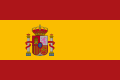
State · Europe

Spain

1516 – present · 510 years · still standing

Came after Spanish Empire and Kingdom of Aragon

The united crowns of Castile and Aragon: conquerors of an empire across the Atlantic, then Franco's dictatorship, then a democratic monarchy.

Spain grew from the union of the crowns of Castile and Aragon, joined by the marriage of Isabella I and Ferdinand II. In the Age of Discovery it led the conquest of the Americas and built one of history's largest empires. It later declined, lost most of its American colonies in the 19th century and fell into civil war in 1936. After Francisco Franco's dictatorship ended with his death in 1975, democracy returned under a parliamentary monarchy.

What the record holds

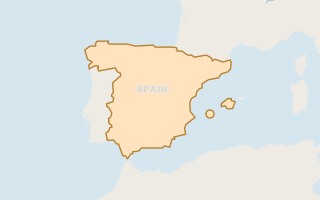
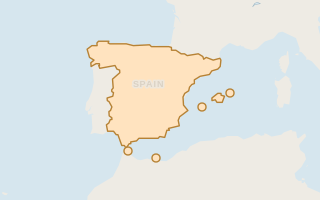
It was founded in 1516, replacing the Spanish Empire and the Kingdom of Aragon.↓ Its borders are first mapped in 1516, around 689,100 km².↓

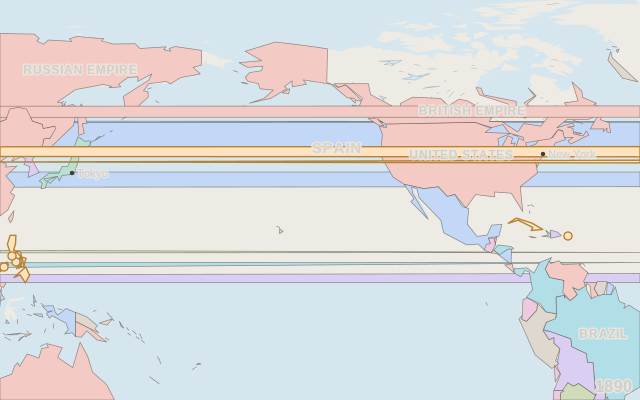
It reached its greatest extent in 1890: 1.30 million km².↓ Its line counts 17 rulers, covering 1714 – 2014, the median reign 12 years; 9 of 18 handovers were irregular.↓ Among them, Francisco Franco, Juan Carlos I and Felipe VI are the best known.↓ The atlas files 577 rows under it, wars and battles the largest group of them.↓

From Wikipedia’s article, retold · CC BY-SA 4.0

510 years

Longer than the Abbasid Caliphate, shorter than Macedonia

1.3 million km²

At its height in 1890 · about the size of Peru

17 rulers

the Monarch of Spain

275 wars and battles

More per century than 99% of states · 577 entries in all

Map: Spain in 1890, its borders in gold among its neighbours
Battle of Trafalgar, 1805Peninsular War, 1808 – 1814Spanish Civil War, 1936 – 19392004 Madrid train bombings, 200416001700180019002000
Beside it on the map in 1890: French Third Republic, United States, Russian Empire, British Empire, United Kingdom of Great Britain and Ireland and Brazil.How far it reached, year by year: its ground inside the borders Cliopatria draws (CC BY 4.0), measured on an equal-area grid; the map shows it at its largest, with the cities of the year.

The story

Five acts, 1516 – present

Spain in 1713, at the end of act I
I1516 – 1714689,000 → 494,000 km²

An empire across the oceans

Spain leads the conquest of the New World and the first voyage around the globe, building one of history's largest empires on precious metals. The Comuneros revolt in 1520 and Portugal's Restoration War begins in 1640. Decline ends in the War of the Spanish Succession, which costs Spain its European lands and installs the Bourbons.

Watch this act on the live map, from 1516
III1808 – 1936

Occupation, revolt and lost colonies

French troops occupy Spain's fortresses, the king abdicates and a puppet kingdom is installed. In 1808 come the Dos de Mayo Uprising and the Peninsular War, won by 1814. Liberals and absolutists fight through the century, Carlist Wars are fought from 1833, most American colonies are lost, and Cuba fights for independence from 1895. Alfonso XIII reigns until 1931.

Watch this act on the live map, from 1808
IV1936 – 1975

Civil war and dictatorship

A military coup in July 1936 splits Spain into two zones. The Republic draws help from the Soviet Union and Mexico, the rebels from Nazi Germany and Fascist Italy, while Britain leads the Western powers in non-intervention. Francisco Franco, the rebels' leader from October 1936, wins and rules as dictator from 1939 until his death in 1975.

Watch this act on the live map, from 1936
V1975 – present

Democracy restored

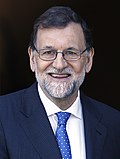
Juan Carlos succeeds Franco as king in 1975, and the Constitution of 1978 restores democracy and devolves power to autonomous communities. A coup attempt fails in 1981. Spain adopts the euro in 2002, suffers the Madrid train bombings of 2004, faces a Catalan declaration of independence in 2017, and sees Pedro Sánchez replace Mariano Rajoy in 2018.

Watch this act on the live map, from 1975
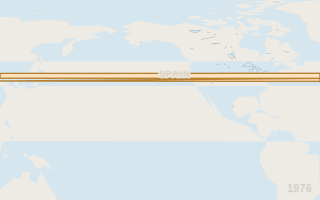
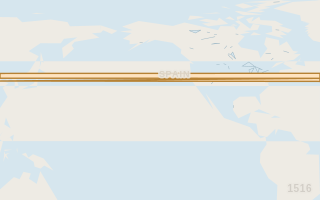
Spain in 1976, last mappedSpain in 1516, first mapped
The rise and the fall in one frame: drag across it from 1516, first mapped at 689,100 km², to 1976, last mapped at 506,000 km². Open the live map in 1516 or 1976.

Before and after

Before it

Where it sits in time

3000 BCE2000 BCE1000 BCE110002000Kingdom of Aragon: 1035 – 1707Crown of Aragon: 1162 – 1715First Spanish Republic: 1873 – 1874Spain: 1516 – 2026

Five thousand years, 3000 BCE to 2026; the state in gold, what it replaced or followed and what replaced or followed it in grey.

Its people

Lives across Spain

16001700180019002000
Writers, artists and thinkersStatesmen and generalsAll its people on the timeline →

How it was governed

17 monarchs

17 monarchs on record, 1714 to 2014; a reign lasted 12 years at the median. Each bar is a reign, as long as it lasted.

Philip V of Spain · 1714 – 1724 · died a natural deathLouis I of Spain · 1724 – 1724 · died a natural deathPhilip V of Spain · 1724 – 1746 · died a natural deathFerdinand VI · 1746 – 1759 · died a natural deathCharles III of Spain · 1759 – 1788 · died a natural deathCharles IV of Spain · 1788 – 1808 · abdicatedFerdinand VII · 1808 – 1808 · abdicatedJoseph Bonaparte · 1808 – 1813 · ended by a named eventFerdinand VII · 1814 – 1833 · died in office, manner not recordedIsabella II · 1833 – 1868 · ended by a named eventAmadeo I of Spain · 1870 – 1873 · abdicatedAlfonso XII · 1874 – 1885 · died in office of natural causesAlfonso XIII · 1886 – 1931 · ended by a named eventNiceto Alcalá-Zamora · 1931 – 1936 · left office aliveDiego Martínez Barrio · 1936 – 1936 · no death date to read the end againstManuel Azaña · 1936 – 1939 · resigned or stood down, the article saysFrancisco Franco · 1936 – 1975 · died in office of natural causesJuan Carlos I · 1975 – 2014 · abdicatedFelipe VI · 2014 – … · still in office16001700180019002000
a second row: a reign that began before the last had ended — rival claimants, or a shared throne
How their terms ended, where it is known (18 of 19):Deposed or removed 4Died in office 8Left office alive 5In office 1Not on record 1
Every term, with how it ended and its source

Rulers

3 terms are shared from Second Spanish Republic.

How 19 reigns ended - choose one to show only those

How they died, where the record says: died of natural causes 8.

RulerReignLengthHow it ended · sourceTo the ruler before
18th century · 6 reigns · 1 killed or removed
Philip V of Spain · aged 311714 – 172410 yearsnatural deathcoded by Kokkonen & Sundelldied of natural causes
Louis I of Spain · aged 171724 – 1724under a yearnatural deathcoded by Kokkonen & Sundelldied of natural causeschild
Philip V of Spain · aged 411724 – 174622 yearsnatural deathcoded by Kokkonen & Sundelldied of natural causesparent
Ferdinand VI · aged 331746 – 175913 yearsnatural deathcoded by Kokkonen & Sundellchild
Charles III of Spain · aged 431759 – 178829 yearsnatural deathcoded by Kokkonen & Sundellsibling
Charles IV of Spain · aged 401788 – 180820 yearsabdicatedWikidata's end cause on the termchild
19th century · 7 reigns · 2 killed or removed
Ferdinand VII · aged 241808 – 1808under a yearabdicatedWikidata's end cause on the termchild
Joseph Bonaparte · aged 401808 – 18135 yearsended by an eventWikidata's end cause on the term
Ferdinand VII · aged 301814 – 183319 yearsdied in officeread off the dates alone
Isabella II · aged 31833 – 186835 yearsended by an eventWikidata's end cause on the termdied of natural causeschild
Amadeo I of Spain · aged 251870 – 18733 yearsabdicatedWikidata's end cause on the termdied of natural causes
Alfonso XII · aged 171874 – 188511 yearsdied in officeWikidata's manner of deathdied of natural causes
Alfonso XIII1886 – 193145 yearsended by an eventWikidata's end cause on the termdied of natural causeschild
20th century · 5 reigns · 1 killed or removed
Niceto Alcalá-Zamora · from the line of Second Spanish Republic · aged 541931 – 19365 yearsleft office aliveread off the dates alone
Diego Martínez Barrio · from the line of Second Spanish Republic1936 – 1936under a yearending not on record
Manuel Azaña · from the line of Second Spanish Republic · aged 561936 – 19393 yearsresignedread from the ruler's own article
Francisco Franco · aged 441936 – 197539 yearsdied in officeWikidata's manner of deathdied of natural causes
Juan Carlos I · aged 371975 – 201439 yearsabdicatedWikidata's end cause on the term
21st century · 1 reign
Felipe VI · aged 462014 – in officein office since 2014still in officechild

17 rulers, 17 with terms dated as terms, covering 1714 – 2014. Median reign 12 years. 9 of 18 handovers irregular - a killing, a deposition, a rival claimant, a rising or a coup beside it. A blank in the last column means no kin on record, which is coverage, never “unrelated”.

Heads of government

The line of Prime Minister of Spain, drawn and never measured: a cabinet is not a reign.

Joaquín Jovellar y Soler1875 – 1875
José Sánchez-Guerra y Martínez1922 – 1922
Joaquín Chapaprieta1935 – 1935
Santiago Casares Quiroga1936 – 1936
Luis Carrero Blanco1973 – 1973
Carlos Arias Navarro1973 – 1976
Torcuato Fernández-Miranda1973 – 1973
Adolfo Suárez1976 – 1981
Fernando de Santiago1976 – 1976
Leopoldo Calvo-Sotelo1981 – 1982
Felipe González1982 – 1996
José María Aznar1996 – 2004
José Luis Rodríguez Zapatero2004 – 2011
Mariano Rajoy2011 – 2015
Mariano Rajoy2015 – 2016
Pedro Sánchez2018 – 2019
Pedro Sánchez2020 – 2023
Pedro Sánchez2023 – …

Flags and arms, in order

  • Escudo de España (mazonado)
    coat of arms, undatedEscudo de España (mazonado) · Public domain
  • Flag of Spain (1873–1874)
    flag, undatedFlag of Spain (1873–1874) · CC BY-SA 2.5 · Ignacio Gavira (original image), B1mbo (modifications)
  • Flag of Spain (1701–1760)
    flag, 1701 – 1760Flag of Spain (1701–1760) · CC BY-SA 4.0 · Durero
  • Flag of Spain (1760–1785)
    flag, 1760 – 1843Flag of Spain (1760–1785) · CC BY-SA 4.0 · Durero
  • Flag of Spain (1785–1873, 1875–1931)
    flag, 1843 – 1873Flag of Spain (1785–1873, 1875–1931) · CC BY-SA 3.0 · previous version User:Ignaciogavira ; current version HansenBCN , designs from SanchoPanz…
  • Flag of Spain (1785–1873, 1875–1931)
    flag, 1874 – 1931Flag of Spain (1785–1873, 1875–1931) · CC BY-SA 3.0 · previous version User:Ignaciogavira ; current version HansenBCN , designs from SanchoPanz…
  • Flag of the Second Spanish Republic
    flag, 1931 – 1939Flag of the Second Spanish Republic · Public domain
  • Flag of Spain (1938–1945)
    flag, 1939 – 1945Flag of Spain (1938–1945) · CC BY-SA 4.0 · SanchoPanzaXXI
  • Flag of Spain (1945–1977)
    flag, 1945 – 1977Flag of Spain (1945–1977) · CC BY-SA 4.0 · SanchoPanzaXXI
  • Flag of Spain (1977–1981)
    flag, 1977 – 1981Flag of Spain (1977–1981) · CC BY-SA 4.0 · Miguillen
  • Escudo de España (1977-1981)
    coat of arms, 1977 – 1981Escudo de España (1977-1981) · CC BY-SA 4.0 · Miguillen
  • Flag of Spain
    flag, from 1981Flag of Spain · Public domain

1 more in the atlas.

Its world

Rivals, and who else stood

Who it fought most

Wars and battles both took part in, on whichever side: the record names who took part, not who fought whom.

Meanwhile, elsewhere

The best-known states of other regions that stood while it did; the band is Spain’s own years.

150016001700180019002000

How it compares

Among 3,073 states

Stood longer than 87% of 3,073 states
Spain · 510 yearsAbbasid CaliphateMacedoniaHow long it stood, among the states with a recorded end or still standing.
Held more ground at its peak than 87% of 1,464 states
Spain · 1,295,900 km²ChadPeruThe most ground it held, among the states with a border in Cliopatria.
Had more wars on record per century than 99% of 3,073 states
Spain · 4.7Wars recorded per century, among the states, counting the wars the atlas hosts under each.

How it began

How did Spain begin?

What led to it, and what came of it

Reconquista · Linked · 722 – 1492Reconquistafirst arrival of Christopher Columbus to America · Linked · 1492first arrival of Christopher Col…Kingdom of Aragon · Linked · 1035 – 1707Kingdom of AragonCrown of Aragon · Linked · 1162 – 1715Crown of AragonHispanic Monarchy · Linked · 1479 – 1700Hispanic MonarchySpanish Empire · Linked · 1492 – 1899Spanish EmpireSpain · 1516 – 2026Spain100015002000
linked

Open the investigation: every row with its evidence, the conditions at the time, the theories condition by condition, and the succession analysed.

Its centuries in the record

1500 – 1599: 57 recorded — 21 wars and battles, 3 risings, regime changes and massacres, 33 other15001600 – 1699: 59 recorded — 40 wars and battles, 3 risings, regime changes and massacres, 16 other16001700 – 1799: 133 recorded — 69 wars and battles, 2 risings, regime changes and massacres, 62 other17001800 – 1899: 180 recorded — 76 wars and battles, 9 risings, regime changes and massacres, 95 other18001900 – 1999: 137 recorded — 67 wars and battles, 16 risings, regime changes and massacres, 54 other19002000 – 2099: 10 recorded — 2 wars and battles, 4 risings, regime changes and massacres, 4 other2000

Wars and battles in red, risings, coups and massacres beside them, everything else in grey, by the century each began in. A tall bar is partly a fact about Wikipedia: better-documented centuries hold more.

Each century’s own page:1500 – 15991600 – 16991700 – 17991800 – 18991900 – 19992000 – 2099

Keep exploring

Share this page
Copy link
Embed the map
Cite this page

How this page is made

Drawn from Wikidata (Q29, CC0), the opening and history of its English Wikipedia article retold by the atlas (CC BY-SA 4.0), borders from Cliopatria (CC BY 4.0), coast and rivers from Natural Earth, cities from Reba, Reitsma & Seto 2016 (CC BY 4.0), symbols from Wikimedia Commons, each under its own licence. Data built 2026-11-26 · Pastlas v2.47.1, by Oleh Voronko; the published atlas and its data are for non-commercial use.

How to read it

Areas are measured on an equal-area grid from borders simplified to about five kilometres. “c.” marks an approximate date, and a date known to the century is never printed to the year. Counts are what the atlas holds, and they follow Wikipedia’s coverage: a busy century is partly a fact about the record.

  • Still standing: the span runs to the year of the build, 2026.

Something wrong?

Tell us and name the entry. We fix the data, not just this page.

Report a problem