State · 962 – 1806
Holy Roman Empire
A state of 962 – 1806 — 844 years in Europe. It replaced East Francia and Kingdom of Germany and followed Middle Francia. It was replaced by Austrian Empire, Kingdom of Prussia and Confederation of the Rhine and followed by Hamburg, Kingdom of Saxony and Kingdom of Württemberg and 11 more. The atlas records 309 things within it — wars and battles 108 · unrest and atrocity 7 · natural disasters 5 · treaties 23 · people 161 · works and ideas 3 · trade and piracy 2. Its line of rulers holds 36 people, 34 with dated terms. Its own article says it was dissolved.
For the full story, the article on Wikipedia (CC BY-SA 4.0); this page holds what the record says of the state.
- Stood
- 844 years
- 962 – 1806
- Rulers
- 36
- the Holy Roman Emperor
- Most ground
- 910,800 km²
- in 1169
- Within it
- 309
- recorded rows
- Symbols
- 6
- on record, with years
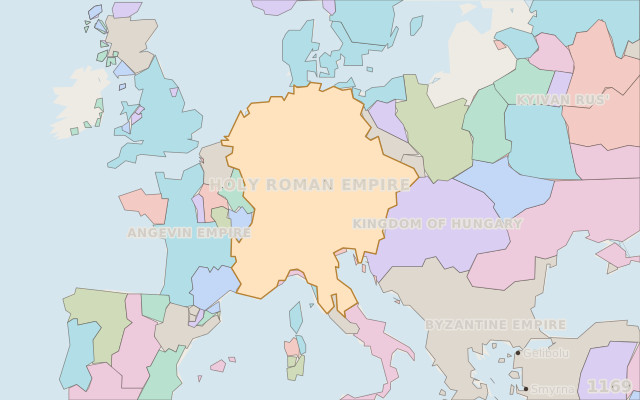
1169 · at its largest · 910,800 km²
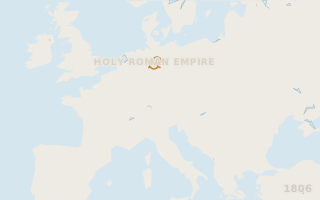
1806 · last mapped · 4,200 km²
Where it sits in time
Five thousand years, 3000 BCE to 2026; the state in gold, what it replaced or followed and what replaced or followed it in grey.
Before and after
The states the record files it as replacing or following, and those that replaced or followed it - Wikidata's own statements, each read from this state's side.
Before it
- East Francia · replaces · 843 – 962
- Kingdom of Germany · replaces · 843
- Middle Francia · follows · 843 – 855
After it
- Austrian Empire · replaced by · 1804 – 1867
- Confederation of the Rhine · replaced by · 1806 – 1813
- Kingdom of Prussia · replaced by · 1701 – 1918
- Hamburg · followed by · 1814 – 1870
- Duchy of Mecklenburg-Schwerin · followed by · 1701 – 1815
- Kingdom of Saxony · followed by · 1806 – 1918
- Kingdom of Württemberg · followed by · 1806 – 1918
- Principality of Waldeck and Pyrmont · followed by · 1180 – 1918
- Grand Duchy of Baden · followed by · 1806 – 1918
- Duchy of Saxe-Weimar · followed by · 1572 – 1809
- Principality of Nassau-Orange-Fulda · followed by · 1803 – 1806
- Electorate of Hesse · followed by · 1814 – 1866
- Principality of Reuss-Greiz · followed by
- Duchy of Saxe-Gotha-Altenburg · followed by · 1680 – 1826
- Swedish Pomerania · followed by · 1648 – 1815
- Duchy of Oldenburg · followed by · 1774 – 1918
- Duchy of Holstein · followed by · 1474 – 1867
How it ended, as its article says
Dissolved, 1806-08-06. Read from the article's section “History - French Revolutionary Wars and final dissolution” by its grammar; the claim is only that the article says so.
The empire was dissolved on 6 August 1806, when the last Holy Roman Emperor Francis II (from 1804, Emperor Francis I of Austria) abdicated, following a military defeat by the French under Napoleon at the Battle of Austerlitz in 1805 (see Treaty of Pressburg).
One sentence of the English Wikipedia article, CC BY-SA 4.0.
Rulers
The line of Holy Roman Emperor - the office this state names as its head of state.
| Ruler | Reign | Length | How it ended · source | To the ruler before |
|---|---|---|---|---|
| Otto the Great | 962 – 973 | 11 years | died in office, manner not recordedread off the dates alone | |
| Otto II | 973 – 983 | 10 years | died in office of natural causesWikidata's manner of death | child |
| Otto III | 996 – 1002 | 6 years | died a natural deathcoded by Kokkonen & Sundell | child |
| Henry II, Holy Roman Emperor | 1014 – 1024 | 10 years | died a natural deathcoded by Kokkonen & Sundell | |
| Conrad II | 1027 – 1039 | 12 years | died a natural deathcoded by Kokkonen & Sundell | |
| Henry III | 1046 – 1056 | 10 years | died a natural deathcoded by Kokkonen & Sundell | child |
| Henry IV | 1084 – 1106 | 22 years | deposed or killedcoded by Kokkonen & Sundell | child |
| Henry V | 1111 – 1125 | 14 years | died a natural deathcoded by Kokkonen & Sundell | child |
| Lothair III | 1133 – 1137 | 4 years | died a natural deathcoded by Kokkonen & Sundell | |
| Frederick Barbarossa | 1155 – 1190 | 35 years | ended otherwise, as coded — neither deposed nor a natural deathcoded by Kokkonen & Sundell | |
| Henry VI | 1191 – 1197 | 6 years | died a natural deathcoded by Kokkonen & Sundell | child |
| Otto IV, Holy Roman Emperor | 1209 – 1218 | 9 years | deposed or killedcoded by Kokkonen & Sundell | |
| Frederick II, Holy Roman Emperor | 1220 – 1250 | 30 years | died a natural deathcoded by Kokkonen & Sundell | |
| Henry VII, Holy Roman Emperor | 1312 – 1313 | 1 year | ended otherwise, as coded — neither deposed nor a natural deathcoded by Kokkonen & Sundell | |
| Louis IV, Holy Roman Emperor | 1328 – 1347 | 19 years | died a natural deathcoded by Kokkonen & Sundell | |
| Charles IV | 1355 – 1378 | 23 years | died a natural deathcoded by Kokkonen & Sundell | |
| Sigismund | 1433 – 1437 | 4 years | died in office, manner not recordedread off the dates alone | child |
| Frederick III, Holy Roman Emperor | 1452 – 1493 | 41 years | died in office, manner not recordedread off the dates alone | |
| Maximilian I | 1508 – 1519 | 11 years | died in office, manner not recordedread off the dates alone | child |
| Charles V | 1519 – 1556 | 37 years | left office aliveread off the dates alone | grandchild |
| Ferdinand I, Holy Roman Emperor | 1556 – 1564 | 8 years | died in office, manner not recordedread off the dates alone | sibling |
| Maximilian II, Holy Roman Emperor | 1564 – 1576 | 12 years | died in office, manner not recordedread off the dates alone | child |
| Rudolf II, Holy Roman Emperor | 1576 – 1612 | 36 years | died in office, manner not recordedread off the dates alone | child |
| Matthias, Holy Roman Emperor | 1612 – 1619 | 7 years | died in office, manner not recordedread off the dates alone | sibling |
| Ferdinand II, Holy Roman Emperor | 1619 – 1637 | 18 years | died in office, manner not recordedread off the dates alone | |
| Ferdinand III, Holy Roman Emperor | 1637 – 1657 | 20 years | died in office, manner not recordedread off the dates alone | child |
| Leopold I, Holy Roman Emperor | 1658 – 1705 | 47 years | died in office, manner not recordedread off the dates alone | child |
| Joseph I, Holy Roman Emperor | 1705 – 1711 | 6 years | died in office of natural causesWikidata's manner of death | child |
| Charles VI, Holy Roman Emperor | 1711 – 1740 | 29 years | died by accidentWikidata's manner of death | sibling |
| Charles VII, Holy Roman Emperor | 1742 – 1745 | 3 years | died in office of natural causesWikidata's manner of death | |
| Francis I, Holy Roman Emperor | 1745 – 1765 | 20 years | died by accidentWikidata's manner of death | |
| Joseph II, Holy Roman Emperor | 1765 – 1790 | 25 years | died in office, manner not recordedread off the dates alone | child |
| Leopold II, Holy Roman Emperor | 1790 – 1792 | 2 years | died in office of natural causesWikidata's manner of death | sibling |
| Francis II, Holy Roman Emperor | 1792 – 1806 | 14 years | resignedWikidata's end cause on the term | child |
36 rulers, 34 with terms dated as terms, covering 962 – 1806. Median reign 12 years. 5 of 33 handovers irregular - a killing, a deposition, a rival claimant, a rising or a coup beside it. A blank in the last column means no kin on record, which is coverage, never “unrelated”.
Ground held, by year
km² inside its borders as the borders dataset draws them, measured on an equal-area grid; a step series, held between the years the dataset maps.
722,200 km² in 987, 4,200 km² in 1806; at its largest 891,700 km² in 1062. Cliopatria, CC BY 4.0.
Flags and arms, in order
Each symbol with the years its own statement gives; the timeline flies the one of the year on screen.
.svg/120px-Heiliges_R%C3%B6misches_Reich_-_Reichssturmfahne_vor_1433_(Nimbierter_Adler).svg.png)
flag, undatedHeiliges Römisches Reich - Reichssturmfahne vor 1433 (Nimbierter Adler) · Attribution · Drawing created by David Liuzzo 
coat of arms, undatedHoly Roman Empire Arms-double head · CC BY-SA 3.0 · Ipankonin 
flag, undatedKönigsbanner 14Jh · CC BY-SA 4.0 · Own work , Ronald Preuss (eagle) .svg/120px-Banner_of_the_Holy_Roman_Emperor_with_haloes_(1430-1806).svg.png)
flag, undatedBanner of the Holy Roman Emperor with haloes (1430-1806) · CC BY-SA 3.0 · David Liuzzo , eagle by N3MO .svg/120px-Coat_of_arms_of_the_Holy_Roman_Empire_(1200_-_1400).svg.png)
coat of arms, undatedCoat of arms of the Holy Roman Empire (1200 - 1400) · CC BY-SA 4.0 · FDRMRZUSA .svg/120px-Coat_of_Arms_of_the_Holy_Roman_Emperor_(c.1433-c.1450).svg.png)
coat of arms, undatedCoat of Arms of the Holy Roman Emperor (c.1433-c.1450) · CC BY-SA 3.0 · Tom Lemmens & Heralder
What happened within it, by century
Every row the atlas hosts under this state, by the century it began in: wars and battles in red, risings, regime changes and massacres beside them, everything else in grey. A tall bar is a century the record is full for, which is partly a fact about Wikipedia.
900 – 9996 rows · 1 wars and battles
- Otto the Great · ruler · 912 – 973
- Otto II · ruler · 955 – 983
- Otto III · ruler · 980 – 1002
- Conrad II · ruler · 990 – 1039
- Thietmar of Merseburg · religious leader · 975 – 1019
- Slavic revolt of 983 · battle · 983
1000 – 109920 rows · 7 wars and battles · 1 risings, regime changes and massacres
- Hildegard of Bingen · scientist · 1098 – 1179
- Pope Gregory VII · politician · 1020 – 1085
- Pope Leo IX · writer · 1002 – 1054
- Pope Alexander II · writer · 1010 – 1073
- Godfrey of Bouillon · ruler · 1060 – 1100
- Henry IV · ruler · 1050 – 1106
- Henry V · ruler · 1086 – 1125
- Conrad III of Germany · ruler · 1093 – 1152
and 12 more in the atlas.
1100 – 119923 rows · 5 wars and battles
- Francis of Assisi · philosopher · 1182 – 1226
- Frederick Barbarossa · ruler · 1122 – 1190
- Pope Alexander III · writer · 1100 – 1181
- Henry VI · ruler · 1165 – 1197
- Otto IV, Holy Roman Emperor · ruler · 1175 – 1218
- Giovanni da Pian del Carpine · explorer · 1182 – 1252
- Philip of Swabia · religious leader · 1177 – 1208
- Otto of Freising · religious leader · 1111 – 1158
and 15 more in the atlas.
1200 – 129920 rows · 11 wars and battles · 1 risings, regime changes and massacres
- Albertus Magnus · religious leader · 1200 – 1280
- Rudolf I of Germany · person · 1218 – 1291
- Louis IV, Holy Roman Emperor · ruler · 1286 – 1347
- Albert I of Germany · ruler · 1255 – 1308
- Albert II of Austria · religious leader · 1298 – 1358
- Frederick II of Austria · person · 1211 – 1246
- John I of Brabant · artist · 1252 – 1294
- Rudolf I of Bavaria · person · 1274 – 1319
and 12 more in the atlas.
1300 – 139926 rows · 8 wars and battles · 2 risings, regime changes and massacres
- Jan van Eyck · artist · 1390 – 1441
- Catherine of Siena · philosopher · 1347 – 1380
- Charles IV · ruler · 1316 – 1378
- The Decameron · literature · 1353
- Sigismund · ruler · 1368 – 1437
- Leopold III, Duke of Austria · person · 1351 – 1386
- Ernest, Duke of Austria · politician · 1377 – 1424
- Albert III of Austria · person · 1349 – 1395
and 18 more in the atlas.
1400 – 149930 rows · 6 wars and battles
- Martin Luther · philosopher · 1483 – 1546
- Raphael · artist · 1483 – 1520
- Johannes Gutenberg · inventor · 1400 – 1468
- Ludovico Ariosto · writer · 1474 – 1533
- Pope Pius II · politician · 1405 – 1464
- Pope Adrian VI · philosopher · 1459 – 1523
- Nicholas of Cusa · scientist · 1401 – 1464
- Maximilian I · ruler · 1459 – 1519
and 22 more in the atlas.
1500 – 159952 rows · 10 wars and battles · 1 risings, regime changes and massacres
- Johannes Kepler · inventor · 1572 – 1630
- Peter Paul Rubens · artist · 1577 – 1640
- Charles V · ruler · 1500 – 1558
- William the Silent · commander · 1533 – 1584
- Ferdinand I, Holy Roman Emperor · ruler · 1503 – 1564
- Rudolf II, Holy Roman Emperor · ruler · 1552 – 1612
- Ferdinand II, Holy Roman Emperor · ruler · 1578 – 1637
- Maximilian II, Holy Roman Emperor · ruler · 1527 – 1576
and 44 more in the atlas.
1600 – 169956 rows · 28 wars and battles · 1 risings, regime changes and massacres
- Johann Sebastian Bach · artist · 1685 – 1750
- George Frideric Handel · artist · 1685 – 1759
- Thirty Years' War · war · 1618 – 1648
- Peace of Westphalia · treaty · 1648
- Leopold I, Holy Roman Emperor · ruler · 1640 – 1705
- Ferdinand III, Holy Roman Emperor · ruler · 1608 – 1657
- Joseph I, Holy Roman Emperor · ruler · 1678 – 1711
- Charles VII, Holy Roman Emperor · ruler · 1697 – 1745
and 48 more in the atlas.
1700 – 179972 rows · 29 wars and battles · 1 risings, regime changes and massacres
- Johann Wolfgang von Goethe · politician · 1749 – 1832
- Ludwig van Beethoven · artist · 1770 – 1827
- Carl Friedrich Gauss · scientist · 1777 – 1855
- Georg Wilhelm Friedrich Hegel · philosopher · 1770 – 1831
- Joseph Haydn · artist · 1732 – 1809
- Zirconium · discovery · 1789
- Alessandro Manzoni · politician · 1785 – 1873
- Georg Ohm · scientist · 1789 – 1854
and 64 more in the atlas.
1800 – 18994 rows · 3 wars and battles
- Justus von Liebig · inventor · 1803 – 1873
- War of the Third Coalition · war · 1805 – 1806
- Ulm campaign · battle · 1805
- Battle of Messkirch · battle · 1800
Among all states
Each measure against the states that carry it, never against all of them: a bar is the share of those states below this one.
- How long it stood844 years
stood longer than 96% of 3,187 states with a recorded end or still standing.
- The most ground it held910,800 km²
held more ground at its peak than 83% of 1,465 states with a border in Cliopatria.
- Wars recorded per century2.1
had more wars on record per century than 98% of 3,187 states, counting the wars the atlas hosts under each.
- How long a reign lasted, at the median12 years
had longer reigns, at the median, than 41% of 967 states whose dated line can carry a median.
- Rulers on record36
has more rulers on record than 96% of 1,968 states with a line of rulers.
What led to it, and what came of it
The investigation's own picture: 19 causes the record names and 19 results, the strongest six of each at their own years, joined to the state by the kind of claim - a recorded statement solid, the article's sentence dashed, a theory dash-dot.
Open the investigation: every row with its evidence, the conditions at the time, the theories condition by condition, and the succession analysed.
Theories that apply to its ending
Of 3 theories of why states fall, 1 has every condition present at this ending and 1 some of them; each is applied by its own logic, condition by condition, and whether its authors named this case is a footnote.
Challenge, failed response and dissolution
Toynbee 1934 · Toynbee & Somervell 1946
Applies by its own logic: 2 of its 2 conditions held here (it needs all of them), and this is the kind of outcome it predicts — the state's ending.
- territory shrank by 25% over the 100 y ending 25 y before — territory -27
- unrest, adverse regime change or atrocity within 100 y in the state, or a war the state is fighting, still under way, or a war the state fought, ended within 50 y, or battle within 50 y in the state — prior; warOngoing; warEnded; prior
Open in the atlas
- On the timeline, 878 – 1890, with everything that stood beside it.
- On the map in 1169, live: scrub the year and watch its borders move.
- Investigate it: what led to it, what came of it, and its succession analysed.
Wikidata Q12548 (CC0) · borders Cliopatria, CC BY 4.0 · coast and rivers Natural Earth · symbols from Wikimedia Commons, each credited above · one sentence of the English Wikipedia article, CC BY-SA 4.0 · data built 2026-10-06 · Pastlas v2.9.1, by Oleh Voronko. The published atlas and its data are for non-commercial use.