State · South Asia

Mughal Empire

1526 – 1857 · 331 years

Came after Delhi Sultanate and Deccan sultanates · became British Raj and Maratha Empire

An early modern empire of South Asia, founded by Babur, enriched by Akbar's taxes and remembered for the Taj Mahal.

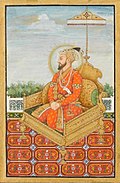
In 1526 Babur, a ruler from what is now Uzbekistan, beat Ibrahim Lodi, Sultan of Delhi, at the First Battle of Panipat and founded the Mughal Empire. At its height it reached from the Indus River Basin and Kashmir to Assam, Bangladesh and the Deccan Plateau. Akbar's farm taxes, paid in silver, carried its wealth, and its court patronised painting, letters and architecture, above all under Shah Jahan. After Aurangzeb it shrank fast.

What the record holds

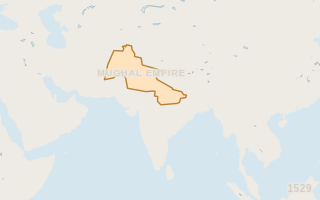
The Mughal Empire began in 1526, after the Delhi Sultanate and Deccan sultanates.↓ Its borders are first mapped in 1529, around 1.20 million km².↓

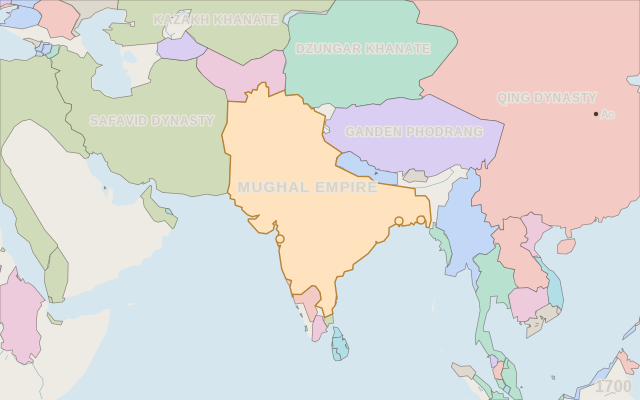
At its largest, in 1700, it held 3.77 million km².↓ The record names 20 rulers in its line, covering 1526 – 1857, the median reign 6 years; 8 of 21 handovers were irregular.↓ Among them, Akbar, Babur and Shah Jahan are the best known.↓ The atlas files 98 rows under it, most of them wars and battles.↓

It was replaced by Company rule in India, Bahawalpur State and the British Raj in 1857, 331 years after it began.↓

From Wikipedia’s article, retold · CC BY-SA 4.0

331 years

Longer than the Song dynasty, shorter than Kyivan Rus'

3.77 million km²

At its height in 1700 · a little larger than India

20 rulers

the Mughal emperor

56 wars and battles

More per century than 95% of states · 98 entries in all

Map: Mughal Empire in 1700, its borders in gold among its neighbours
Second Battle of Panipat, 1556Battle of Haldighati, 1576Campaigns of Nader Shah, 1720 – 1747Nader Shah's invasion of India, 1738 – 1740160017001800
Beside it on the map in 1700: Qing dynasty, Safavid Iran, Dzungar Khanate, Ganden Phodrang, Kazakh Khanate and Ottoman Empire.How far it reached, year by year: its ground inside the borders Cliopatria draws (CC BY 4.0), measured on an equal-area grid; the map shows it at its largest, with the cities of the year.

The story

Four acts, 1526 – 1857

Mughal Empire in 1555, at the end of act I
I1526 – 1556

Babur and Humayun

Descended from Timur through his father and from Genghis Khan through his mother, Babur is driven from Central Asia, settles in Kabul and pushes into India through the Khyber Pass. His firearms and cannon shatter Ibrahim Lodi's army at Panipat in 1526. Humayun reigns from 1531 to 1540, loses the throne, and regains it in 1555.

Watch this act on the live map, from 1526
Mughal Empire in 1627, at the end of act II
II1556 – 1628506,000 → 2.82 million km²

Akbar's empire

Akbar comes to the throne in 1556 under the regent Bairam Khan. Through war he extends the empire in all directions, to almost the whole subcontinent north of the Godavari River, builds a loyal ruling elite and a new administration, levies farm taxes paid in silver, and trades more with European companies. Jahangir I succeeds him in 1605.

Watch this act on the live map, from 1556
Mughal Empire in 1706, at the end of act III
III1628 – 17072.82 million → 3.72 million km²

Shah Jahan and Aurangzeb

Under Shah Jahan, from 1628, the court's wealth pays for painting, letters, textiles and architecture; the Taj Mahal, Red Fort and Lahore Fort are among the Mughal monuments. Relative peace through much of the 17th century helps India's economy grow. Aurangzeb, reigning from 1658 to 1707, carries the empire to its greatest extent, fighting long Deccan wars.

Watch this act on the live map, from 1628
Mughal Empire in 1856, at the end of act IV
IV1707 – 18573.72 million → 241,000 km²

Decline to Delhi

Bahadur Shah I repeals his father's religious policies, but after his death in 1712 the dynasty sinks into feuds; in 1719 four emperors take the throne as puppets of the Sayyid Brothers. Under Muhammad Shah much of central India passes into Maratha hands, Nader Shah invades, and by 1760 the empire is reduced to the region around Old Delhi.

Watch this act on the live map, from 1707
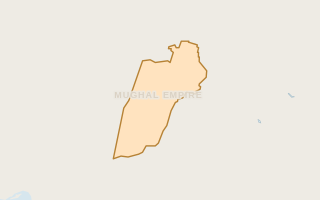
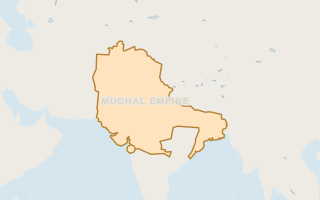
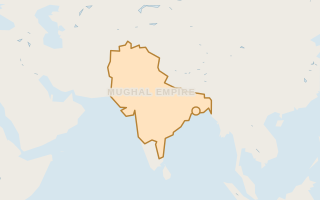
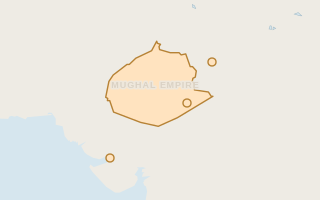
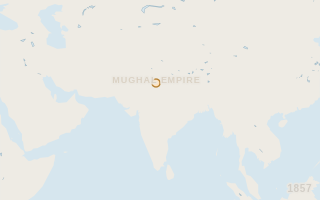
Mughal Empire in 1857, last mappedMughal Empire in 1529, first mapped
The rise and the fall in one frame: drag across it from 1529, first mapped at 1.20 million km², to 1857, last mapped at 600 km². Open the live map in 1529 or 1857.

Before and after

Before it

After it

Where it sits in time

3000 BCE2000 BCE1000 BCE110002000Delhi Sultanate: 1206 – 1526Deccan sultanates: 1527 – 1686Bengal Sultanate: 1352 – 1576Cambay State: 1730 – 1948Gondal State: 1634 – 1949Jhabua State: 1584 – 1948Mughal Empire: 1526 – 1857

Five thousand years, 3000 BCE to 2026; the state in gold, what it replaced or followed and what replaced or followed it in grey.

Its people

Lives across the Mughal Empire

160017001800
Statesmen and generalsWriters, artists and thinkersLived on after it endedAll its people on the timeline →

How it was governed

20 emperors

20 emperors on record, 1526 to 1857; a reign lasted 6 years at the median. Each bar is a reign, as long as it lasted.

Babur · 1526 – 1531 · died in office, manner not recordedHumayun · 1531 – 1540 · left office aliveHumayun · 1555 – 1556 · died by accidentAkbar · 1556 – 1605 · died in office of natural causesJahangir I · 1605 – 1627 · died in office, manner not recordedShah Jahan · 1628 – 1658 · left office aliveAurangzeb · 1658 – 1707 · died in office, manner not recordedMuhammad Azam Shah · 1707 – 1707 · died in office, manner not recordedBahadur Shah I · 1707 – 1712 · died in office, manner not recordedJahandar Shah · 1712 – 1713 · killedFarrukhsiyar · 1713 – 1719 · executedRafi ud-Darajat · 1719 – 1719 · died in office of natural causesShah Jahan II · 1719 – 1719 · died in office, manner not recordedMuhammad Shah · 1719 – 1748 · killed, the article saysAhmad Shah Bahadur · 1748 – 1754 · deposed, the article saysAlamgir II · 1754 – 1759 · died in office, manner not recordedShah Jahan III · 1759 – 1760 · deposed, the article saysShah Alam II · 1760 – 1788 · left office aliveJahan Shah (Mughal Emperor) · 1788 – 1788 · deposed, the article saysShah Alam II · 1788 – 1806 · died in office, manner not recordedAkbar II · 1806 – 1837 · died in office, manner not recordedBahadur Shah Zafar · 1837 – 1857 · left office alive160017001800
How their terms ended, where it is known (22 of 22):Killed 3Deposed or removed 3Died in office 12Left office alive 4
Every term, with how it ended and its source

Rulers

How 22 reigns ended - choose one to show only those

How they died, where the record says: died by accident 2 · died of natural causes 2 · killed 1 · executed 1.

RulerReignLengthHow it ended · sourceTo the ruler before
16th century · 4 reigns
Babur · aged 431526 – 15315 yearsdied in officeread off the dates alone
Humayun · aged 231531 – 15409 yearsleft office aliveread off the dates alonedied by accidentchild
Humayun · aged 471555 – 15561 yeardied by accidentWikidata's manner of deathdied by accident
Akbar · aged 141556 – 160549 yearsdied in officeWikidata's manner of deathdied of natural causeschild
17th century · 3 reigns
Jahangir I · aged 361605 – 162722 yearsdied in officeread off the dates alonechild
Shah Jahan · aged 361628 – 165830 yearsleft office aliveread off the dates alonechild
Aurangzeb · aged 401658 – 170749 yearsdied in officeread off the dates alonechild
18th century · 13 reigns · 6 killed or removed
Muhammad Azam Shah · aged 541707 – 1707under a yeardied in officeread off the dates alonechild
Bahadur Shah I · aged 641707 – 17125 yearsdied in officeread off the dates alonesibling
Jahandar Shah · aged 511712 – 17131 yearkilled in officeWikidata's manner of deathchild
Farrukhsiyar · aged 301713 – 17196 yearsexecutedWikidata's manner of deathnephew or niece
Rafi ud-Darajat · aged 201719 – 1719under a yeardied in officeWikidata's manner of deathdied of natural causes
Shah Jahan II · aged 231719 – 1719under a yeardied in officeread off the dates alonesibling
Muhammad Shah · aged 171719 – 174829 yearskilledread from the ruler's own article
Ahmad Shah Bahadur · aged 231748 – 17546 yearsdeposedread from the ruler's own articlechild
Alamgir II · aged 551754 – 17595 yearsdied in officeread off the dates alone
Shah Jahan III · aged 481759 – 17601 yeardeposedread from the ruler's own article
Shah Alam II · aged 321760 – 178828 yearsleft office aliveread off the dates alone
Jahan Shah (Mughal Emperor) · aged 391788 – 1788under a yeardeposedread from the ruler's own article
Shah Alam II · aged 601788 – 180618 yearsdied in officeread off the dates alone
19th century · 2 reigns
Akbar II · aged 461806 – 183731 yearsdied in officeread off the dates alonechild
Bahadur Shah Zafar · aged 621837 – 185720 yearsleft office aliveread off the dates alonechild

20 rulers, 20 with terms dated as terms, covering 1526 – 1857. Median reign 6 years. 8 of 21 handovers irregular - a killing, a deposition, a rival claimant, a rising or a coup beside it. A blank in the last column means no kin on record, which is coverage, never “unrelated”.

Flag or arms

  • Imperial Seal of the Mughal Empire
    seal, undatedImperial Seal of the Mughal Empire · CC BY-SA 3.0 · TRAJAN 117 This W3C-unspecified vector image was created with Inkscape .

Its world

Rivals, and who else stood

Who it fought most

Wars and battles both took part in, on whichever side: the record names who took part, not who fought whom.

Meanwhile, elsewhere

The best-known states of other regions that stood while it did; the band is the Mughal Empire’s own years.

15001600170018001900

How it compares

Among 3,073 states

Stood longer than 75% of 3,073 states
Mughal Empire · 331 yearsSong dynastyKyivan Rus'How long it stood, among the states with a recorded end or still standing.
Held more ground at its peak than 96% of 1,464 states
Mughal Empire · 3,767,600 km²IndiaAustraliaThe most ground it held, among the states with a border in Cliopatria.
Had more wars on record per century than 95% of 3,073 states
Mughal Empire · 1.8Wars recorded per century, among the states, counting the wars the atlas hosts under each.

Why it fell

Why did the Mughal Empire fall?

Historians still argue. Here is what the atlas records about its last century:

2

wars and battles in its last century

÷2.2

its land, between 1757 and 1856

1788

Jahan Shah (Mughal Emperor), deposed or removed in office

What led to it, and what came of it

Deccan sultanates · Linked · 1527 – 1686Deccan sultanatesDelhi Sultanate · Linked · 1206 – 1526Delhi SultanateBengal Sultanate · Linked · 1352 – 1576Bengal SultanateGajapati Empire · Linked · 1434 – 1541Gajapati EmpireBairam Khan · Coincidence · 1501 – 1561Bairam KhanPir Roshan · Coincidence · 1525 – 1573Pir RoshanMughal Empire · 1526 – 1857Mughal EmpireBritish Raj · Linked · 1858 – 1947British RajNabha State · Linked · 1763 – 1947Nabha StateCompany rule in India · Linked · 1757 – 1858Company rule in IndiaCambay State · Linked · 1730 – 1948Cambay StateBahawalpur State · Linked · 1690 – 1955Bahawalpur StateGondal State · Linked · 1634 – 1949Gondal State1200140016001800
linkedcoincidence

Open the investigation: every row with its evidence, the conditions at the time, the theories condition by condition, and the succession analysed.

Its centuries in the record

1500 – 1599: 12 recorded — 4 wars and battles, 0 risings, regime changes and massacres, 8 other15001600 – 1699: 46 recorded — 23 wars and battles, 0 risings, regime changes and massacres, 23 other16001700 – 1799: 37 recorded — 27 wars and battles, 1 risings, regime changes and massacres, 9 other17001800 – 1899: 3 recorded — 2 wars and battles, 0 risings, regime changes and massacres, 1 other1800

Wars and battles in red, risings, coups and massacres beside them, everything else in grey, by the century each began in. A tall bar is partly a fact about Wikipedia: better-documented centuries hold more.

Each century’s own page:1500 – 15991600 – 16991700 – 17991800 – 1899

Keep exploring

Share this page
Copy link
Embed the map
Cite this page

How this page is made

Drawn from Wikidata (Q33296, CC0), the opening and history of its English Wikipedia article retold by the atlas (CC BY-SA 4.0), borders from Cliopatria (CC BY 4.0), coast and rivers from Natural Earth, cities from Reba, Reitsma & Seto 2016 (CC BY 4.0), symbols from Wikimedia Commons, each under its own licence. Data built 2026-11-26 · Pastlas v2.47.1, by Oleh Voronko; the published atlas and its data are for non-commercial use.

How to read it

Areas are measured on an equal-area grid from borders simplified to about five kilometres. “c.” marks an approximate date, and a date known to the century is never printed to the year. Counts are what the atlas holds, and they follow Wikipedia’s coverage: a busy century is partly a fact about the record.

Something wrong?

Tell us and name the entry. We fix the data, not just this page.

Report a problem