State · Europe

Polish–Lithuanian Commonwealth

1569 – 1795 · 226 years

Came after Kingdom of Poland (1385–1569) and Polish–Lithuanian union · became Duchy of Warsaw and Cossack Hetmanate

Poland and Lithuania joined under elected kings and a parliament of nobles: one of Europe's largest states, partitioned by its neighbours.

The Union of Lublin of 1 July 1569 fused Poland with the Grand Duchy of Lithuania into one Commonwealth. Once the Jagiellonian line died out in 1572, its kings were elected for life and bound by the Henrician Articles, while a Sejm whose lower house the szlachta chose made law: the Golden Liberty. It was unusually tolerant of faiths and peoples. Worn down by its neighbours, it was partitioned by Russia, Prussia and Austria.

What the record holds

The Polish–Lithuanian Commonwealth began in 1569, replacing the Kingdom of Poland.↓ When the borders dataset first draws it, in 1570, it held 773,300 km².↓ The Russo-Turkish War, 1768 – 1774, began with it holding 727,500 km² and ended with 531,200 km².↓

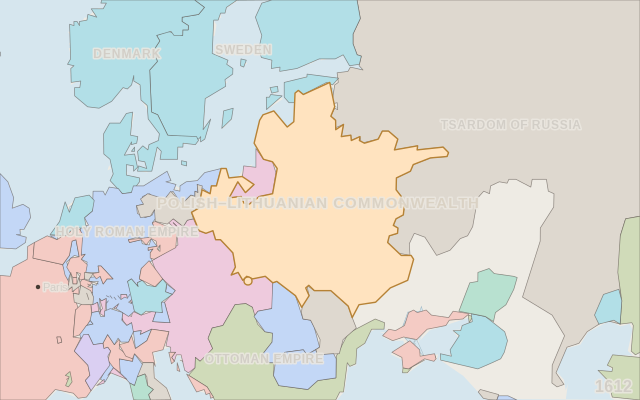
It reached its greatest extent in 1612: 947,100 km².↓ The record names 16 rulers in its line, covering 1530 – 1795, the median reign 18 years; 8 of 15 handovers were irregular.↓ The best known of them are John III Sobieski, Henry III of France and Sigismund III Vasa.↓ Most of the 241 rows the atlas files under it are wars and battles.↓

Its own article says it was partitioned, in 1795.↓ In 1795, after 226 years, it was replaced by the Duchy of Warsaw and Cossack Hetmanate.↓

From Wikipedia’s article, retold · CC BY-SA 4.0

226 years

Longer than the Achaemenid Empire, shorter than the Gupta Empire

947,000 km²

At its height in 1612 · about the size of Venezuela

16 rulers

the King of Poland

126 wars and battles

More per century than 99% of states · 241 entries in all

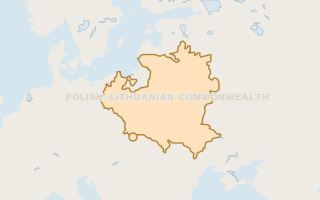
Map: Polish–Lithuanian Commonwealth in 1612, its borders in gold among its neighbours
Khmelnytsky Uprising, 1648 – 1657Great Northern War, 1700 – 1721: 788,300 km² → 760,200 km²War of the Polish Succession, 1733 – 1735: 760,200 km² → 760,100 km²Russo-Turkish War (1768–1774), 1768 – 1774: 727,500 km² → 531,200 km²1600165017001750
Beside it on the map in 1612: Tsardom of Russia, Sweden, Denmark, Kingdom of France, Habsburg monarchy and Holy Roman Empire.How far it reached, year by year: its ground inside the borders Cliopatria draws (CC BY 4.0), measured on an equal-area grid; the map shows it at its largest, with the cities of the year.

The story

Four acts, 1569 – 1795

Polish–Lithuanian Commonwealth in 1647, at the end of act I
I1569 – 1648

Elected kings, golden age

With the Jagiellonian line extinct, some forty thousand nobles elect Henry de Valois king on 11 May 1573, beginning the Golden Liberty, and the Warsaw Confederation Act guarantees religious tolerance. Under Sigismund III Vasa the Commonwealth is at its widest around 1612, with some 12 million people by 1618, while it fights the Polish–Swedish and Polish–Russian wars.

Watch this act on the live map, from 1569
Polish–Lithuanian Commonwealth in 1695, at the end of act II
II1648 – 1696891,000 → 723,000 km²

Rebellion and the Deluge

Power ebbs under the weak John II Casimir as persecution drives minorities to revolt. In 1648 the Ukrainian Cossacks of the south-eastern borderlands rise against Polish and Catholic oppression in the Khmelnytsky Uprising, then seek protection under the Treaty of Pereyaslav. The Deluge rages from 1655 to 1660, and John III Sobieski reigns from 1674 to 1696.

Watch this act on the live map, from 1648
Polish–Lithuanian Commonwealth in 1771, at the end of act III
III1696 – 1772756,000 → 728,000 km²

Foreign meddling and bribed elections

Sobieski's death in 1696 opens an age of decline. The political system drifts toward civil war, and at each royal election foreign houses buy votes from corrupt nobles. The throne passes between Augustus II the Strong and Stanisław Leszczyński, and in 1764 Stanisław August Poniatowski is elected with the backing of Catherine the Great.

Watch this act on the live map, from 1696
IV1772 – 1795

Reform and partition

Poniatowski's reforms meet resistance at home and abroad. In 1773 king and parliament create the Commission of National Education, Europe's first ministry of education, and the 3 May Constitution is enacted. The Polish–Russian War of 1792 and the Kościuszko Uprising of 1794 follow, and in three stages Russia, Prussia and Austria divide the country.

Watch this act on the live map, from 1772
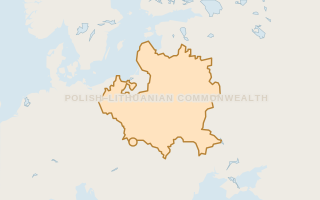
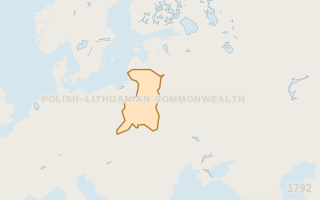
Polish–Lithuanian Commonwealth in 1792, last mappedPolish–Lithuanian Commonwealth in 1612, at its largest
The rise and the fall in one frame: drag across it from 1612, at its largest at 947,100 km², to 1792, last mapped at 221,400 km². Open the live map in 1612 or 1792.

Before and after

Before it

After it

Where it sits in time

3000 BCE2000 BCE1000 BCE110002000Kingdom of Poland (1385–1569): 1386 – 1569Polish–Lithuanian union: 1385 – 1569Duchy of Warsaw: 1807 – 1815Cossack Hetmanate: 1648 – 1764Polish–Lithuanian Commonwealth: 1569 – 1795

Five thousand years, 3000 BCE to 2026; the state in gold, what it replaced or followed and what replaced or followed it in grey.

Its people

Lives across the Polish–Lithuanian Commonwealth

155016001650170017501800
Statesmen and generalsScientists and explorersWriters, artists and thinkersLived on after it endedAll its people on the timeline →

How it was governed

16 kings

16 kings on record, 1530 to 1795; a reign lasted 18 years at the median. Each bar is a reign, as long as it lasted.

Sigismund II Augustus · 1530 – 1572 · died a natural deathHenry III of France · 1573 – 1574 · deposed or killedAnna Jagiellon · 1575 – 1596 · died a natural deathStephen Báthory · 1576 – 1586 · died a natural deathSaul Wahl · 1587 – 1587 · deposed or killedSigismund III Vasa · 1587 – 1632 · died a natural deathWładysław IV Vasa · 1632 – 1648 · died a natural deathJohn II Casimir Vasa · 1648 – 1668 · ended otherwise, as coded — neither deposed nor a natural deathMichał Korybut Wiśniowiecki · 1669 – 1673 · died a natural deathJohn III Sobieski · 1674 – 1696 · died a natural deathAugustus II the Strong · 1697 – 1706 · deposed or killedStanisław Leszczyński · 1704 – 1709 · deposed or killedAugustus II the Strong · 1709 – 1733 · died a natural deathStanisław Leszczyński · 1733 – 1736 · deposed or killedAugustus III of Poland · 1733 – 1763 · died a natural deathStanisław August Poniatowski · 1764 – 1795 · ended otherwise, as coded — neither deposed nor a natural death1600165017001750
a second row: a reign that began before the last had ended — rival claimants, or a shared throne
How their terms ended, where it is known (16 of 16):Deposed or removed 5Died in office 9Left office alive 2
Every term, with how it ended and its source

Rulers

How 16 reigns ended - choose one to show only those

How they died, where the record says: died of natural causes 7 · killed 1.

RulerReignLengthHow it ended · sourceTo the ruler before
16th century · 6 reigns · 2 killed or removed
Sigismund II Augustus · aged 101530 – 157242 yearsnatural deathcoded by Kokkonen & Sundell
Henry III of France · aged 221573 – 15741 yeardeposed or killedcoded by Kokkonen & Sundellkilled
Anna Jagiellon · aged 521575 – 159621 yearsnatural deathcoded by Kokkonen & Sundell
Stephen Báthory · aged 431576 – 158610 yearsnatural deathcoded by Kokkonen & Sundelldied of natural causesspouse
Saul Wahl · aged 461587 – 1587under a yeardeposed or killedcoded by Kokkonen & Sundell
Sigismund III Vasa · aged 211587 – 163245 yearsnatural deathcoded by Kokkonen & Sundelldied of natural causes
17th century · 5 reigns · 1 killed or removed
Władysław IV Vasa · aged 371632 – 164816 yearsnatural deathcoded by Kokkonen & Sundellchild
John II Casimir Vasa · aged 391648 – 166820 yearsended otherwisecoded by Kokkonen & Sundellsibling
Michał Korybut Wiśniowiecki · aged 291669 – 16734 yearsnatural deathcoded by Kokkonen & Sundelldied of natural causes
John III Sobieski · aged 451674 – 169622 yearsnatural deathcoded by Kokkonen & Sundelldied of natural causes
Augustus II the Strong · aged 271697 – 17069 yearsdeposed or killedcoded by Kokkonen & Sundelldied of natural causes
18th century · 5 reigns · 2 killed or removed
Stanisław Leszczyński · aged 271704 – 17095 yearsdeposed or killedcoded by Kokkonen & Sundell
Augustus II the Strong · aged 391709 – 173324 yearsnatural deathcoded by Kokkonen & Sundelldied of natural causes
Stanisław Leszczyński · aged 561733 – 17363 yearsdeposed or killedcoded by Kokkonen & Sundell
Augustus III of Poland · aged 371733 – 176330 yearsnatural deathcoded by Kokkonen & Sundell
Stanisław August Poniatowski · aged 321764 – 179531 yearsended otherwisecoded by Kokkonen & Sundelldied of natural causes

16 rulers, 14 with terms dated as terms, covering 1530 – 1795. Median reign 18 years. 8 of 15 handovers irregular - a killing, a deposition, a rival claimant, a rising or a coup beside it. A blank in the last column means no kin on record, which is coverage, never “unrelated”.

Flags and arms, in order

  • Flaga Rzeczypospolitej Obojga Narodow ogolna
    flag, undatedFlaga Rzeczypospolitej Obojga Narodow ogolna · CC BY-SA 2.5 · Flaga_Rzeczpospolitej_Obojga_Narodow.svg : Olek Remesz (wiki-pl: Orem , commons: Orem ) d…
  • Coat of arms of the Polish-Lithuanian Commonwealth
    coat of arms, undatedCoat of arms of the Polish-Lithuanian Commonwealth · CC BY-SA 3.0 · Avalokitesvara This W3C-unspecified vector image was created with Inkscape . using , by S…
  • Chorągiew królewska króla Zygmunta III Wazy
    flag, undatedChorągiew królewska króla Zygmunta III Wazy · CC BY-SA 2.5 · Olek Remesz (wiki-pl: Orem , commons: Orem )
  • Lob Rech Pospolita
    coat of arms, undatedLob Rech Pospolita · CC BY-SA 3.0 · Лобачев Владимир . Base colors: File:Tapestry with the coats of arms of Poland (White Eag…
  • Herb Rzeczypospolitej Obojga Narodow (Alex K)
    coat of arms, undatedHerb Rzeczypospolitej Obojga Narodow (Alex K) · CC BY-SA 3.0 · Alex Tora

Its world

Rivals, and who else stood

Who it fought most

Wars and battles both took part in, on whichever side: the record names who took part, not who fought whom.

Meanwhile, elsewhere

The best-known states of other regions that stood while it did; the band is the Polish–Lithuanian Commonwealth’s own years.

155016001650170017501800

How it compares

Among 3,073 states

Stood longer than 66% of 3,073 states
Polish–Lithuanian Commonwealth · 226 yearsAchaemenid EmpireGupta EmpireHow long it stood, among the states with a recorded end or still standing.
Held more ground at its peak than 84% of 1,464 states
Polish–Lithuanian Commonwealth · 947,100 km²VenezuelaEgyptThe most ground it held, among the states with a border in Cliopatria.
Had more wars on record per century than 99% of 3,073 states
Polish–Lithuanian Commonwealth · 5.8Wars recorded per century, among the states, counting the wars the atlas hosts under each.

Why it fell

Why did the Polish–Lithuanian Commonwealth fall?

Historians still argue. Here is what the atlas records about its last century:

35

wars and battles in its last century

1736

Stanisław Leszczyński, deposed or removed in office

How it ended, as its article says

Partitioned. Read from the article's section “History - Partitions (1772–1795)” by its grammar; the claim is only that the article says so.

The country was partitioned in three stages by the Russian Empire, the German Kingdom of Prussia, and the Austrian Habsburg monarchy.

One sentence of the English Wikipedia article, CC BY-SA 4.0.

What led to it, and what came of it

Polish–Lithuanian union · Linked · 1385 – 1569Polish–Lithuanian unionKingdom of Poland (1385–1569) · Linked · 1386 – 1569Kingdom of Poland (1385–1569)Ottoman–Habsburg wars · Linked · 1526 – 1791Ottoman–Habsburg warsLivonian War · Linked · 1558 – 1583Livonian WarMykhailo Doroshenko · Coincidence · 1505 – 1628Mykhailo DoroshenkoIvan Fyodorov · Coincidence · 1510 – 1583Ivan FyodorovPolish–Lithuanian Commonwealth · 1569 – 1795Polish–Lithuanian CommonwealthDuchy of Warsaw · Linked · 1807 – 1815Duchy of Warsaw14001500160017001800
linkedcoincidence

Open the investigation: every row with its evidence, the conditions at the time, the theories condition by condition, and the succession analysed.

Its centuries in the record

1500 – 1599: 16 recorded — 2 wars and battles, 0 risings, regime changes and massacres, 14 other15001600 – 1699: 142 recorded — 89 wars and battles, 3 risings, regime changes and massacres, 50 other16001700 – 1799: 83 recorded — 35 wars and battles, 3 risings, regime changes and massacres, 45 other1700

Wars and battles in red, risings, coups and massacres beside them, everything else in grey, by the century each began in. A tall bar is partly a fact about Wikipedia: better-documented centuries hold more.

Each century’s own page:1500 – 15991600 – 16991700 – 1799

Keep exploring

Share this page
Copy link
Embed the map
Cite this page

How this page is made

Drawn from Wikidata (Q172107, CC0), the opening and history of its English Wikipedia article retold by the atlas (CC BY-SA 4.0), borders from Cliopatria (CC BY 4.0), coast and rivers from Natural Earth, cities from Reba, Reitsma & Seto 2016 (CC BY 4.0), symbols from Wikimedia Commons, each under its own licence, and one sentence of the article, quoted. Data built 2026-11-26 · Pastlas v2.47.1, by Oleh Voronko; the published atlas and its data are for non-commercial use.

How to read it

Areas are measured on an equal-area grid from borders simplified to about five kilometres. “c.” marks an approximate date, and a date known to the century is never printed to the year. Counts are what the atlas holds, and they follow Wikipedia’s coverage: a busy century is partly a fact about the record.

Something wrong?

Tell us and name the entry. We fix the data, not just this page.

Report a problem