State · Europe

Kingdom of Italy (Holy Roman Empire)

774 – 1806 · 1,032 years

Came after Kingdom of the Lombards · became France and Austrian Empire

Its record opens in 774, replacing the Kingdom of the Lombards.↓ Its line counts 38 rulers, covering 781 – 1801, the median reign 12 years; 11 of 37 handovers were irregular.↓ The best known of them are Charles V, Frederick Barbarossa and Frederick II, Holy Roman Emperor.↓ Most of the 16 rows the atlas files under it are people.↓

Continue reading

France and the Austrian Empire followed it in 1806, after 1,032 years.↓ Its end fits “Elite conflict”, every condition present.↓

1,032 years

Longer than the Holy Roman Empire, shorter than the Byzantine Empire

172,000 km²

At its height in 911 · about the size of Uruguay

38 rulers

the King of Italy

2 wars and battles

16 entries in all

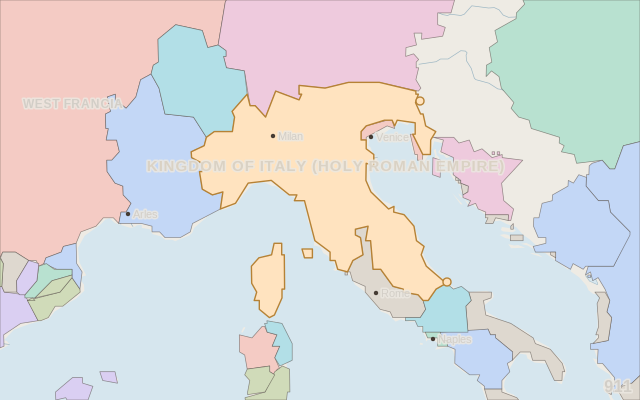
Map: Kingdom of Italy (Holy Roman Empire) in 911, its borders in gold among its neighbours
Beside it on the map in 911: West Francia, Principality of Hungary, East Francia, Lower Burgundy, First Bulgarian Empire and Upper Burgundy.How far it reached, year by year: its ground inside the borders Cliopatria draws (CC BY 4.0), measured on an equal-area grid; the map shows it at its largest, with the cities of the year.

The story

Its key moments

Before and after

Before it

After it

Where it sits in time

3000 BCE2000 BCE1000 BCE110002000Kingdom of the Lombards: 568 – 774Republic of Pisa: 1000 – 1406Republic of Genoa: 1005 – 1797Austrian Empire: 1804 – 1867Kingdom of Italy (Holy Roman Empire): 774 – 1806

Five thousand years, 3000 BCE to 2026; the state in gold, what it replaced or followed and what replaced or followed it in grey.

Its people

Lives across the Kingdom of Italy

800100012001400
Statesmen and generalsWriters, artists and thinkersAll its people on the timeline →

How it was governed

38 kings

38 kings on record, 781 to 1801; a reign lasted 12 years at the median. Each bar is a reign, as long as it lasted.

Pepin of Italy · 781 – 810 · no death date to read the end againstBernard of Italy · 810 – 817 · no death date to read the end againstLothair I · 818 – 855 · no death date to read the end againstLouis II of Italy · 844 – 875 · no death date to read the end againstCarloman of Bavaria · 877 – 879 · abdicated, the article saysCharles the Fat · 880 – 887 · no death date to read the end againstBerengar I of Italy · 887 – 924 · no death date to read the end againstGuy III of Spoleto · 889 – 894 · no death date to read the end againstLambert of Italy · 891 – 898 · no death date to read the end againstArnulf of Carinthia · 894 – 899 · no death date to read the end againstLouis the Blind · 900 – 905 · deposed, the article saysHugh of Italy · 926 – 947 · no death date to read the end againstLothair II of Italy · 947 – 950 · no death date to read the end againstBerengar II of Italy · 950 – 961 · no death date to read the end againstOtto the Great · 961 – 973 · no death date to read the end againstOtto II · 980 – 983 · no death date to read the end againstOtto III, Holy Roman Emperor · 996 – 1002 · no death date to read the end againstArduin of Ivrea · 1002 – 1014 · no death date to read the end againstHenry II, Holy Roman Emperor · 1004 – 1024 · no death date to read the end againstConrad II · 1026 – 1039 · no death date to read the end againstHenry III, Holy Roman Emperor · 1039 – 1056 · no death date to read the end againstHenry IV, Holy Roman Emperor · 1056 – 1105 · no death date to read the end againstConrad II of Italy · 1093 – 1098 · no death date to read the end againstHenry V · 1098 – 1125 · no death date to read the end againstLothair III · 1125 – 1137 · no death date to read the end againstConrad III of Germany · 1128 – 1135 · no death date to read the end againstFrederick Barbarossa · 1155 – 1190 · no death date to read the end againstHenry VI · 1186 – 1197 · no death date to read the end againstFrederick II, Holy Roman Emperor · 1196 – 1250 · no death date to read the end againstOtto IV, Holy Roman Emperor · 1208 – 1212 · no death date to read the end againstHenry (VII) of Germany · 1217 – 1217 · no death date to read the end againstConrad IV of Germany · 1237 – 1254 · no death date to read the end againstHenry VII, Holy Roman Emperor · 1311 – 1313 · no death date to read the end againstLouis IV, Holy Roman Emperor · 1327 – 1347 · no death date to read the end againstCharles IV · 1355 – 1378 · no death date to read the end againstFrederick III, Holy Roman Emperor · 1452 – 1493 · no death date to read the end againstCharles V · 1519 – 1556 · no death date to read the end againstFrancis II, Holy Roman Emperor · 1792 – 1801 · no death date to read the end against80010001200140016001800
a second row: a reign that began before the last had ended — rival claimants, or a shared throne
How their terms ended, where it is known (2 of 38):Deposed or removed 2Not on record 36
Every term, with how it ended and its source

Rulers

How 38 reigns ended - choose one to show only those

How they died, where the record says: died of natural causes 16 · killed 2 · died by accident 2 · died by suicide 1.

RulerReignLengthHow it ended · sourceTo the ruler before
8th century · 1 reign
Pepin of Italy781 – 81029 yearsending not on recorddied of natural causes
9th century · 10 reigns · 2 killed or removed
Bernard of Italy810 – 8177 yearsending not on recordchild
Lothair I818 – 85537 yearsending not on record
Louis II of Italy844 – 87531 yearsending not on recorddied of natural causeschild
Carloman of Bavaria877 – 8792 yearsabdicatedread from the ruler's own articledied of natural causes
Charles the Fat880 – 8877 yearsending not on recorddied of natural causessibling
Berengar I of Italy887 – 92437 yearsending not on recordkilled
Guy III of Spoleto889 – 8945 yearsending not on record
Lambert of Italy891 – 8987 yearsending not on recorddied by accidentchild
Arnulf of Carinthia894 – 8995 yearsending not on recorddied of natural causes
Louis the Blind900 – 9055 yearsdeposedread from the ruler's own article
10th century · 6 reigns
Hugh of Italy926 – 94721 yearsending not on record
Lothair II of Italy947 – 9503 yearsending not on recordkilledchild
Berengar II of Italy950 – 96111 yearsending not on record
Otto the Great961 – 97312 yearsending not on record
Otto II980 – 9833 yearsending not on recorddied of natural causeschild
Otto III, Holy Roman Emperor996 – 10026 yearsending not on recorddied of natural causeschild
11th century · 7 reigns
Arduin of Ivrea1002 – 101412 yearsending not on record
Henry II, Holy Roman Emperor1004 – 102420 yearsending not on record
Conrad II1026 – 103913 yearsending not on record
Henry III, Holy Roman Emperor1039 – 105617 yearsending not on recorddied of natural causeschild
Henry IV, Holy Roman Emperor1056 – 110549 yearsending not on recordchild
Conrad II of Italy1093 – 10985 yearsending not on recordchild
Henry V1098 – 112527 yearsending not on recordsibling
12th century · 5 reigns
Lothair III1125 – 113712 yearsending not on record
Conrad III of Germany1128 – 11357 yearsending not on record
Frederick Barbarossa1155 – 119035 yearsending not on recorddied by accidentnephew or niece
Henry VI1186 – 119711 yearsending not on recorddied of natural causeschild
Frederick II, Holy Roman Emperor1196 – 125054 yearsending not on recorddied of natural causeschild
13th century · 3 reigns
Otto IV, Holy Roman Emperor1208 – 12124 yearsending not on recorddied of natural causes
Henry (VII) of Germany1217 – 1217under a yearending not on recorddied by suicide
Conrad IV of Germany1237 – 125417 yearsending not on recorddied of natural causessibling
14th century · 3 reigns
Henry VII, Holy Roman Emperor1311 – 13132 yearsending not on recorddied of natural causes
Louis IV, Holy Roman Emperor1327 – 134720 yearsending not on recorddied of natural causes
Charles IV1355 – 137823 yearsending not on recorddied of natural causes
15th century · 1 reign
Frederick III, Holy Roman Emperor1452 – 149341 yearsending not on record
16th century · 1 reign
Charles V1519 – 155637 yearsending not on recorddied of natural causes
18th century · 1 reign
Francis II, Holy Roman Emperor1792 – 18019 yearsending not on record

38 rulers, 38 with terms dated as terms, covering 781 – 1801. Median reign 12 years. 11 of 37 handovers irregular - a killing, a deposition, a rival claimant, a rising or a coup beside it. A blank in the last column means no kin on record, which is coverage, never “unrelated”.

Flag or arms

  • Lombard cross
    flag, undatedLombard cross · CC BY-SA 4.0 · Gimliunderthemountain

Its world

Who else stood

Meanwhile, elsewhere

The best-known states of other regions that stood while it did; the band is the Kingdom of Italy’s own years.

7501000125015001750

How it compares

Among 3,073 states

Stood longer than 97% of 3,073 states
Kingdom of Italy (Holy Roman Empire) · 1,032 yearsHoly Roman EmpireByzantine EmpireHow long it stood, among the states with a recorded end or still standing.
Held more ground at its peak than 55% of 1,464 states
Kingdom of Italy (Holy Roman Empire) · 171,500 km²TunisiaUruguayThe most ground it held, among the states with a border in Cliopatria.

Why it fell

Why did the Kingdom of Italy fall?

Historians still argue. Here is what the atlas records about its last century:

What led to it, and what came of it

Kingdom of the Lombards · Linked · 568 – 774Kingdom of the LombardsArab–Byzantine wars · Linked · 629 – 1050Arab–Byzantine warsWestern Roman Empire · In the article · 395 · “Its original capital was Pavia until the 11th century. Following the fall of the Western Roman Empire in 476 and the brief rule of Odoacer, Italy was ruled by…”Western Roman EmpireDuchy of Spoleto · Coincidence · 570 – 1203Duchy of SpoletoKingdom of Italy (Holy Roman Empire) · 774 – 1806Kingdom of Italy (Holy Roman Empire)Austrian Empire · Linked · 1804 – 1867Austrian EmpireKingdom of Etruria · Linked · 1801 – 1807Kingdom of EtruriaLigurian Republic · Linked · 1797 – 1805Ligurian RepublicPapal States · Linked · 754 – 1870Papal States50010001500
in the articlelinkedcoincidence

Open the investigation: every row with its evidence, the conditions at the time, the theories condition by condition, and the succession analysed.

Theories that apply to its ending

  • Elite conflict

    Lachmann 2000 · Lachmann 2010

    Applies by its own logic: 2 of its 2 conditions held here (it needs all of them), and this is the kind of outcome it predicts — adverse regime change, unrest or the state's ending.

    • 2 or more elite groups in the regime's support, or a parliament met within 100 y — agrarian elites, business elites, civil servants, the military (1800)
    • an elite group among the regime's opposition within 5 y, or an elite group left the regime's support over 10 y, or a monarch deposed or killed by others within 20 y, or overlapping reigns — rival claimants — within 20 y — the aristocracy (1806)

Its centuries in the record

700 – 799: 2 recorded — 0 wars and battles, 0 risings, regime changes and massacres, 2 other700800 – 899: 6 recorded — 1 wars and battles, 0 risings, regime changes and massacres, 5 other800900 – 999: 4 recorded — 0 wars and battles, 0 risings, regime changes and massacres, 4 other9001000 – 1099: 1 recorded — 0 wars and battles, 0 risings, regime changes and massacres, 1 other10001100 – 1199: 1 recorded — 1 wars and battles, 0 risings, regime changes and massacres, 0 other11001200 – 1299: 1 recorded — 0 wars and battles, 0 risings, regime changes and massacres, 1 other12001300 – 1399: 0 recorded — 0 wars and battles, 0 risings, regime changes and massacres, 0 other13001400 – 1499: 0 recorded — 0 wars and battles, 0 risings, regime changes and massacres, 0 other14001500 – 1599: 1 recorded — 0 wars and battles, 0 risings, regime changes and massacres, 1 other15001600 – 1699: 0 recorded — 0 wars and battles, 0 risings, regime changes and massacres, 0 other16001700 – 1799: 0 recorded — 0 wars and battles, 0 risings, regime changes and massacres, 0 other17001800 – 1899: 0 recorded — 0 wars and battles, 0 risings, regime changes and massacres, 0 other1800

Wars and battles in red, risings, coups and massacres beside them, everything else in grey, by the century each began in. A tall bar is partly a fact about Wikipedia: better-documented centuries hold more.

Each century’s own page:700 – 799800 – 899900 – 9991000 – 10991100 – 11991200 – 12991300 – 13991400 – 14991500 – 15991600 – 16991700 – 17991800 – 1899

Keep exploring

Share this page
Copy link
Embed the map
Cite this page

How this page is made

Drawn from Wikidata (Q838931, CC0), borders from Cliopatria (CC BY 4.0), coast and rivers from Natural Earth, cities from Reba, Reitsma & Seto 2016 (CC BY 4.0), symbols from Wikimedia Commons, each under its own licence. Data built 2026-11-26 · Pastlas v2.47.1, by Oleh Voronko; the published atlas and its data are for non-commercial use.

How to read it

Areas are measured on an equal-area grid from borders simplified to about five kilometres. “c.” marks an approximate date, and a date known to the century is never printed to the year. Counts are what the atlas holds, and they follow Wikipedia’s coverage: a busy century is partly a fact about the record.

  • Wikidata records foundings in 774, 855, 888 and 961; the atlas draws the kingdom from Charlemagne's conquest in 774, as the map's borders file it, where its article's infobox begins with Otto I in 962.
  • Wikidata's English label: Kingdom of Italy.

Something wrong?

Tell us and name the entry. We fix the data, not just this page.

Report a problem