State · Europe

Habsburg monarchy

1526 – 1918 · 392 years

Came after Crown of Aragon · became Austrian Empire

The Habsburgs' patchwork of kingdoms and duchies, from Austria and Hungary to Spain, bound together only by a common monarch.

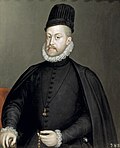
The Habsburg monarchy was the union of empires, kingdoms, duchies and counties ruled by the House of Habsburg, sharing little beyond the court. Charles V held it at its greatest extent, with Spain and its colonies; after 1556 it was split between his brother, Ferdinand I, and his son, Philip II of Spain. Unified as the Austrian Empire in 1804 and divided as Austria-Hungary in 1867, it broke apart in defeat at the close of World War I.

What the record holds

Its record opens in 1526, replacing the Crown of Aragon.↓ When the borders dataset first draws it, in 1526, it held 123,000 km².↓ Between the start and the end of the Great Turkish War, 1683 – 1699, it went from 277,100 km² to 521,600 km².↓

It reached its greatest extent in 1721: 750,200 km².↓ Its line counts 9 rulers, covering 1519 – 1918, the median reign 37 years; 2 of 8 handovers were irregular.↓ Among them, Charles V, Philip II of Spain and Maria Theresa are the best known.↓ The atlas files 175 rows under it, wars and battles the largest group of them.↓

The Austrian Empire replaced it in 1918, after 392 years.↓

From Wikipedia’s article, retold · CC BY-SA 4.0

392 years

Longer than Kyivan Rus', shorter than the Spanish Empire

750,000 km²

At its height in 1721 · about the size of Zambia

9 rulers

the Monarch

81 wars and battles

More per century than 97% of states · 175 entries in all

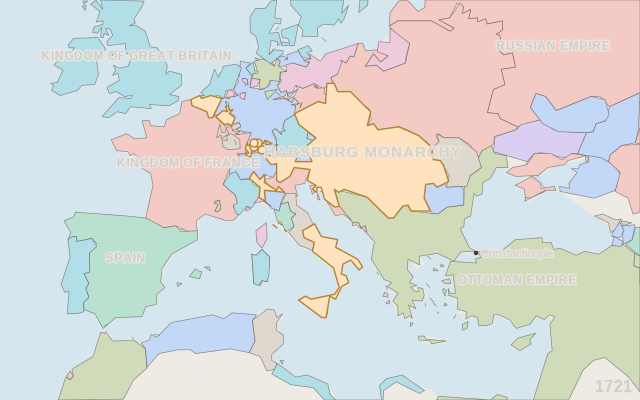
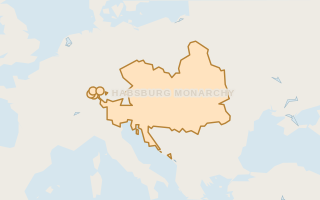
Map: Habsburg monarchy in 1721, its borders in gold among its neighbours
Battle of Vienna, 1683Great Turkish War, 1683 – 1699: 277,100 km² → 521,600 km²Treaty of Karlowitz, 1699Treaty of Passarowitz, 1718155016001650170017501800
Beside it on the map in 1721: Ottoman Empire, Russian Empire, Polish–Lithuanian Commonwealth, Kingdom of France, Spain and Kingdom of Great Britain.How far it reached, year by year: its ground inside the borders Cliopatria draws (CC BY 4.0), measured on an equal-area grid; the map shows it at its largest, with the cities of the year.

The story

Four acts, 1526 – 1918

Habsburg monarchy in 1617, at the end of act I
I1526 – 1618123,000 → 351,000 km²

The divided inheritance

Charles V rules the dynasty's lands at their widest, Spain and its colonies included. His abdication in 1556 splits the house: his son Philip II of Spain takes Iberia, the Netherlands and lands in Italy, while his brother Ferdinand I, chosen king of Bohemia, Hungary and Croatia, keeps the Austrian side, itself split among branches in 1564.

Watch this act on the live map, from 1526
Habsburg monarchy in 1698, at the end of act II
II1618 – 1699351,000 → 522,000 km²

Bohemia, Vienna and the Turkish wars

The Bohemian Revolt breaks out in 1618; the Peace of Prague follows in 1635. After the battle of Saint Gotthard in 1664, the Austrian branches, split since 1564, reunite in 1665. Then come the Battle of Vienna in 1683 and the Great Turkish War, closed by the Treaty of Karlowitz in 1699.

Watch this act on the live map, from 1618
Habsburg monarchy in 1803, at the end of act III
III1699 – 1804522,000 → 678,000 km²

Habsburg-Lorraine and Maria Theresa

The Spanish branch dies out in 1700, its line carried on through the House of Bourbon. When the Austrian male line also ends, in 1740, the house continues through the female line as Habsburg-Lorraine. Maria Theresa reigns through the Silesian Wars; Joseph II and Francis II follow, and in 1804 the realms are unified as the Austrian Empire.

Watch this act on the live map, from 1699
IV1804 – 1918

Austrian Empire to Austria-Hungary

Proclaimed in 1804, the Austrian Empire is split in two by the Austro-Hungarian Compromise of 1867. Franz Joseph I reigns from 1848 to 1916. Facing defeat in World War I, the monarchy fractures, and in late 1918 it gives way to a First Hungarian Republic, a Republic of German-Austria and a State of Slovenes, Croats and Serbs.

Watch this act on the live map, from 1804
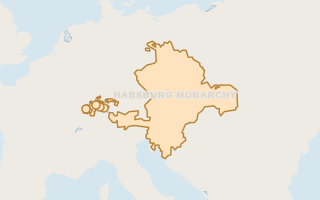
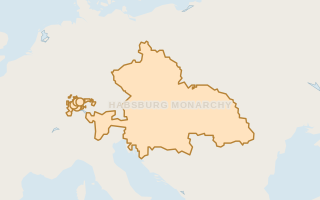
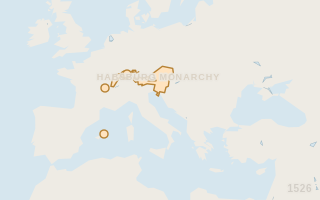
Habsburg monarchy in 1721, at its largestHabsburg monarchy in 1526, first mapped
The rise and the fall in one frame: drag across it from 1526, first mapped at 123,000 km², to 1721, at its largest at 750,200 km². Open the live map in 1526 or 1721.

Before and after

Before it

After it

Where it sits in time

3000 BCE2000 BCE1000 BCE110002000Crown of Aragon: 1162 – 1715Austrian Empire: 1804 – 1867Habsburg monarchy: 1526 – 1918

Five thousand years, 3000 BCE to 2026; the state in gold, what it replaced or followed and what replaced or followed it in grey.

Its people

Lives across Habsburg monarchy

160017001800
Statesmen and generalsWriters, artists and thinkersAll its people on the timeline →

How it was governed

9 monarchs

9 monarchs on record, 1519 to 1918; a reign lasted 37 years at the median. Each bar is a reign, as long as it lasted.

Charles V · 1519 – 1556 · ended otherwise, as coded — neither deposed nor a natural deathFerdinand I, Holy Roman Emperor · 1556 – 1564 · died a natural deathPhilip II of Spain · 1556 – 1598 · no death date to read the end againstCharles II of Spain · 1665 – 1700 · no death date to read the end againstMaria Theresa · 1740 – 1780 · died a natural deathJoseph II, Holy Roman Emperor · 1780 – 1790 · died a natural deathFrancis II, Holy Roman Emperor · 1792 – 1835 · no death date to read the end againstFranz Joseph I · 1848 – 1916 · no death date to read the end againstCharles I of Austria · 1916 – 1918 · no death date to read the end against1600170018001900
a second row: a reign that began before the last had ended — rival claimants, or a shared throne
How their terms ended, where it is known (4 of 9):Died in office 3Left office alive 1Not on record 5
Every term, with how it ended and its source

Rulers

How 9 reigns ended - choose one to show only those

How they died, where the record says: died of natural causes 5.

RulerReignLengthHow it ended · sourceTo the ruler before
16th century · 3 reigns
Charles V1519 – 155637 yearsended otherwisecoded by Kokkonen & Sundelldied of natural causes
Ferdinand I, Holy Roman Emperor1556 – 15648 yearsnatural deathcoded by Kokkonen & Sundellsibling
Philip II of Spain1556 – 159842 yearsending not on recorddied of natural causesnephew or niece
17th century · 1 reign
Charles II of Spain1665 – 170035 yearsending not on record
18th century · 3 reigns
Maria Theresa1740 – 178040 yearsnatural deathcoded by Kokkonen & Sundelldied of natural causes
Joseph II, Holy Roman Emperor1780 – 179010 yearsnatural deathcoded by Kokkonen & Sundellchild
Francis II, Holy Roman Emperor1792 – 183543 yearsending not on recordnephew or niece
19th century · 1 reign
Franz Joseph I1848 – 191668 yearsending not on recorddied of natural causesgrandchild
20th century · 1 reign
Charles I of Austria1916 – 19182 yearsending not on recorddied of natural causes

9 rulers, 9 with terms dated as terms, covering 1519 – 1918. Median reign 37 years. 2 of 8 handovers irregular - a killing, a deposition, a rival claimant, a rising or a coup beside it. A blank in the last column means no kin on record, which is coverage, never “unrelated”.

Flags and arms, in order

  • Arms of the Archduchy of Austria
    coat of arms, undatedArms of the Archduchy of Austria · CC BY-SA 3.0 · Heralder
  • Lesser and Middle Arms of Francis II, Holy Roman Emperor (1804-1806)
    coat of arms, undatedLesser and Middle Arms of Francis II, Holy Roman Emperor (1804-1806) · CC BY-SA 3.0 · Adelbrecht (in collaboration with Heralder )
  • ArchdukesOfHabsburgLorraineArmsPre1896
    coat of arms, undatedArchdukesOfHabsburgLorraineArmsPre1896 · CC BY-SA 4.0 · Icodeswift
  • ArchdukesOfHabsburgLorraineArmsPost1896
    coat of arms, undatedArchdukesOfHabsburgLorraineArmsPost1896 · CC BY-SA 4.0 · Icodeswift
  • Flag of Austria (1230–1934, 1945–2000)
    flag, 1230 – 1934Flag of Austria (1230–1934, 1945–2000) · Public domain
  • Banner of the Holy Roman Emperor with Arms (1437-1493)
    flag, 1437 – 1493Banner of the Holy Roman Emperor with Arms (1437-1493) · CC BY-SA 3.0 · Sir Iain , eagle by N3MO
  • Banner of the Holy Roman Emperor with Arms (1493-1556)
    flag, 1493 – 1556Banner of the Holy Roman Emperor with Arms (1493-1556) · CC BY-SA 3.0 · Sir Iain , eagle by N3MO
  • Flag of the Habsburg Monarchy
    flag, 1804 – 1918Flag of the Habsburg Monarchy · Public domain

Its world

Rivals, and who else stood

Who it fought most

Wars and battles both took part in, on whichever side: the record names who took part, not who fought whom.

Meanwhile, elsewhere

The best-known states of other regions that stood while it did; the band is Habsburg monarchy’s own years.

15001600170018001900

How it compares

Among 3,073 states

Stood longer than 80% of 3,073 states
Habsburg monarchy · 392 yearsKyivan Rus'Spanish EmpireHow long it stood, among the states with a recorded end or still standing.
Held more ground at its peak than 80% of 1,464 states
Habsburg monarchy · 750,200 km²ZambiaTurkeyThe most ground it held, among the states with a border in Cliopatria.
Had more wars on record per century than 97% of 3,073 states
Habsburg monarchy · 2.0Wars recorded per century, among the states, counting the wars the atlas hosts under each.

Why it fell

Why did Habsburg monarchy fall?

Historians still argue. Here is what the atlas records about its last century:

What led to it, and what came of it

Crown of Aragon · Linked · 1162 – 1715Crown of AragonGuelders Wars · Linked · 1502 – 1543Guelders WarsRoman Empire · In the article · 27 BCE · “Habsburg monarchy (German Habsburgermonarchie): this is an unofficial umbrella term, very frequently used, but was not an official name. Austrian monarchy (La…”Roman EmpireHoly Roman Empire · In the article · 962 · “Habsburg monarchy (German Habsburgermonarchie): this is an unofficial umbrella term, very frequently used, but was not an official name. Austrian monarchy (La…”Holy Roman EmpireHabsburg monarchy · 1526 – 1918Habsburg monarchy150010001500
in the articlelinked

Open the investigation: every row with its evidence, the conditions at the time, the theories condition by condition, and the succession analysed.

Its centuries in the record

1500 – 1599: 12 recorded — 6 wars and battles, 0 risings, regime changes and massacres, 6 other15001600 – 1699: 44 recorded — 28 wars and battles, 0 risings, regime changes and massacres, 16 other16001700 – 1799: 106 recorded — 44 wars and battles, 1 risings, regime changes and massacres, 61 other17001800 – 1899: 13 recorded — 3 wars and battles, 0 risings, regime changes and massacres, 10 other18001900 – 1999: 0 recorded — 0 wars and battles, 0 risings, regime changes and massacres, 0 other1900

Wars and battles in red, risings, coups and massacres beside them, everything else in grey, by the century each began in. A tall bar is partly a fact about Wikipedia: better-documented centuries hold more.

Each century’s own page:1500 – 15991600 – 16991700 – 17991800 – 18991900 – 1999

Keep exploring

Share this page
Copy link
Embed the map
Cite this page

How this page is made

Drawn from Wikidata (Q153136, CC0), the opening and history of its English Wikipedia article retold by the atlas (CC BY-SA 4.0), borders from Cliopatria (CC BY 4.0), coast and rivers from Natural Earth, cities from Reba, Reitsma & Seto 2016 (CC BY 4.0), symbols from Wikimedia Commons, each under its own licence. Data built 2026-11-26 · Pastlas v2.47.1, by Oleh Voronko; the published atlas and its data are for non-commercial use.

How to read it

Areas are measured on an equal-area grid from borders simplified to about five kilometres. “c.” marks an approximate date, and a date known to the century is never printed to the year. Counts are what the atlas holds, and they follow Wikipedia’s coverage: a busy century is partly a fact about the record.

Something wrong?

Tell us and name the entry. We fix the data, not just this page.

Report a problem