People · Europe

Goths

100 – 1475 · 1,375 years

A Germanic people who crushed a Roman army at Adrianople, sacked Rome, and founded kingdoms in Spain and Italy.

The Goths were a Germanic people first named by Greco-Roman writers in the 3rd century, when they lived beyond the Lower Danube. Pressed by the Huns, they crossed into the Roman Empire, routed the Romans at Adrianople in 378 CE and sacked Rome in 410 CE under Alaric I. Their successors founded the Visigothic Kingdom at Toledo and the Ostrogothic Kingdom at Ravenna, while the Crimean Goths kept a Gothic culture alive for over a thousand years.

What the record holds

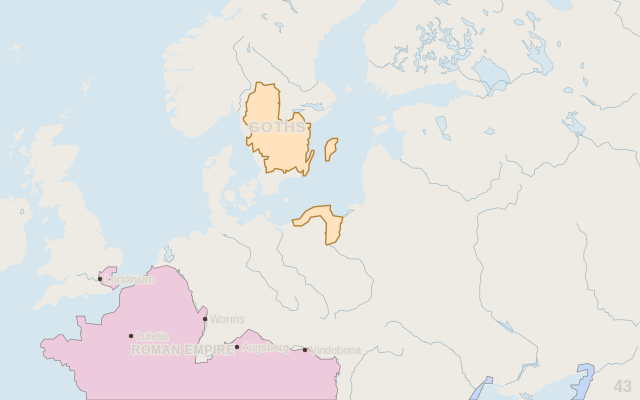
Its record opens in the 1st century.↑ In 30, the first year its borders are mapped, it covered 96,900 km².↓ It reached its greatest extent in 43: 117,100 km².↓ It ended in 1475, 1,375 years after it began.↑

From Wikipedia’s article, retold · CC BY-SA 4.0

1,375 years

Longer than Babylonia, shorter than Assyria

117,000 km²

At its height in 43 · about the size of Benin

1 war or battle

More per century than 86% of states · 1 entries in all

Map: Goths in 43, its borders in gold among its neighbours
100120140160180200
Beside it on the map in 43: Roman Empire, Bosporan Kingdom and Ancient Greece.How far it reached, year by year: its ground inside the borders Cliopatria draws (CC BY 4.0), measured on an equal-area grid; the map shows it at its largest, with the cities of the year.

The story

Four acts, 100 – 1475

I100 – 238

Gutones and the Black Sea

Greco-Roman sources probably first record the Goths in the 1st century as the Gutones. Starting in the mid-2nd century, the Wielbark culture associated with them moves southeast toward the Black Sea, pushing other tribes against the Roman Empire, and by 200 CE Goths are probably serving in the Roman army.

Watch this act on the live map, from 100
II238 – 376

Raiders on the Roman frontier

Goths sack Histria in 238 CE, their first known raid. On the Pontic steppe they take up nomadic customs from the Sarmatians, becoming skilled horsemen, archers and falconers. Constantine checks them on the Danube from 332 CE and defeats many Gothic tribes in 335 and 336 CE. In c. 375 CE the Huns and Alans overrun Gothic lands.

Watch this act on the live map, from 238
III376 – 410

Adrianople and the sack of Rome

Starving refugees, abused by Roman officials, rise under Fritigern in Thrace, and in 378 CE Goth-led forces destroy a Roman army at Adrianople. Theodosius settles Goths in the Balkans in 382 CE and gives them high army posts. After his death in 395 CE Alaric I leads his Balkan Goths into Greece, and in 410 CE they sack Rome.

Watch this act on the live map, from 376
IV410 – 1475

Gothic kingdoms and Crimean Goths

The Visigoths' successors found a kingdom at Toledo, and the Ostrogoths, free of the Huns in the 5th century, build Theodoric the Great's kingdom at Ravenna. Byzantium destroys it in the 6th century; the Umayyad Caliphate takes most of the Visigothic Kingdom early in the 8th, leaving Asturias. In Crimea, Orthodox Goths hold out against Huns and Khazars.

Watch this act on the live map, from 410
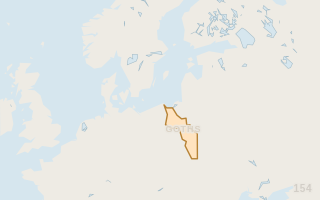
Goths in 154, last mappedGoths in 43, at its largest
The rise and the fall in one frame: drag across it from 43, at its largest at 117,100 km², to 154, last mapped at 75,200 km². Open the live map in 43 or 154.

Where it sits in time

3000 BCE2000 BCE1000 BCE110002000Goths: 100 – 1475

Five thousand years, 3000 BCE to 2026; the state in gold.

Its world

Rivals, and who else stood

Who it fought most

Wars and battles both took part in, on whichever side: the record names who took part, not who fought whom.

Meanwhile, elsewhere

The best-known states of other regions that stood while it did; the band is Goths’s own years.

150010001500

How it compares

Among 3,073 states

Stood longer than 99% of 3,073 states
Goths · 1,375 yearsBabyloniaAssyriaHow long it stood, among the states with a recorded end or still standing.
Held more ground at its peak than 49% of 1,464 states
Goths · 117,100 km²HondurasBeninThe most ground it held, among the states with a border in Cliopatria.
Had more wars on record per century than 86% of 3,073 states
Goths · 0.1Wars recorded per century, among the states, counting the wars the atlas hosts under each.

Why it fell

Why did Goths fall?

Historians still argue. Here is what the atlas records about its last century:

What led to it, and what came of it

Attila · In the article · 450 BCE · “Following the death of Attila and the defeat of the Huns at the Battle of Nedao in 454, the Ostrogoths broke away from Hunnic rule under their king Valamir.”AttilaGoths · 100 – 1475Goths500 BCE150010001500
in the article

Open the investigation: every row with its evidence, the conditions at the time, the theories condition by condition, and the succession analysed.

Its centuries in the record

100 – 199: 0 recorded — 0 wars and battles, 0 risings, regime changes and massacres, 0 other100200 – 299: 0 recorded — 0 wars and battles, 0 risings, regime changes and massacres, 0 other300 – 399: 0 recorded — 0 wars and battles, 0 risings, regime changes and massacres, 0 other300400 – 499: 1 recorded — 1 wars and battles, 0 risings, regime changes and massacres, 0 other500 – 599: 0 recorded — 0 wars and battles, 0 risings, regime changes and massacres, 0 other500600 – 699: 0 recorded — 0 wars and battles, 0 risings, regime changes and massacres, 0 other700 – 799: 0 recorded — 0 wars and battles, 0 risings, regime changes and massacres, 0 other700800 – 899: 0 recorded — 0 wars and battles, 0 risings, regime changes and massacres, 0 other900 – 999: 0 recorded — 0 wars and battles, 0 risings, regime changes and massacres, 0 other9001000 – 1099: 0 recorded — 0 wars and battles, 0 risings, regime changes and massacres, 0 other1100 – 1199: 0 recorded — 0 wars and battles, 0 risings, regime changes and massacres, 0 other11001200 – 1299: 0 recorded — 0 wars and battles, 0 risings, regime changes and massacres, 0 other1300 – 1399: 0 recorded — 0 wars and battles, 0 risings, regime changes and massacres, 0 other13001400 – 1499: 0 recorded — 0 wars and battles, 0 risings, regime changes and massacres, 0 other

Wars and battles in red, risings, coups and massacres beside them, everything else in grey, by the century each began in. A tall bar is partly a fact about Wikipedia: better-documented centuries hold more.

Each century’s own page:100 – 199200 – 299300 – 399400 – 499500 – 599600 – 699700 – 799800 – 899900 – 9991000 – 10991100 – 11991200 – 12991300 – 13991400 – 1499

Keep exploring

Share this page
Copy link
Embed the map
Cite this page

How this page is made

Drawn from Wikidata (Q42193, CC0), the opening and history of its English Wikipedia article retold by the atlas (CC BY-SA 4.0), borders from Cliopatria (CC BY 4.0), coast and rivers from Natural Earth, cities from Reba, Reitsma & Seto 2016 (CC BY 4.0). Data built 2026-11-26 · Pastlas v2.47.1, by Oleh Voronko; the published atlas and its data are for non-commercial use.

How to read it

Areas are measured on an equal-area grid from borders simplified to about five kilometres. “c.” marks an approximate date, and a date known to the century is never printed to the year. Counts are what the atlas holds, and they follow Wikipedia’s coverage: a busy century is partly a fact about the record.

Something wrong?

Tell us and name the entry. We fix the data, not just this page.

Report a problem