People · Europe

Huns

106 – 673 · 567 years

Steppe nomads who drove the Goths and Alans west and, under Attila, built a short-lived empire on Rome's Danube frontier.

The Huns were nomads who ranged across Eastern Europe, the Caucasus and Central Asia from the 4th to the 6th centuries CE. Arriving on the Volga by 370 CE, they set Goths and Alans moving west, and by 430 CE held a vast empire on Rome's Danube frontier. Under Attila they raided the Eastern Roman Empire and invaded Gaul and Italy, but after his death in 453 CE they lost much of their empire.

What the record holds

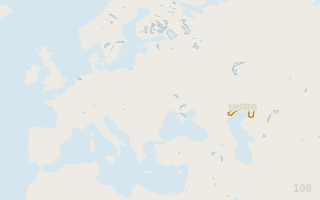
The record dates its beginning to 106.↑ Its borders are first mapped in 106, around 58,300 km².↓

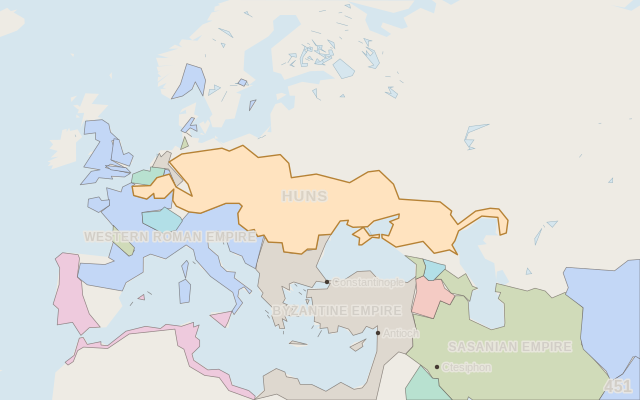
Its ground peaked in 451 at 1.91 million km².↓ Its highest office was held by 12 rulers, covering 370 – 469, the median reign 9.5 years; 5 of 11 handovers were irregular.↓ Among them, Attila, Uldin and Bleda are the best known.↓ The atlas files 10 rows under it, most of them people.↓ It ended in 673, 567 years after it began.↑

From Wikipedia’s article, retold · CC BY-SA 4.0

567 years

Longer than Kathmandu, shorter than the Ottoman Empire

1.91 million km²

At its height in 451 · about the size of Saudi Arabia

12 rulers

the King of the Huns

1 war or battle

More per century than 87% of states · 10 entries in all

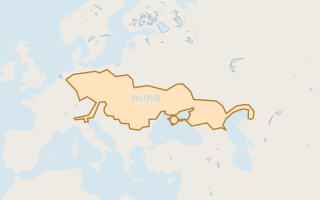
Map: Huns in 451, its borders in gold among its neighbours
200300400500600
Beside it on the map in 451: Sasanian Empire, Byzantine Empire, Western Roman Empire, Hephthalites, Kingdom of the Suebi and Vandal Kingdom.How far it reached, year by year: its ground inside the borders Cliopatria draws (CC BY 4.0), measured on an equal-area grid; the map shows it at its largest, with the cities of the year.

The story

Four acts, 106 – 673

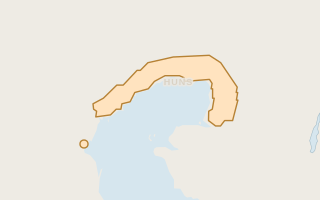
Huns in 369, at the end of act I
I106 – 37058,300 → 58,300 km²

From beyond the Volga

European tradition first places the Huns east of the Volga River, in what was then Scythia. Their roots are disputed: in the 18th century Joseph de Guignes tied them to the Xiongnu, and remains from around the Tian Shan mountains point to a people of mixed East Asian and West Eurasian descent.

Watch this act on the live map, from 106
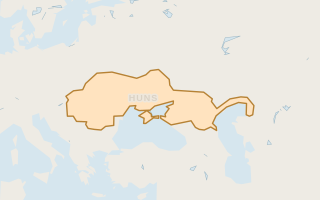
Huns in 433, at the end of act II
II370 – 43458,300 → 1.21 million km²

Onto the Danube

Reaching the Volga by 370 CE, the Huns drive Goths and Alans west; in 376 CE thousands of Goths flee across the Lower Danube into the Roman Empire. The Huns subdue the Alans and most Goths, and from 395 CE strike the Eastern Roman Empire, raiding Thrace, Armenia, Cappadocia and Syria. By 430 CE their empire lines the Danube.

Watch this act on the live map, from 370
Huns in 452, at the end of act III
III434 – 4531.21 million → 1.81 million km²

Attila and Bleda

Ruling jointly from 434 CE, Attila and Bleda force the Treaty of Margus on the Eastern Roman Empire, winning trade rights and tribute, and when it is broken in 440 CE they raze Margus, Singidunum and Viminacium. In 451 CE the Huns fight Romans and Visigoths at the Catalaunian Fields in Gaul, and in 452 CE invade Italy.

Watch this act on the live map, from 434
IV453 – 673

After Attila

Attila dies in 453 CE, and the subject Germanic peoples turn on their Hunnic masters: at Nedao the Gepid king Ardaric's coalition fights the Huns under Ellac, Attila's favoured son, and the Amali Goths revolt under Valamir. Hunnic power in the Carpathian region endures, but many vassals are lost, and more Oghur Turkic peoples arrive.

Watch this act on the live map, from 453
Huns in 451, at its largestHuns in 106, first mapped
The rise and the fall in one frame: drag across it from 106, first mapped at 58,300 km², to 451, at its largest at 1.91 million km². Open the live map in 106 or 451.

Where it sits in time

3000 BCE2000 BCE1000 BCE110002000Huns: 106 – 673

Five thousand years, 3000 BCE to 2026; the state in gold.

Its people

Lives across Huns

Notable figures

How it was governed

12 kings

12 kings on record, 370 to 469; a reign lasted 9.5 years at the median. Each bar is a reign, as long as it lasted.

Balamber · 370 – 370 · no death date to read the end againstKursich · 395 – 395 · no death date to read the end againstBasich · 395 – 395 · no death date to read the end againstUldin · 400 – 409 · no death date to read the end againstCharaton · 412 – 420 · no death date to read the end againstOctar · 420 – 430 · no death date to read the end againstRugila · 420 – 435 · no death date to read the end againstBleda · 434 – 445 · no death date to read the end againstAttila · 434 – 453 · no death date to read the end againstEllac · 453 – 454 · no death date to read the end againstErnak · 453 – 469 · no death date to read the end againstDengizich · 454 – 469 · no death date to read the end against200300400500600
a second row: a reign that began before the last had ended — rival claimants, or a shared throne
How their terms ended, where it is known (0 of 12):Not on record 12
Every term, with how it ended and its source

Rulers

RulerReignLengthHow it ended · sourceTo the ruler before
4th century · 4 reigns
Balamber370 – 370under a yearending not on record
Kursich395 – 395under a yearending not on record
Basich395 – 395under a yearending not on record
Uldin400 – 4099 yearsending not on record
5th century · 8 reigns
Charaton412 – 4208 yearsending not on record
Octar420 – 43010 yearsending not on record
Rugila420 – 43515 yearsending not on recorddied by accidentsibling
Bleda434 – 44511 yearsending not on recordnephew or niece
Attila434 – 45319 yearsending not on recorddied by accidentsibling
Ellac453 – 4541 yearending not on recordchild
Ernak453 – 46916 yearsending not on recordsibling
Dengizich454 – 46915 yearsending not on recorddied in battlesibling

12 rulers, 12 with terms dated as terms, covering 370 – 469. Median reign 9.5 years. 5 of 11 handovers irregular - a killing, a deposition, a rival claimant, a rising or a coup beside it. A blank in the last column means no kin on record, which is coverage, never “unrelated”.

Its world

Rivals, and who else stood

Who it fought most

Wars and battles both took part in, on whichever side: the record names who took part, not who fought whom.

Meanwhile, elsewhere

The best-known states of other regions that stood while it did; the band is Huns’s own years.

200400600

How it compares

Among 3,073 states

Stood longer than 89% of 3,073 states
Huns · 567 yearsKathmanduOttoman EmpireHow long it stood, among the states with a recorded end or still standing.
Held more ground at its peak than 90% of 1,464 states
Huns · 1,907,500 km²SudanSaudi ArabiaThe most ground it held, among the states with a border in Cliopatria.
Had more wars on record per century than 87% of 3,073 states
Huns · 0.2Wars recorded per century, among the states, counting the wars the atlas hosts under each.

Why it fell

Why did Huns fall?

Historians still argue. Here is what the atlas records about its last century:

What led to it, and what came of it

Xiongnu · In the article · 250 BCE · “They argued that this population descended from Xiongnu who expanded westward and mixed with Iranian Sakas.”XiongnuHuns · 106 – 673Huns200 BCE1200400600
in the article

Open the investigation: every row with its evidence, the conditions at the time, the theories condition by condition, and the succession analysed.

Its centuries in the record

100 – 199: 0 recorded — 0 wars and battles, 0 risings, regime changes and massacres, 0 other100200 – 299: 0 recorded — 0 wars and battles, 0 risings, regime changes and massacres, 0 other200300 – 399: 3 recorded — 0 wars and battles, 0 risings, regime changes and massacres, 3 other300400 – 499: 5 recorded — 1 wars and battles, 0 risings, regime changes and massacres, 4 other400500 – 599: 2 recorded — 0 wars and battles, 0 risings, regime changes and massacres, 2 other500600 – 699: 0 recorded — 0 wars and battles, 0 risings, regime changes and massacres, 0 other600

Wars and battles in red, risings, coups and massacres beside them, everything else in grey, by the century each began in. A tall bar is partly a fact about Wikipedia: better-documented centuries hold more.

Each century’s own page:100 – 199200 – 299300 – 399400 – 499500 – 599600 – 699

Keep exploring

Share this page
Copy link
Embed the map
Cite this page

How this page is made

Drawn from Wikidata (Q45813, CC0), the opening and history of its English Wikipedia article retold by the atlas (CC BY-SA 4.0), borders from Cliopatria (CC BY 4.0), coast and rivers from Natural Earth, cities from Reba, Reitsma & Seto 2016 (CC BY 4.0). Data built 2026-11-26 · Pastlas v2.47.1, by Oleh Voronko; the published atlas and its data are for non-commercial use.

How to read it

Areas are measured on an equal-area grid from borders simplified to about five kilometres. “c.” marks an approximate date, and a date known to the century is never printed to the year. Counts are what the atlas holds, and they follow Wikipedia’s coverage: a busy century is partly a fact about the record.

  • Wikidata records no founding for it; the borders dataset maps it from 106 to 673, and those are the years drawn here.

Something wrong?

Tell us and name the entry. We fix the data, not just this page.

Report a problem