Ruler · 830 – 880
Carloman of Bavaria
Lived 830 – 880; monarch. King of Italy of  Kingdom of Italy (Holy Roman Empire), 877 – 879.
Open in the atlas
Open Carloman of Bavaria in the atlas
The article, every line they sat in, and the map in their years.
- Analyse the succession of Kingdom of Italy (Holy Roman Empire): every reign, how each ended, and the numbers over them
For the full story, the article on Wikipedia (CC BY-SA 4.0); this page holds what the record says of the reign.
- Lived
- 830 – 880
- 50 years
- In office
- 2 years
- one reign
- Lines
- 1
- Kingdom of Italy (Holy Roman Empire)
- Left it
- abdicated
- the ruler's own article
King of Italy
Kingdom of Italy (Holy Roman Empire) · the 5th of 38 dated reigns · 781 – 1801

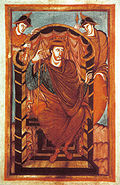

 Carloman of Bavaria877 – 879


Reigned 877 – 879 · 2 years
- Left it
- abdicatedread from the ruler's own article
In 879 he was incapacitated, perhaps by a stroke, and abdicated his domains in favour of his younger brothers: Bavaria to Louis the Younger and Italy to Charles the Fat.
The reign in its line
At 2 years, it is the joint 36th longest of the 38 dated reigns in the line of the Kingdom of Italy. It began 2 years after the reign of  Louis II of Italy ended.
 Charles the Fat followed 1 year after it ended.
Ruling at the same time
Rulers of other states whose reigns overlap 877 – 879: the best known of each region, best known first.
 Alfred the Great,
 Kingdom of Wessex 871 – 899
 Charles the Bald, West Francia 843 – 877
 Pope John VIII,
 Papal States 872 – 882
 Basil I, Byzantine Empire 867 – 886
 Louis III of France, West Francia 879 – 882
 Carloman II, West Francia 879 – 884
 Harald Fairhair,
 Kingdom of Norway (872–1397) 872 – 930
 Anarawd ap Rhodri,
 Kingdom of Gwynedd 878 – 916
Open in the atlas: Carloman of Bavaria in the atlas · the succession of Kingdom of Italy (Holy Roman Empire)
Wikidata Q157084 (CC0) · the reigns from Wikidata's P39 terms, the rulers' own articles read by grammar (sentences quoted above, CC BY-SA 4.0) and Kokkonen & Sundell where they code the line · data built 2026-11-26 · Pastlas v2.47.1, by Oleh Voronko. The published atlas and its data are for non-commercial use.