Battle of Andernach (876)
battle · 876
State · Europe
843 – 962 · 119 years
Came after Francia and Carolingian Empire · became  Holy Roman Empire
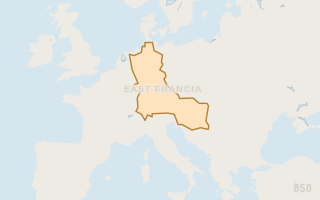
It was founded in 843, replacing the Carolingian Empire.↓ Its borders are first mapped in 850, around 435,100 km².↓
Its ground peaked in 962 at 734,600 km².↓ Its highest office was held by 8 rulers, covering 843 – 973, the median reign 11.5 years; 1 of 7 handovers was irregular.↓ Among them,  Otto the Great,
 Charles the Fat and
 Henry the Fowler are the best known.↓ The atlas files 14 rows under it, most of them people.↓
It was replaced by the Holy Roman Empire in 962, 119 years after it began.↓ One theory of why states fall has every condition present at its end: “Dynastic cycle and the decay of group feeling”.↓
Best known for
119 years
Longer than Nizhny Novgorod, shorter than the Maurya Empire
735,000 km²
At its height in 962 · about the size of Zambia
8 rulers
the King of East Francia
5 wars and battles
14 entries in all
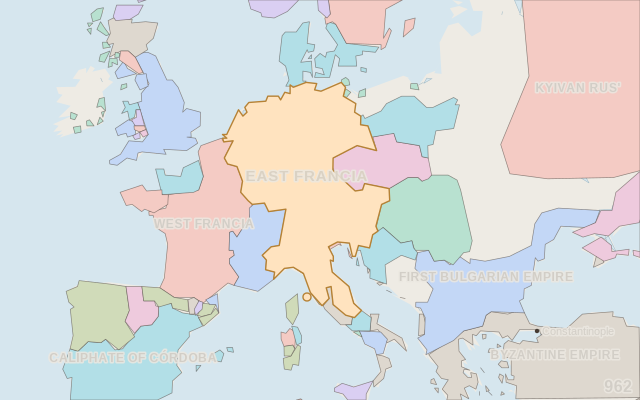
 Kyivan Rus', Byzantine Empire, West Francia,
 First Bulgarian Empire, Caliphate of Córdoba and
 Principality of Hungary.How far it reached, year by year: its ground inside the borders Cliopatria draws (CC BY 4.0), measured on an equal-area grid; the map shows it at its largest, with the cities of the year.
The story
The best-known wars, battles, risings and changes of regime the record files under it; a war within a war is folded into it.
battle · 876
battle · 891
battle · 929
battle · 939
battle · 955
The states the record files it as replacing or following, and those that replaced or followed it - Wikidata's own statements, each read from this state's side.
Holy Roman Empire · replaced by · 962 – 1806Five thousand years, 3000 BCE to 2026; the state in gold, what it replaced or followed and what replaced or followed it in grey.
Its people
One axis for everyone, so you can see who knew whom: the best-known, ordered by birth.
 Louis the Germanking806 – 876
 Louis the Youngerking835 – 882
 Arnulf of Carinthiaking850 – 899
 Henry the Fowlerking876 – 936
 Conrad I of Germanyking881 – 918
 Louis the Childking893 – 911
 Conrad, Duke of Lorraineperson920 – 955
How it was governed
8 kings on record, 843 to 973; a reign lasted 11.5 years at the median. Each bar is a reign, as long as it lasted.
The line of King of East Francia - the office this state names as its head of state.
| Ruler | Reign | Length | How it ended · source | To the ruler before |
|---|---|---|---|---|
| 9th century · 5 reigns · 1 killed or removed | ||||
| Louis the German · aged 37 | 843 – 876 | 33 years | died in officeread off the dates alone | |
| Louis the Younger · aged 41 | 876 – 882 | 6 years | died in officeWikidata's manner of deathdied of natural causes | child |
 Charles the Fat · aged 50 | 882 – 887 | 5 years | deposedread from the ruler's own articledied of natural causes | sibling |
| Arnulf of Carinthia · aged 37 | 887 – 899 | 12 years | died in officeWikidata's manner of deathdied of natural causes | nephew or niece |
| Louis the Child · aged 7 | 900 – 911 | 11 years | died in officeWikidata's manner of deathdied of natural causes | child |
| 10th century · 3 reigns | ||||
| Conrad I of Germany · aged 30 | 911 – 918 | 7 years | died in officeread off the dates alone | |
| Henry the Fowler · aged 43 | 919 – 936 | 17 years | died in officeWikidata's manner of deathdied of natural causes | |
 Otto the Great · aged 24 | 936 – 973 | 37 years | died in officeread off the dates alone | child |
8 rulers, 8 with terms dated as terms, covering 843 – 973. Median reign 11.5 years. 1 of 7 handovers irregular - a killing, a deposition, a rival claimant, a rising or a coup beside it. A blank in the last column means no kin on record, which is coverage, never “unrelated”.
Otto the Great37 yrsLouis the German33 yrsHenry the Fowler17 yrsArnulf of Carinthia12 yrsLouis the Child11 yrsIts world
Wars and battles both took part in, on whichever side: the record names who took part, not who fought whom.
Holy Roman EmpireBattle of Lechfeld2The best-known states of other regions that stood while it did; the band is East Francia’s own years.
 Abbasid CaliphateMiddle East and North Africa
 TibetansSouth Asia
How it compares
Each column is a share of the states; gold is East Francia.
Why it fell
Historians still argue. Here is what the atlas records about its last century:
3
wars and battles in its last century, more than in any before it
×1.7
its land, between 862 and 961
887
Charles the Fat, deposed or removed in office
The investigation's own picture: 4 causes the record names and 15 results, the strongest six of each at their own years, joined to the state by the kind of claim - a recorded statement solid, the article's sentence dashed, a theory dash-dot.
Open the investigation: every row with its evidence, the conditions at the time, the theories condition by condition, and the succession analysed.
Of 5 theories of why states fall, 1 has every condition present at this ending; each is applied by its own logic, condition by condition, and whether its authors named this case is a footnote.
Ibn Khaldun 1377 · Turchin & Nefedov 2009
Applies by its own logic: the condition it names held here, and this is the kind of outcome it predicts — adverse regime change or the state's ending.
“East Francia”, Pastlas, a historical atlas, 2026-11-26. https://app.pastlas.com/state/east-francia/
Drawn from Wikidata (Q153080, CC0), borders from Cliopatria (CC BY 4.0), coast and rivers from Natural Earth, cities from Reba, Reitsma & Seto 2016 (CC BY 4.0). Data built 2026-11-26 · Pastlas v2.47.1, by Oleh Voronko; the published atlas and its data are for non-commercial use.
Areas are measured on an equal-area grid from borders simplified to about five kilometres. “c.” marks an approximate date, and a date known to the century is never printed to the year. Counts are what the atlas holds, and they follow Wikipedia’s coverage: a busy century is partly a fact about the record.