State · Europe

Kingdom of the Lombards

568 – 774 · 206 years

Became Kingdom of Italy (Holy Roman Empire)

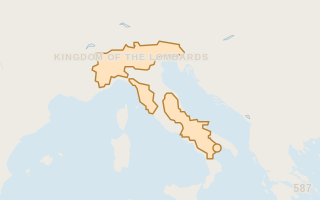
Its record opens in 568.↑ In 587, the first year its borders are mapped, it covered 147,700 km².↓

Continue reading

At its largest, in 755, it held 219,100 km².↓ The record names 8 rulers in its line, covering 560 – 744, the median reign 9 years; 1 of 5 handovers was irregular.↓ Among them, Alboin, Liutprand, King of the Lombards and Cleph are the best known.↓ The atlas files 10 rows under it, most of them people.↓

The Kingdom of Italy replaced it in 774, after 206 years.↓

206 years

Longer than the Russian Empire, shorter than the Achaemenid Empire

219,000 km²

At its height in 755 · about the size of Uganda

8 rulers

the King of Lombards

1 war or battle

10 entries in all

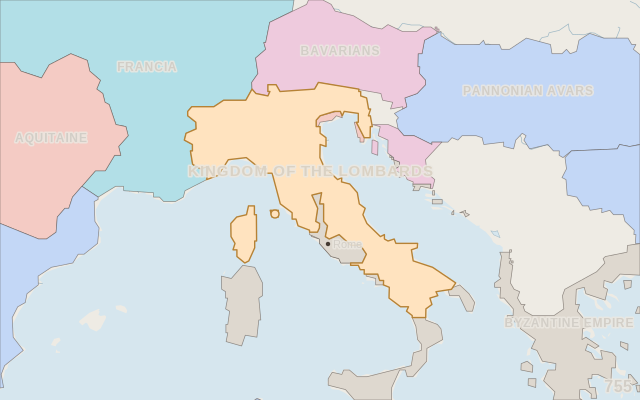
Map: Kingdom of the Lombards in 755, its borders in gold among its neighbours
600650700750
Beside it on the map in 755: Francia, Avar Khaganate, Byzantine Empire, Bavarians, Umayyad Caliphate and First Bulgarian Empire.How far it reached, year by year: its ground inside the borders Cliopatria draws (CC BY 4.0), measured on an equal-area grid; the map shows it at its largest, with the cities of the year.

The story

Its key moments

Kingdom of the Lombards in 755, at its largestKingdom of the Lombards in 587, first mapped
The rise and the fall in one frame: drag across it from 587, first mapped at 147,700 km², to 755, at its largest at 219,100 km². Open the live map in 587 or 755.

Before and after

After it

Where it sits in time

3000 BCE2000 BCE1000 BCE110002000Kingdom of Italy (Holy Roman Empire): 774 – 1806Kingdom of the Lombards: 568 – 774

Five thousand years, 3000 BCE to 2026; the state in gold, what it replaced or followed and what replaced or followed it in grey.

Its people

Lives across the Kingdom of the Lombards

550600650700750
Statesmen and generalsWriters, artists and thinkersLived on after it endedAll its people on the timeline →

How it was governed

8 kings

8 kings on record, 560 to 744; a reign lasted 9 years at the median. Each bar is a reign, as long as it lasted.

Alboin · 560 – 572 · killedCleph · 572 – 574 · died in office, manner not recordedAuthari · 584 – 590 · died in office, manner not recordedAgilulf · 591 – 616 · died in office, manner not recordedAnsprand · 712 – 712 · died in office, manner not recordedLiutprand, King of the Lombards · 712 – 744 · died in office, manner not recorded600650700750
How their terms ended, where it is known (6 of 6):Killed 1Died in office 5
Every term, with how it ended and its source

Rulers

How 6 reigns ended - choose one to show only those

How they died, where the record says: killed 1.

RulerReignLengthHow it ended · sourceTo the ruler before
6th century · 4 reigns · 1 killed or removed
Alboin · aged 34560 – 57212 yearskilled in officeWikidata's manner of death
Cleph572 – 5742 yearsdied in officeread off the dates alonesibling
Authari · aged 34584 – 5906 yearsdied in officeread off the dates alonechild
Agilulf · aged 36591 – 61625 yearsdied in officeread off the dates alonechild
8th century · 2 reigns
Ansprand · aged 55712 – 712under a yeardied in officeread off the dates alone
Liutprand, King of the Lombards · aged 32712 – 74432 yearsdied in officeread off the dates alonechild

8 rulers, 6 with terms dated as terms, covering 560 – 744. Median reign 9 years. 1 of 5 handovers irregular - a killing, a deposition, a rival claimant, a rising or a coup beside it. A blank in the last column means no kin on record, which is coverage, never “unrelated”.

The line also names one holder with a page of their own whose term the record gives no first year, so the table cannot place it: Charlemagne.

Its world

Rivals, and who else stood

Who it fought most

Wars and battles both took part in, on whichever side: the record names who took part, not who fought whom.

Meanwhile, elsewhere

The best-known states of other regions that stood while it did; the band is the Kingdom of the Lombards’s own years.

550600650700750800

How it compares

Among 3,073 states

Stood longer than 63% of 3,073 states
Kingdom of the Lombards · 206 yearsRussian EmpireAchaemenid EmpireHow long it stood, among the states with a recorded end or still standing.
Held more ground at its peak than 60% of 1,464 states
Kingdom of the Lombards · 219,100 km²UgandaLaosThe most ground it held, among the states with a border in Cliopatria.

Why it fell

Why did the Kingdom of the Lombards fall?

Historians still argue. Here is what the atlas records about its last century:

1

wars and battles in its last century, more than in any before it

What led to it, and what came of it

Kingdom of the Lombards · 568 – 774Kingdom of the LombardsKingdom of Italy (Holy Roman Empire) · Linked · 774 – 1806Kingdom of Italy (Holy Roman Emp…10001500
linked

Open the investigation: every row with its evidence, the conditions at the time, the theories condition by condition, and the succession analysed.

Its centuries in the record

500 – 599: 4 recorded — 0 wars and battles, 0 risings, regime changes and massacres, 4 other500600 – 699: 2 recorded — 0 wars and battles, 0 risings, regime changes and massacres, 2 other600700 – 799: 4 recorded — 1 wars and battles, 0 risings, regime changes and massacres, 3 other700

Wars and battles in red, risings, coups and massacres beside them, everything else in grey, by the century each began in. A tall bar is partly a fact about Wikipedia: better-documented centuries hold more.

Each century’s own page:500 – 599600 – 699700 – 799

Keep exploring

Share this page
Copy link
Embed the map
Cite this page

How this page is made

Drawn from Wikidata (Q854415, CC0), borders from Cliopatria (CC BY 4.0), coast and rivers from Natural Earth, cities from Reba, Reitsma & Seto 2016 (CC BY 4.0). Data built 2026-11-26 · Pastlas v2.47.1, by Oleh Voronko; the published atlas and its data are for non-commercial use.

How to read it

Areas are measured on an equal-area grid from borders simplified to about five kilometres. “c.” marks an approximate date, and a date known to the century is never printed to the year. Counts are what the atlas holds, and they follow Wikipedia’s coverage: a busy century is partly a fact about the record.

Something wrong?

Tell us and name the entry. We fix the data, not just this page.

Report a problem