State · Europe

Russian Empire

1721 – 1917 · 196 years

Came after Tsardom of Russia and Cossack Hetmanate · became Russian Republic and Kingdom of Poland (1917–1918)

Peter the Great's empire across northern Eurasia, the third largest in history, ruled by emperors until revolution swept away Nicholas II.

The Russian Empire stretched across northern Eurasia from 1721, when Peter the Great made the tsardom an empire, until 1917. In the late 19th century, at its largest, it covered about 22,800,000 square kilometres, a sixth of the world's land, and the census of 1897 counted 126 million people. Catherine the Great enlarged it, Alexander I helped defeat Napoleon, and Alexander II freed the serfs in 1861. War and revolution ended it in 1917.

What the record holds

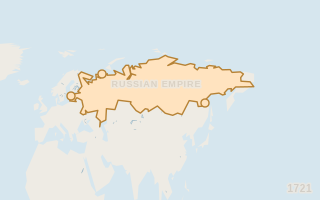
The Russian Empire began in 1721, replacing the Tsardom of Russia and Cossack Hetmanate.↓ Its borders are first mapped in 1721, around 14.37 million km².↓ The Russo-Japanese War, 1904 – 1905, began with it holding 22.96 million km² and ended with 22.19 million km².↓

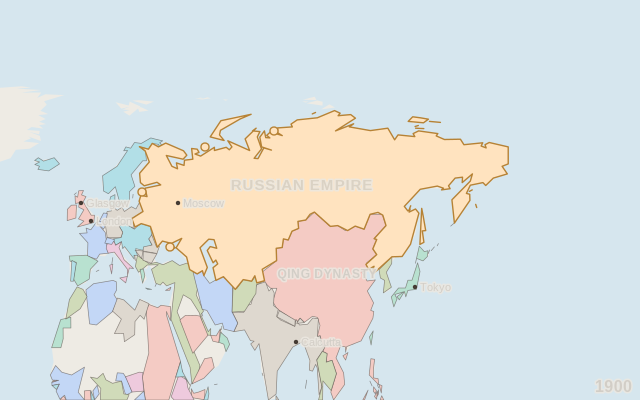
Its ground peaked in 1900 at 22.96 million km².↓ Its highest office was held by 15 rulers, covering 1721 – 1917, the median reign 10 years; 7 of 14 handovers were irregular.↓ Among them, Peter the Great, Catherine the Great and Nicholas II are the best known.↓ The atlas files 1,410 rows under it, most of them people.↓

It was replaced by the Russian Republic and the Kingdom of Poland in 1917, 196 years after it began.↓ 2 theories of why states fall have every condition present at its end: “Demographic-structural breakdown” and “The five conditions of revolution”.↓

From Wikipedia’s article, retold · CC BY-SA 4.0

196 years

Longer than the Mongol Empire, shorter than Greenland

23 million km²

At its height in 1900

15 rulers

the Emperor of all the Russias

91 wars and battles

More per century than 99% of states · 1,410 entries in all

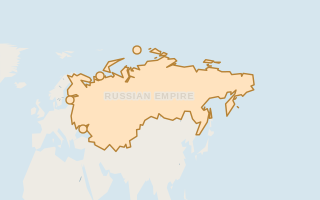
Map: Russian Empire in 1900, its borders in gold among its neighbours
French invasion of Russia, 1812Russo-Turkish War (1877–1878), 1877 – 1878Russo-Japanese War, 1904 – 1905: 22.96 million km² → 22.19 million km²Russian Revolution of 1905, 1905 – 19071750180018501900
Beside it on the map in 1900: Qing dynasty, British Raj, British Empire, French Third Republic, Ottoman Empire and Qajar Iran.How far it reached, year by year: its ground inside the borders Cliopatria draws (CC BY 4.0), measured on an equal-area grid; the map shows it at its largest, with the cities of the year.

The story

Four acts, 1721 – 1917

Russian Empire in 1795, at the end of act I
I1721 – 179614.4 million → 16.7 million km²

Peter's empire, Catherine's conquests

Peter the Great builds a European-style state, moves the capital to Saint Petersburg and gains standing through the Great Northern War. Catherine the Great, enthroned by a coup against her husband Peter III, frees nobles from compulsory service and extends Russian power over the Polish–Lithuanian Commonwealth; after the partitions of Poland, Russia is Europe's most populous state.

Watch this act on the live map, from 1721
Russian Empire in 1854, at the end of act II
II1796 – 185516.7 million → 20.9 million km²

Napoleon and the Caucasus

Paul I is killed in a coup in 1801. Napoleon beats Alexander I at Austerlitz and Friedland, and the Treaties of Tilsit make them allies, but in 1812 the French invade, and Russia helps defeat Napoleon and founds the Holy Alliance. Wars with Persia win Dagestan, eastern Georgia and most of Azerbaijan.

Watch this act on the live map, from 1796
Russian Empire in 1893, at the end of act III
III1855 – 189420.9 million → 22.2 million km²

Reform and expansion

Defeat in the Crimean War, sealed by the Treaty of Paris in 1856, exposes Russia's technical lag. Alexander II frees 23 million serfs in 1861, while his armies take Tashkent, Samarkand and Khiva, alarming the British in the Great Game. After his assassination in 1881, Alexander III turns reactionary and allies with France.

Watch this act on the live map, from 1855
Russian Empire in 1916, at the end of act IV
IV1894 – 191722.2 million → 22.8 million km²

War and revolution

Nicholas II holds fast to autocracy as industry slowly grows. War with Japan is followed by the revolution of 1905, and in 1914 Russia goes to war with Germany and Austria-Hungary. Defeats at Tannenberg and the Masurian Lakes, the Great Retreat, inflation and hunger wear the regime down; in March 1917 Petrograd rises.

Watch this act on the live map, from 1894
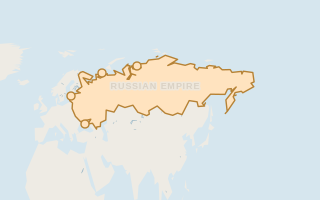
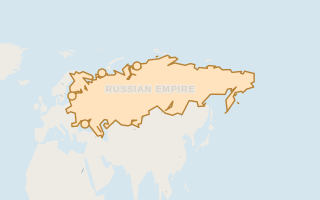
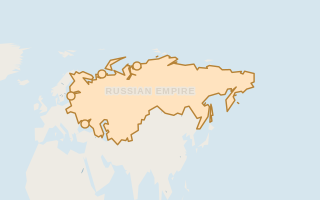
Russian Empire in 1900, at its largestRussian Empire in 1721, first mapped
The rise and the fall in one frame: drag across it from 1721, first mapped at 14.37 million km², to 1900, at its largest at 22.96 million km². Open the live map in 1721 or 1900.

Before and after

Before it

After it

Where it sits in time

3000 BCE2000 BCE1000 BCE110002000Kingdom of Imereti: 1260 – 1810Talysh Khanate: 1747 – 1828Principality of Abkhazia: 1463 – 1810Russian Republic: 1917 – 1917Kingdom of Poland (1917–1918): 1916 – 1918Russian Empire: 1721 – 1917

Five thousand years, 3000 BCE to 2026; the state in gold, what it replaced or followed and what replaced or followed it in grey.

Its people

Lives across the Russian Empire

17501800185019001950
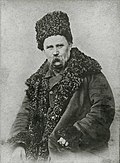
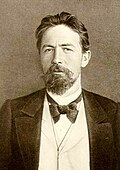
Statesmen and generalsWriters, artists and thinkersScientists and explorersLived on after it endedAll its people on the timeline →

How it was governed

15 emperors

15 emperors on record, 1721 to 1917; a reign lasted 10 years at the median. Each bar is a reign, as long as it lasted.

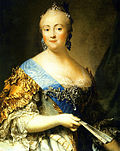
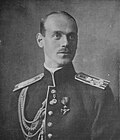
Peter the Great · 1721 – 1725 · died a natural deathCatherine I of Russia · 1725 – 1727 · died a natural deathPeter II of Russia · 1727 – 1730 · died a natural deathAnna of Russia · 1730 – 1740 · died a natural deathIvan VI of Russia · 1740 – 1741 · deposed or killedElizabeth of Russia · 1741 – 1762 · died a natural deathPeter III of Russia · 1762 – 1762 · deposed or killedCatherine the Great · 1762 – 1796 · died a natural deathPaul I of Russia · 1796 – 1801 · killedAlexander I of Russia · 1801 – 1825 · died in office of natural causesNicholas I of Russia · 1825 – 1855 · died in office of natural causesAlexander II of Russia · 1855 – 1881 · killedAlexander III of Russia · 1881 – 1894 · died in office of natural causesNicholas II · 1894 – 1917 · abdicatedGrand Duke Michael Alexandrovich of Russia · 1917 – 1917 · killed1750180018501900
How their terms ended, where it is known (15 of 15):Killed 3Deposed or removed 3Died in office 9
Every term, with how it ended and its source

Rulers

How 15 reigns ended - choose one to show only those

How they died, where the record says: died of natural causes 8 · killed 6.

RulerReignLengthHow it ended · sourceTo the ruler before
18th century · 9 reigns · 3 killed or removed
Peter the Great · aged 491721 – 17254 yearsnatural deathcoded by Kokkonen & Sundelldied of natural causes
Catherine I of Russia · aged 411725 – 17272 yearsnatural deathcoded by Kokkonen & Sundelldied of natural causesspouse
Peter II of Russia · aged 121727 – 17303 yearsnatural deathcoded by Kokkonen & Sundelldied of natural causes
Anna of Russia · aged 371730 – 174010 yearsnatural deathcoded by Kokkonen & Sundelldied of natural causes
Ivan VI of Russia1740 – 17411 yeardeposed or killedcoded by Kokkonen & Sundellkilled
Elizabeth of Russia · aged 321741 – 176221 yearsnatural deathcoded by Kokkonen & Sundell
Peter III of Russia · aged 341762 – 1762under a yeardeposed or killedcoded by Kokkonen & Sundellkillednephew or niece
Catherine the Great · aged 331762 – 179634 yearsnatural deathcoded by Kokkonen & Sundelldied of natural causesspouse
Paul I of Russia · aged 421796 – 18015 yearskilled in officeWikidata's manner of deathchild
19th century · 5 reigns · 2 killed or removed
Alexander I of Russia · aged 241801 – 182524 yearsdied in officeWikidata's manner of deathdied of natural causeschild
Nicholas I of Russia · aged 291825 – 185530 yearsdied in officeWikidata's manner of deathdied of natural causessibling
Alexander II of Russia · aged 371855 – 188126 yearskilled in officeWikidata's manner of deathchild
Alexander III of Russia · aged 361881 – 189413 yearsdied in officeWikidata's manner of deathdied of natural causeschild
Nicholas II · aged 261894 – 191723 yearsabdicatedWikidata's end cause on the termkilledchild
20th century · 1 reign · 1 killed or removed
Grand Duke Michael Alexandrovich of Russia · aged 391917 – 1917under a yearkilled in officeWikidata's manner of deathsibling

15 rulers, 15 with terms dated as terms, covering 1721 – 1917. Median reign 10 years. 7 of 14 handovers irregular - a killing, a deposition, a rival claimant, a rising or a coup beside it. A blank in the last column means no kin on record, which is coverage, never “unrelated”.

Heads of government

The line of head of government, drawn and never measured: a cabinet is not a reign.

Adam Czartoryski1804 – 1806
Nikolay Rumyantsev1810 – 1812
Sergei Witte1905 – 1906
Pyotr Stolypin1906 – 1911
Ivan Goremykin1906 – 1906
Vladimir Kokovtsov1911 – 1914
Ivan Goremykin1914 – 1916
Alexander Trepov1916 – 1916
Nikolai Golitsyn1916 – 1917
Boris Stürmer1916 – 1916
Ivan Shcheglovitov1917 – 1917

Flags and arms, in order

  • Greater Coat of Arms of the Russian Empire
    coat of arms, undatedGreater Coat of Arms of the Russian Empire · Public domain
  • Lesser coat of arms of the Russian Empire
    coat of arms, undatedLesser coat of arms of the Russian Empire · Public domain
  • Flag of Russia
    flag, 1721 – 1858Flag of Russia · Public domain
  • Flag of Russia (1858–1896)
    flag, 1858 – 1896Flag of Russia (1858–1896) · Public domain
  • Flag of Russia
    flag, from 1896Flag of Russia · Public domain

Its world

Rivals, and who else stood

Who it fought most

Wars and battles both took part in, on whichever side: the record names who took part, not who fought whom.

Meanwhile, elsewhere

The best-known states of other regions that stood while it did; the band is the Russian Empire’s own years.

17001750180018501900

How it compares

Among 3,073 states

Stood longer than 61% of 3,073 states
Russian Empire · 196 yearsMongol EmpireGreenlandHow long it stood, among the states with a recorded end or still standing.
Held more ground at its peak than 99% of 1,464 states
Russian Empire · 22,964,700 km²RussiaThe most ground it held, among the states with a border in Cliopatria.
Had more wars on record per century than 99% of 3,073 states
Russian Empire · 10.2Wars recorded per century, among the states, counting the wars the atlas hosts under each.

Why it fell

Why did the Russian Empire fall?

Historians still argue. Here is what the atlas records about its last century:

33

wars and battles in its last century

1917

Nicholas II, deposed or removed in office

What led to it, and what came of it

Battle of Stäket · Linked · 1719Battle of StäketTreaty of Copenhagen (1709) · Linked · 1709Treaty of Copenhagen (1709)Siege of Tartu · Linked · 1704Siege of TartuBattle at the Mouth of the Neva · Linked · 1703Battle at the Mouth of the NevaKingdom of Imereti · Linked · 1260 – 1810Kingdom of ImeretiPrincipality of Abkhazia · Linked · 1463 – 1810Principality of AbkhaziaRussian Empire · 1721 – 1917Russian EmpireRussian Republic · Linked · 1917Russian RepublicKingdom of Poland (1917–1918) · Linked · 1916 – 1918Kingdom of Poland (1917–1918)Ice Cruise of the Baltic Fleet · Linked · 1918Ice Cruise of the Baltic Fleet140016001800
linked

Open the investigation: every row with its evidence, the conditions at the time, the theories condition by condition, and the succession analysed.

Theories that apply to its ending

  • Demographic-structural breakdown

    Goldstone 1991 · Turchin & Nefedov 2009

    Applies by its own logic: 2 of its 3 conditions held here (it needs 2), and this is the kind of outcome it predicts — unrest, adverse regime change or the state's ending.

    • famine, plague or disaster within 30 y in the state, or population up 25% over 50 y — prior
    • a war the state is fighting, still under way, or a war the state fought, ended within 10 y — warOngoing
  • The five conditions of revolution

    Goldstone 2014 · Goldstone 2001

    Applies by its own logic: 4 of its 5 conditions held here (it needs 4), and this is the kind of outcome it predicts — unrest, adverse regime change or the state's ending.

    • GDP per capita down 5% over 5 y, or a war the state is fighting, still under way, or a war the state fought, ended within 5 y, or famine within 5 y in the state — warOngoing
    • an elite group among the regime's opposition within 5 y, or an elite group left the regime's support over 10 y, or a monarch deposed or killed within 10 y, or overlapping reigns — rival claimants — within 10 y, or 2 or more reigns of two years or less within 10 y — the aristocracy, agrarian elites, civil servants, the military (1917)
    • mass mobilisation at 3 or more of 4 within 5 y, or a popular class among the regime's opposition within 5 y, or unrest within 5 y in the state — many large-scale and small-scale events (1917); urban working classes, urban middle classes, rural working classes (1912); prior
    • anti-system movements at 3 or more of 4 within 5 y — a very high level, a real and present threat (1917)

Its centuries in the record

1700 – 1799: 138 recorded — 12 wars and battles, 4 risings, regime changes and massacres, 122 other17001800 – 1899: 947 recorded — 46 wars and battles, 10 risings, regime changes and massacres, 891 other18001900 – 1999: 323 recorded — 33 wars and battles, 13 risings, regime changes and massacres, 277 other1900

Wars and battles in red, risings, coups and massacres beside them, everything else in grey, by the century each began in. A tall bar is partly a fact about Wikipedia: better-documented centuries hold more.

Each century’s own page:1700 – 17991800 – 18991900 – 1999

Keep exploring

Share this page
Copy link
Embed the map
Cite this page

How this page is made

Drawn from Wikidata (Q34266, CC0), the opening and history of its English Wikipedia article retold by the atlas (CC BY-SA 4.0), borders from Cliopatria (CC BY 4.0), coast and rivers from Natural Earth, cities from Reba, Reitsma & Seto 2016 (CC BY 4.0), symbols from Wikimedia Commons, each under its own licence. Data built 2026-11-26 · Pastlas v2.47.1, by Oleh Voronko; the published atlas and its data are for non-commercial use.

How to read it

Areas are measured on an equal-area grid from borders simplified to about five kilometres. “c.” marks an approximate date, and a date known to the century is never printed to the year. Counts are what the atlas holds, and they follow Wikipedia’s coverage: a busy century is partly a fact about the record.

Something wrong?

Tell us and name the entry. We fix the data, not just this page.

Report a problem