State · Europe

Crown of Aragon

1162 – 1715 · 553 years

Came after Kingdom of Aragon and County of Barcelona · became Spain and Spanish Empire

Aragon, Catalonia and Valencia under one king: a composite monarchy whose sea empire reached from the Balearic Islands to Greece.

Petronilla of Aragon's marriage to Raymond Berenguer IV of Barcelona joined two realms, which their son Alfonso II inherited in 1162. Its king ruled each realm by that realm's own laws and parliaments. Its peak came in the 14th and 15th centuries, when it held much of the eastern Iberian Peninsula and a Mediterranean empire. From 1479 it shared its monarchs with Castile, until Philip V's Nueva Planta decrees abolished it after the War of the Spanish Succession.

What the record holds

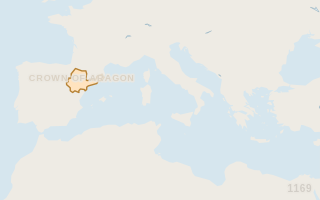
The Crown of Aragon began in 1162, replacing the County of Empúries.↓ Its borders are first mapped in 1169, around 60,200 km².↓ The Navarrese Civil War, 1451 – 1464, began with it holding 243,700 km² and ended with 162,600 km².↓

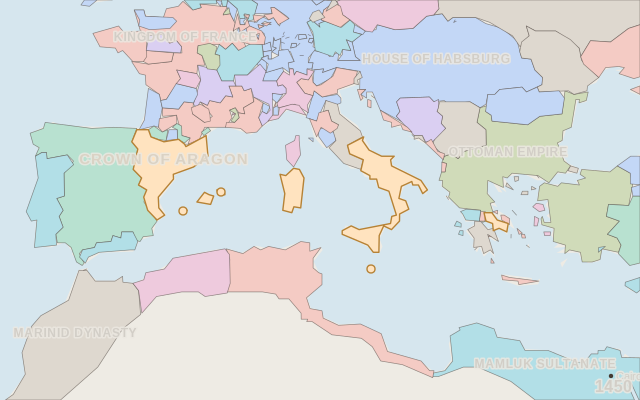
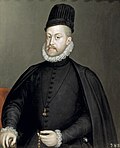
At its largest, in 1450, it held 243,700 km².↓ The record names 20 rulers in its line, covering 1164 – 1714, the median reign 27.5 years; none of its 19 handovers was irregular.↓ Among them, Charles V, Philip II of Spain and Ferdinand II of Aragon are the best known.↓ The atlas files 27 rows under it, most of them people.↓

It was replaced by Spain and the Spanish Empire in 1715, 553 years after it began.↓

From Wikipedia’s article, retold · CC BY-SA 4.0

553 years

Longer than Vikings, shorter than Kathmandu

244,000 km²

At its height in 1450 · about the size of Ghana

20 rulers

the monarch of the Crown of Aragon

5 wars and battles

More per century than 89% of states · 27 entries in all

Map: Crown of Aragon in 1450, its borders in gold among its neighbours
Aragonese Crusade, 1283 – 1286: 91,600 km² → 116,100 km²Peace of Caltabellotta, 1302War of the Two Pedros, 1356 – 1375: 129,000 km² → 128,300 km²Compromise of Caspe, 1412Navarrese Civil War, 1451 – 1464: 243,700 km² → 162,600 km²1200130014001500
Beside it on the map in 1450: House of Habsburg, Ottoman Empire, Crown of Castile, Marinid dynasty, Mamluk Sultanate and Kingdom of France.How far it reached, year by year: its ground inside the borders Cliopatria draws (CC BY 4.0), measured on an equal-area grid; the map shows it at its largest, with the cities of the year.

The story

Four acts, 1162 – 1715

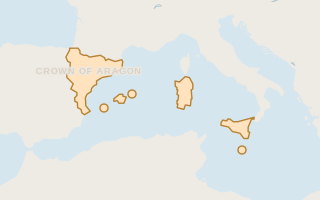
Crown of Aragon in 1282, at the end of act I
I1162 – 1283

Two realms, two ambitions

Alfonso II inherits two realms with two ambitions: the House of Jiménez looks south, contesting the middle Ebro valley with Castile, while the House of Barcelona looks north to Occitania, above all Toulouse, Provence and Foix. Pressed by the Aragonese nobility, he sets out to conquer Valencia. In the 13th century Majorca and Valencia are won.

Watch this act on the live map, from 1162
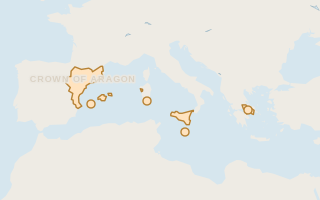
Crown of Aragon in 1409, at the end of act II
II1283 – 141091,600 → 138,000 km²

The great age at sea

The Crown's great age: Sicily is won, population grows without social strife, and urban prosperity peaks in 1345. It fights the Aragonese Crusade and the War of the Two Pedros, and its sea empire takes in Sardinia, Corsica, Malta and, until 1388, parts of Greece. In 1410 King Martin I dies without heirs.

Watch this act on the live map, from 1283
Crown of Aragon in 1478, at the end of act III
III1410 – 1479138,000 → 163,000 km²

The Compromise of Caspe

In 1412 delegates of Aragon, Valencia and Catalonia meeting at Caspe choose Ferdinand of Antequera, of the Castilian Trastámara dynasty, as king. Southern Italy is added in 1442, but Navarre, lately joined, is lost in dynastic quarrels, and the War of the Remences breaks out. In 1469 his grandson Ferdinand marries Infanta Isabella of Castile.

Watch this act on the live map, from 1410
IV1479 – 1715

Joined to Castile

From 1479 the Catholic Monarchs rule both the Crown and Castile; Ferdinand II wins back Roussillon and Cerdagne. Wealth stagnates as authority shifts to the Spanish crown in Castile, and expulsions of Jews, Muslims and Moriscos cut into its people. Habsburg kings follow, until Philip V defeats Archduke Charles in the War of the Spanish Succession and abolishes it.

Watch this act on the live map, from 1479
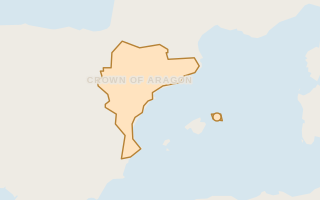
Crown of Aragon in 1450, at its largestCrown of Aragon in 1169, first mapped
The rise and the fall in one frame: drag across it from 1169, first mapped at 60,200 km², to 1450, at its largest at 243,700 km². Open the live map in 1169 or 1450.

Before and after

Before it

After it

  • British Minorca · replaced by
  • Habsburg monarchy · replaced by · 1526 – 1918
  • Council of Italy · replaced by
  • Kingdom of Spain · replaced by
  • Kingdom of France · replaced by · 987 – 1791
  • Spain · replaced by · 1516 – present
  • Spanish Empire · replaced by · 1492 – 1899

Where it sits in time

3000 BCE2000 BCE1000 BCE110002000County of Empúries: 812 – 1402County of Barcelona: 801 – 1164Kingdom of Aragon: 1035 – 1707Habsburg monarchy: 1526 – 1918Kingdom of France: 987 – 1791Spain: 1516 – 2026Crown of Aragon: 1162 – 1715

Five thousand years, 3000 BCE to 2026; the state in gold, what it replaced or followed and what replaced or followed it in grey.

Its people

Lives across the Crown of Aragon

12001300140015001600
Statesmen and generalsAll its people on the timeline →

How it was governed

20 monarchs

20 monarchs on record, 1164 to 1714; a reign lasted 27.5 years at the median. Each bar is a reign, as long as it lasted.

Alfonso II of Aragon · 1164 – 1196 · died a natural deathPeter II of Aragon · 1196 – 1213 · ended otherwise, as coded — neither deposed nor a natural deathJames I of Aragon · 1213 – 1276 · died a natural deathAlfonso III of Aragon · 1285 – 1291 · died a natural deathJames II of Aragon · 1291 – 1327 · died a natural deathAlfonso IV of Aragon · 1327 – 1336 · died a natural deathPeter IV of Aragon · 1336 – 1387 · died a natural deathJohn I of Aragon · 1387 – 1396 · died a natural deathMartin of Aragon · 1396 – 1410 · died a natural deathFerdinand I of Aragon · 1412 – 1416 · died a natural deathAlfonso V of Aragon · 1416 – 1458 · died a natural deathJohn II of Aragon · 1458 – 1479 · died a natural deathFerdinand II of Aragon · 1479 – 1516 · died in office, manner not recordedCharles V · 1516 – 1556 · ended otherwise, as coded — neither deposed nor a natural deathPhilip II of Spain · 1556 – 1598 · died a natural deathPhilip III of Spain · 1598 – 1621 · died a natural deathPhilip IV of Spain · 1621 – 1665 · died a natural deathCharles II of Spain · 1665 – 1700 · died a natural deathPhilip V of Spain · 1700 – 1706 · ended otherwise, as coded — neither deposed nor a natural deathCharles VI, Holy Roman Emperor · 1706 – 1714 · ended by a named event120013001400150016001700
How their terms ended, where it is known (20 of 20):Died in office 16Left office alive 4
Every term, with how it ended and its source

Rulers

How 20 reigns ended - choose one to show only those

How they died, where the record says: died of natural causes 3 · died by accident 2 · died in battle 1.

RulerReignLengthHow it ended · sourceTo the ruler before
12th century · 2 reigns
Alfonso II of Aragon · aged 71164 – 119632 yearsnatural deathcoded by Kokkonen & Sundell
Peter II of Aragon · aged 191196 – 121317 yearsended otherwisecoded by Kokkonen & Sundelldied in battlechild
13th century · 3 reigns
James I of Aragon · aged 51213 – 127663 yearsnatural deathcoded by Kokkonen & Sundellchild
Alfonso III of Aragon · aged 201285 – 12916 yearsnatural deathcoded by Kokkonen & Sundellgrandchild
James II of Aragon · aged 241291 – 132736 yearsnatural deathcoded by Kokkonen & Sundellsibling
14th century · 4 reigns
Alfonso IV of Aragon · aged 281327 – 13369 yearsnatural deathcoded by Kokkonen & Sundellchild
Peter IV of Aragon · aged 171336 – 138751 yearsnatural deathcoded by Kokkonen & Sundellchild
John I of Aragon · aged 361387 – 13969 yearsnatural deathcoded by Kokkonen & Sundelldied by accidentchild
Martin of Aragon · aged 401396 – 141014 yearsnatural deathcoded by Kokkonen & Sundellsibling
15th century · 4 reigns
Ferdinand I of Aragon · aged 321412 – 14164 yearsnatural deathcoded by Kokkonen & Sundellnephew or niece
Alfonso V of Aragon · aged 201416 – 145842 yearsnatural deathcoded by Kokkonen & Sundellchild
John II of Aragon · aged 601458 – 147921 yearsnatural deathcoded by Kokkonen & Sundellsibling
Ferdinand II of Aragon · aged 271479 – 151637 yearsdied in officeread off the dates alonechild
16th century · 3 reigns
Charles V · aged 161516 – 155640 yearsended otherwisecoded by Kokkonen & Sundelldied of natural causesgrandchild
Philip II of Spain · aged 291556 – 159842 yearsnatural deathcoded by Kokkonen & Sundelldied of natural causeschild
Philip III of Spain · aged 201598 – 162123 yearsnatural deathcoded by Kokkonen & Sundellchild
17th century · 3 reigns
Philip IV of Spain · aged 161621 – 166544 yearsnatural deathcoded by Kokkonen & Sundellchild
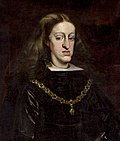
Charles II of Spain · aged 41665 – 170035 yearsnatural deathcoded by Kokkonen & Sundellchild
Philip V of Spain · aged 171700 – 17066 yearsended otherwisecoded by Kokkonen & Sundelldied of natural causes
18th century · 1 reign
Charles VI, Holy Roman Emperor · aged 211706 – 17148 yearsended by an eventWikidata's end cause on the termdied by accident

20 rulers, 20 with terms dated as terms, covering 1164 – 1714. Median reign 27.5 years. 0 of 19 handovers irregular - a killing, a deposition, a rival claimant, a rising or a coup beside it. A blank in the last column means no kin on record, which is coverage, never “unrelated”.

Flags and arms, in order

  • Blason d'Aragon
    coat of arms, undatedBlason d'Aragon · CC BY-SA 3.0
  • Royal arms of Aragon (Crowned)
    coat of arms, undatedRoyal arms of Aragon (Crowned) · CC BY-SA 3.0 · Heralder
  • Armas del soberano de Aragón
    coat of arms, undatedArmas del soberano de Aragón · Public domain
  • Royal Banner of Aragón
    flag, undatedRoyal Banner of Aragón · CC BY-SA 3.0 · Heralder i The source code of this SVG is valid . This vector image was created with Inks…
  • Sinyal d'Aragón
    flag, undatedSinyal d'Aragón · Public domain

Its world

Rivals, and who else stood

Who it fought most

Wars and battles both took part in, on whichever side: the record names who took part, not who fought whom.

Meanwhile, elsewhere

The best-known states of other regions that stood while it did; the band is the Crown of Aragon’s own years.

120014001600

How it compares

Among 3,073 states

Stood longer than 88% of 3,073 states
Crown of Aragon · 553 yearsVikingsKathmanduHow long it stood, among the states with a recorded end or still standing.
Held more ground at its peak than 63% of 1,464 states
Crown of Aragon · 243,700 km²GhanaGuineaThe most ground it held, among the states with a border in Cliopatria.
Had more wars on record per century than 89% of 3,073 states
Crown of Aragon · 0.7Wars recorded per century, among the states, counting the wars the atlas hosts under each.

Why it fell

Why did the Crown of Aragon fall?

Historians still argue. Here is what the atlas records about its last century:

What led to it, and what came of it

County of Barcelona · Linked · 801 – 1164 · “The Crown of Aragon originated in 1137, when the Kingdom of Aragon and the County of Barcelona (along with the County of Provence, Girona, Cerdanya, Osona, an…”County of BarcelonaKingdom of Aragon · Linked · 1035 – 1707 · “The Crown of Aragon originated in 1137, when the Kingdom of Aragon and the County of Barcelona (along with the County of Provence, Girona, Cerdanya, Osona, an…”Kingdom of AragonReconquista · Linked · 722 – 1492ReconquistaCounty of Cerdanya · Linked · 798 – 1403County of CerdanyaCounty of Empúries · Linked · 812 – 1402County of EmpúriesCounty of Roussillon · Linked · 812 – 1172County of RoussillonCrown of Aragon · 1162 – 1715Crown of AragonKingdom of Spain · Linked · 1700 – 1873Kingdom of SpainCouncil of Italy · Linked · 1556Council of ItalyHabsburg monarchy · Linked · 1526 – 1918Habsburg monarchySpain · Linked · 1516 – 2026SpainSpanish Empire · Linked · 1492 – 1899Spanish EmpireKingdom of France · Linked · 987 – 1791Kingdom of France100015002000
linked

Open the investigation: every row with its evidence, the conditions at the time, the theories condition by condition, and the succession analysed.

Its centuries in the record

1100 – 1199: 2 recorded — 0 wars and battles, 0 risings, regime changes and massacres, 2 other11001200 – 1299: 5 recorded — 1 wars and battles, 0 risings, regime changes and massacres, 4 other12001300 – 1399: 9 recorded — 2 wars and battles, 0 risings, regime changes and massacres, 7 other13001400 – 1499: 7 recorded — 1 wars and battles, 1 risings, regime changes and massacres, 5 other14001500 – 1599: 3 recorded — 1 wars and battles, 0 risings, regime changes and massacres, 2 other15001600 – 1699: 1 recorded — 0 wars and battles, 0 risings, regime changes and massacres, 1 other16001700 – 1799: 0 recorded — 0 wars and battles, 0 risings, regime changes and massacres, 0 other1700

Wars and battles in red, risings, coups and massacres beside them, everything else in grey, by the century each began in. A tall bar is partly a fact about Wikipedia: better-documented centuries hold more.

Each century’s own page:1100 – 11991200 – 12991300 – 13991400 – 14991500 – 15991600 – 16991700 – 1799

Keep exploring

Share this page
Copy link
Embed the map
Cite this page

How this page is made

Drawn from Wikidata (Q204920, CC0), the opening and history of its English Wikipedia article retold by the atlas (CC BY-SA 4.0), borders from Cliopatria (CC BY 4.0), coast and rivers from Natural Earth, cities from Reba, Reitsma & Seto 2016 (CC BY 4.0), symbols from Wikimedia Commons, each under its own licence. Data built 2026-11-26 · Pastlas v2.47.1, by Oleh Voronko; the published atlas and its data are for non-commercial use.

How to read it

Areas are measured on an equal-area grid from borders simplified to about five kilometres. “c.” marks an approximate date, and a date known to the century is never printed to the year. Counts are what the atlas holds, and they follow Wikipedia’s coverage: a busy century is partly a fact about the record.

Something wrong?

Tell us and name the entry. We fix the data, not just this page.

Report a problem