State · Europe

Kingdom of Great Britain

1707 – 1801 · 94 years

Came after Kingdom of England and Kingdom of Scotland · became United Kingdom of Great Britain and Ireland

England and Scotland joined under one parliament: a kingdom that became the world's leading colonial power, then lost the Thirteen Colonies.

The Kingdom of Great Britain came into being when the Acts of Union took effect on 1 May 1707, joining England and Scotland under one parliament at Westminster while each kept its own law and church. Its early years saw Jacobite risings and, under Robert Walpole, the rise of the prime minister. Victory in the Seven Years' War made it the leading colonial power, but it lost the Thirteen Colonies, and from 1801 it was united with Ireland.

What the record holds

It was founded in 1707, replacing the Kingdom of England and the Kingdom of Scotland.↓ Its borders are first mapped in 1709, around 340,200 km².↓

It reached its greatest extent in 1794: 351,600 km².↓ Its line counts 4 rulers, covering 1707 – 1801, the median reign 23 years; 2 of 3 handovers were irregular.↓ Among them, George III, Anne, Queen of Great Britain and George II of Great Britain are the best known.↓ The atlas files 249 rows under it, most of them people.↓

The United Kingdom of Great Britain and Ireland replaced it in 1801, after 94 years.↓ One theory of why states fall has every condition present at its end: “Dynastic cycle and the decay of group feeling”.↓

From Wikipedia’s article, retold · CC BY-SA 4.0

94 years

Longer than the British Raj, shorter than the Inca Empire

352,000 km²

At its height in 1794 · about the size of Malaysia

4 rulers

the Monarch of Great Britain

21 wars and battles

More per century than 99% of states · 249 entries in all

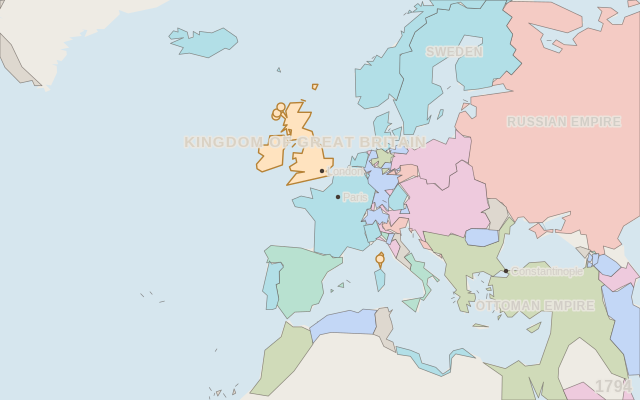
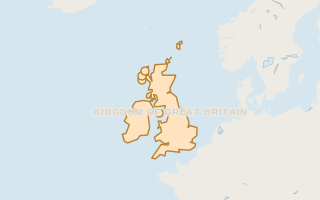
Map: Kingdom of Great Britain in 1794, its borders in gold among its neighbours
Jacobite rising of 1745, 1745 – 1746Battle of Culloden, 1746American Revolution, 1763 – 1783Mutiny on the Bounty, 17891720174017601780
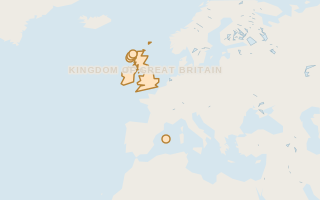
Beside it on the map in 1794: Russian Empire, Ottoman Empire, Sweden, Denmark, Habsburg monarchy and French First Republic.How far it reached, year by year: its ground inside the borders Cliopatria draws (CC BY 4.0), measured on an equal-area grid; the map shows it at its largest, with the cities of the year.

The story

Four acts, 1707 – 1801

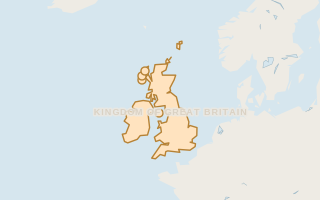
Kingdom of Great Britain in 1755, at the end of act II
II1721 – 1756340,000 → 340,000 km²

The age of Walpole

Robert Walpole dominates the Commons from 1721 to 1742 as the first prime minister, managing Parliament through patronage. He keeps Britain out of war, cuts the land tax and reduces the national debt. His followers Pelham and Newcastle succeed him, and the Jacobite cause is crushed at Culloden in 1746.

Watch this act on the live map, from 1721
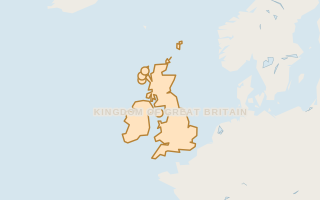
Kingdom of Great Britain in 1774, at the end of act III
III1756 – 1775340,000 → 340,000 km²

Empire won

The Seven Years' War, fought from Europe to India and the Caribbean, starts badly with the loss of Minorca, then turns in the miracle year of 1759 under William Pitt the Elder. In 1763 Britain takes over most of France's North American holdings, the East India Company gains territory in India, and James Cook reaches Australia's eastern coast in 1770.

Watch this act on the live map, from 1756
Kingdom of Great Britain in 1800, at the end of act IV
IV1775 – 1801340,000 → 342,000 km²

America lost, France fought

Parliament's insistence on taxing the colonists without consent drives the Thirteen Colonies to revolt in 1775, and the war ends in American victory. A second empire turns to Asia and the Pacific, planning a penal colony at Botany Bay. War with revolutionary France begins in 1793, and after the Irish rebellion of 1798 Pitt the Younger seeks union with Ireland.

Watch this act on the live map, from 1775

Before and after

Before it

After it

Where it sits in time

3000 BCE2000 BCE1000 BCE110002000Kingdom of England: 927 – 1707Kingdom of Scotland: 843 – 1707United Kingdom of Great Britain and Ireland: 1801 – 1927Kingdom of Great Britain: 1707 – 1801

Five thousand years, 3000 BCE to 2026; the state in gold, what it replaced or followed and what replaced or followed it in grey.

Its people

Lives across the Kingdom of Great Britain

175018001850
Statesmen and generalsWriters, artists and thinkersScientists and explorersLived on after it endedAll its people on the timeline →

How it was governed

4 monarchs

4 monarchs on record, 1707 to 1801; a reign lasted 23 years at the median. Each bar is a reign, as long as it lasted.

Anne, Queen of Great Britain · 1707 – 1714 · died a natural deathGeorge I of Great Britain · 1714 – 1727 · died a natural deathGeorge II of Great Britain · 1727 – 1760 · died a natural deathGeorge III · 1760 – 1801 · left office alive17201740176017801800
How their terms ended, where it is known (4 of 4):Died in office 3Left office alive 1
Every term, with how it ended and its source

Rulers

How 4 reigns ended - choose one to show only those

How they died, where the record says: died of natural causes 4.

RulerReignLengthHow it ended · sourceTo the ruler before
18th century · 4 reigns
Anne, Queen of Great Britain · aged 421707 – 17147 yearsnatural deathcoded by Kokkonen & Sundelldied of natural causes
George I of Great Britain · aged 541714 – 172713 yearsnatural deathcoded by Kokkonen & Sundelldied of natural causes
George II of Great Britain · aged 441727 – 176033 yearsnatural deathcoded by Kokkonen & Sundelldied of natural causeschild
George III · aged 221760 – 180141 yearsleft office aliveread off the dates alonedied of natural causesgrandchild

4 rulers, 4 with terms dated as terms, covering 1707 – 1801. Median reign 23 years. 2 of 3 handovers irregular - a killing, a deposition, a rival claimant, a rising or a coup beside it. A blank in the last column means no kin on record, which is coverage, never “unrelated”.

Heads of government

The line of Prime Minister of the United Kingdom, drawn and never measured: a cabinet is not a reign.

Harriet Jonesundated
Francis Urquhartundated
Jim Hackerundated
Judge McGruderundated
Basil Feilding, 6th Earl of Denbighlived 1719 – 1800
Robert Walpole1721 – 1742
Spencer Compton, 1st Earl of Wilmington1742 – 1743
Henry Pelham1743 – 1754
Thomas Pelham-Holles, 1st Duke of Newcastle1754 – 1756
William Cavendish, 4th Duke of Devonshire1756 – 1757
Thomas Pelham-Holles, 1st Duke of Newcastle1757 – 1762
John Stuart, 3rd Earl of Bute1762 – 1763
George Grenville1763 – 1765
Charles Watson-Wentworth, 2nd Marquess of Rockingham1765 – 1766
William Pitt, 1st Earl of Chatham1766 – 1768
Augustus FitzRoy, 3rd Duke of Grafton1768 – 1770
Frederick North, Lord North1770 – 1782
William Petty, 2nd Earl of Shelburne1782 – 1783
Charles Watson-Wentworth, 2nd Marquess of Rockingham1782 – 1782
William Pitt the Younger1783 – 1801
William Cavendish-Bentinck, 3rd Duke of Portland1783 – 1783
Henry Addington1801 – 1804
William Pitt the Younger1804 – 1806
William Grenville, 1st Baron Grenville1806 – 1807

Flags and arms, in order

  • Coat of arms of Great Britain (1707–1714)
    coat of arms, undatedCoat of arms of Great Britain (1707–1714) · CC BY-SA 3.0 · Sodacan
  • Flag of Great Britain (1707–1800)
    flag, undatedFlag of Great Britain (1707–1800) · Public domain
  • Coat of Arms of Great Britain in Scotland (1707-1714)
    coat of arms, 1707 – 1714Coat of Arms of Great Britain in Scotland (1707-1714) · CC BY-SA 3.0 · Sodacan
  • Coat of arms of Great Britain (1714–1801)
    coat of arms, 1714 – 1801Coat of arms of Great Britain (1714–1801) · CC BY-SA 3.0 · Sodacan
  • Coat of Arms of Great Britain in Scotland (1714-1801)
    coat of arms, 1714 – 1801Coat of Arms of Great Britain in Scotland (1714-1801) · CC BY-SA 3.0 · Sodacan

Its world

Rivals, and who else stood

Who it fought most

Wars and battles both took part in, on whichever side: the record names who took part, not who fought whom.

Meanwhile, elsewhere

The best-known states of other regions that stood while it did; the band is the Kingdom of Great Britain’s own years.

17001725175017751800

How it compares

Among 3,073 states

Stood longer than 45% of 3,073 states
Kingdom of Great Britain · 94 yearsBritish RajInca EmpireHow long it stood, among the states with a recorded end or still standing.
Held more ground at its peak than 68% of 1,464 states
Kingdom of Great Britain · 351,600 km²MalaysiaGermanyThe most ground it held, among the states with a border in Cliopatria.
Had more wars on record per century than 99% of 3,073 states
Kingdom of Great Britain · 4.0Wars recorded per century, among the states, counting the wars the atlas hosts under each.

Why it fell

Why did the Kingdom of Great Britain fall?

Historians still argue. Here is what the atlas records about its last century:

What led to it, and what came of it

Kingdom of Scotland · Linked · 843 – 1707Kingdom of ScotlandKingdom of England · Linked · 927 – 1707Kingdom of EnglandAnglo-Dutch wars · Linked · 1652 – 1784Anglo-Dutch warsGreat Northern War · Linked · 1700 – 1721Great Northern WarWar of the Spanish Succession · Linked · 1701 – 1714War of the Spanish SuccessionBritish America · Coincidence · 1607 – 1783British AmericaKingdom of Great Britain · 1707 – 1801Kingdom of Great BritainUnited Kingdom of Great Britain and Ireland · Linked · 1801 – 1927United Kingdom of Great Britain …Chesapeake–Leopard affair · Linked · 1807Chesapeake–Leopard affair80010001200140016001800
linkedcoincidence

Open the investigation: every row with its evidence, the conditions at the time, the theories condition by condition, and the succession analysed.

Theories that apply to its ending

  • Dynastic cycle and the decay of group feeling

    Ibn Khaldun 1377 · Turchin & Nefedov 2009

    Applies by its own logic: the condition it names held here, and this is the kind of outcome it predicts — adverse regime change or the state's ending.

    • the state 90 to 160 years old — ageBand 94

Its centuries in the record

1700 – 1799: 238 recorded — 21 wars and battles, 12 risings, regime changes and massacres, 205 other17001800 – 1899: 3 recorded — 0 wars and battles, 0 risings, regime changes and massacres, 3 other1800

Wars and battles in red, risings, coups and massacres beside them, everything else in grey, by the century each began in. A tall bar is partly a fact about Wikipedia: better-documented centuries hold more.

Each century’s own page:1700 – 17991800 – 1899

Keep exploring

Share this page
Copy link
Embed the map
Cite this page

How this page is made

Drawn from Wikidata (Q161885, CC0), the opening and history of its English Wikipedia article retold by the atlas (CC BY-SA 4.0), borders from Cliopatria (CC BY 4.0), coast and rivers from Natural Earth, cities from Reba, Reitsma & Seto 2016 (CC BY 4.0), symbols from Wikimedia Commons, each under its own licence. Data built 2026-11-26 · Pastlas v2.47.1, by Oleh Voronko; the published atlas and its data are for non-commercial use.

How to read it

Areas are measured on an equal-area grid from borders simplified to about five kilometres. “c.” marks an approximate date, and a date known to the century is never printed to the year. Counts are what the atlas holds, and they follow Wikipedia’s coverage: a busy century is partly a fact about the record.

Something wrong?

Tell us and name the entry. We fix the data, not just this page.

Report a problem