State · Europe

County of Empúries

812 – 1402 · 590 years

Came after Spanish march · became Crown of Aragon and Principality of Catalonia

It was founded in 812, replacing Spanish march.↓ In 1000, the first year its borders are mapped, it covered 400 km².↓

Continue reading

It reached its greatest extent in 1028: 900 km².↓ Its line counts 30 rulers, covering 813 – 1410, the median reign 16 years; 3 of 29 handovers were irregular.↓ Among them, Martin of Aragon, Humfrid and Berengar the Wise are the best known.↓ The atlas files 24 rows under it, most of them people.↓

It was replaced by the Crown of Aragon and the Principality of Catalonia in 1402, 590 years after it began.↓

590 years

Longer than Huns, shorter than the Ottoman Empire

900 km²

At its height in 1028 · about the size of Bahrain

30 rulers

the Count of Empúries

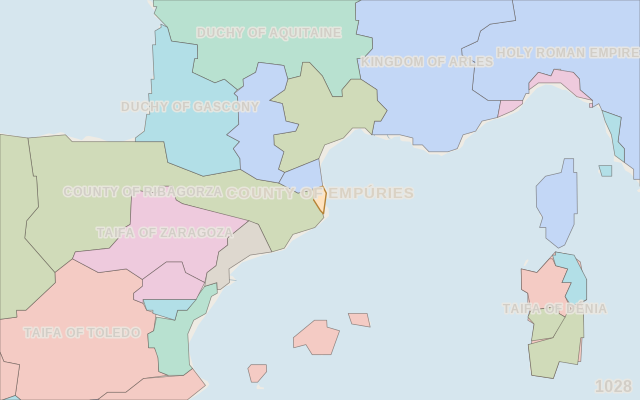
Map: County of Empúries in 1028, its borders in gold among its neighbours
1100120013001400
Beside it on the map in 1028: County of Ribagorza, Holy Roman Empire, Kingdom of Arles, Taifa of Toledo, Duchy of Aquitaine and Duchy of Gascony.How far it reached, year by year: its ground inside the borders Cliopatria draws (CC BY 4.0), measured on an equal-area grid; the map shows it at its largest, with the cities of the year.

The story

Its key moments

Before and after

Before it

  • Spanish march · replaces

After it

Where it sits in time

3000 BCE2000 BCE1000 BCE110002000Crown of Aragon: 1162 – 1715Principality of Catalonia: 1173 – 1714County of Empúries: 812 – 1402

Five thousand years, 3000 BCE to 2026; the state in gold, what it replaced or followed and what replaced or followed it in grey.

Its people

Lives across the County of Empúries

90010001100120013001400
Statesmen and generalsAll its people on the timeline →

How it was governed

30 counts

30 counts on record, 813 to 1410; a reign lasted 16 years at the median. Each bar is a reign, as long as it lasted.

Ermenguer · 813 – 817 · left office aliveGaucelm · 817 – 832 · left office aliveBerengar the Wise · 832 – 835 · died in office, manner not recordedSunyer I of Empúries · 835 – 848 · died in office, manner not recordedWilliam of Septimania · 848 – 850 · executedHumfrid · 858 – 862 · no death date to read the end againstDela · 862 – 894 · died in office, manner not recordedSunyer II of Empúries · 862 – 915 · died in office, manner not recordedBencion · 915 – 916 · died in office, manner not recordedGausbert · 915 – 931 · died in office, manner not recordedGausfred I · 931 – 991 · died in office, manner not recordedHugh I of Empúries · 991 – 1040 · died in office, manner not recordedPonzio I di Empúries · 1040 – 1078 · died in office, manner not recordedHugh II of Empúries · 1078 – 1116 · died in office, manner not recordedPonç II d'Empúries · 1116 – 1154 · died in office, manner not recordedHug III d'Empúries · 1154 – 1173 · died in office, manner not recordedPonzio III di Empúries · 1173 – 1200 · died in office, manner not recordedUgo IV di Empúries · 1200 – 1230 · died in office of natural causesPonzio IV di Empúries · 1230 – 1269 · died in office, manner not recordedUgo V di Empúries · 1269 – 1277 · died in office, manner not recordedPonç V of Empúries · 1277 – 1313 · died in office, manner not recordedPonzio VI di Empúries · 1313 – 1322 · died in office, manner not recordedMarquesa d'Empúries · 1322 – 1322 · left office aliveHugo I de Cardona · 1322 – 1325 · left office alivePeter, Count of Ribagorza · 1325 – 1341 · left office aliveRaimondo Berengario d'Aragona · 1341 – 1364 · left office aliveJohn I, Count of Empúries · 1364 – 1398 · died in office, manner not recordedJohn II, Count of Empúries · 1398 – 1401 · died in office, manner not recordedPeter III, Count of Empúries · 1401 – 1401 · died in office, manner not recordedMartin of Aragon · 1402 – 1410 · died in office, manner not recorded90010001100120013001400
a second row: a reign that began before the last had ended — rival claimants, or a shared throne
How their terms ended, where it is known (29 of 30):Killed 1Died in office 22Left office alive 6Not on record 1
Every term, with how it ended and its source

Rulers

How 30 reigns ended - choose one to show only those

How they died, where the record says: executed 2 · died of natural causes 1.

RulerReignLengthHow it ended · sourceTo the ruler before
9th century · 8 reigns · 1 killed or removed
Ermenguer · aged 13813 – 8174 yearsleft office aliveread off the dates alone
Gaucelm · aged 21817 – 83215 yearsleft office aliveread off the dates aloneexecuted
Berengar the Wise · aged 42832 – 8353 yearsdied in officeread off the dates alone
Sunyer I of Empúries835 – 84813 yearsdied in officeread off the dates alone
William of Septimania · aged 22848 – 8502 yearsexecutedWikidata's manner of death
Humfrid858 – 8624 yearsending not on record
Dela862 – 89432 yearsdied in officeread off the dates alone
Sunyer II of Empúries · aged 22862 – 91553 yearsdied in officeread off the dates alonesibling
10th century · 4 reigns
Bencion · aged 15915 – 9161 yeardied in officeread off the dates alonechild
Gausbert915 – 93116 yearsdied in officeread off the dates alonesibling
Gausfred I · aged 30931 – 99160 yearsdied in officeread off the dates alonechild
Hugh I of Empúries · aged 26991 – 104049 yearsdied in officeread off the dates alonechild
11th century · 2 reigns
Ponzio I di Empúries · aged 501040 – 107838 yearsdied in officeread off the dates alonechild
Hugh II of Empúries · aged 431078 – 111638 yearsdied in officeread off the dates alonechild
12th century · 4 reigns
Ponç II d'Empúries · aged 1151116 – 115438 yearsdied in officeread off the dates alonechild
Hug III d'Empúries1154 – 117319 yearsdied in officeread off the dates alonechild
Ponzio III di Empúries · aged 381173 – 120027 yearsdied in officeread off the dates alonechild
Ugo IV di Empúries · aged 301200 – 123030 yearsdied in officeWikidata's manner of deathdied of natural causeschild
13th century · 3 reigns
Ponzio IV di Empúries · aged 251230 – 126939 yearsdied in officeread off the dates alonechild
Ugo V di Empúries · aged 291269 – 12778 yearsdied in officeread off the dates alonechild
Ponç V of Empúries1277 – 131336 yearsdied in officeread off the dates alonechild
14th century · 7 reigns
Ponzio VI di Empúries · aged 231313 – 13229 yearsdied in officeread off the dates alonechild
Marquesa d'Empúries1322 – 1322under a yearleft office aliveread off the dates alonechild
Hugo I de Cardona1322 – 13253 yearsleft office aliveread off the dates alone
Peter, Count of Ribagorza · aged 201325 – 134116 yearsleft office aliveread off the dates alone
Raimondo Berengario d'Aragona · aged 331341 – 136423 yearsleft office aliveread off the dates alonesibling
John I, Count of Empúries · aged 261364 – 139834 yearsdied in officeread off the dates alonechild
John II, Count of Empúries · aged 231398 – 14013 yearsdied in officeread off the dates alonechild
15th century · 2 reigns
Peter III, Count of Empúries1401 – 1401under a yeardied in officeread off the dates alonesibling
Martin of Aragon · aged 461402 – 14108 yearsdied in officeread off the dates alone

30 rulers, 30 with terms dated as terms, covering 813 – 1410. Median reign 16 years. 3 of 29 handovers irregular - a killing, a deposition, a rival claimant, a rising or a coup beside it. A blank in the last column means no kin on record, which is coverage, never “unrelated”.

Flags and arms, in order

  • Escut del comtat d'Empúries
    coat of arms, undatedEscut del comtat d'Empúries · CC BY-SA 3.0
  • Bandera del Comtat d'Empúries
    flag, undatedBandera del Comtat d'Empúries · Public domain
  • Blason fascé d'or et de gueules
    coat of arms, undatedBlason fascé d'or et de gueules · CC BY-SA 3.0

Its world

Who else stood

Meanwhile, elsewhere

The best-known states of other regions that stood while it did; the band is the County of Empúries’s own years.

800100012001400

How it compares

Among 3,073 states

Stood longer than 90% of 3,073 states
County of Empúries · 590 yearsHunsOttoman EmpireHow long it stood, among the states with a recorded end or still standing.
Held more ground at its peak than 2% of 1,464 states
County of Empúries · 900 km²SingaporeLuxembourgThe most ground it held, among the states with a border in Cliopatria.

Why it fell

Why did the County of Empúries fall?

Historians still argue. Here is what the atlas records about its last century:

What led to it, and what came of it

Spanish march · Linked · 750 – 987Spanish marchCounty of Empúries · 812 – 1402County of EmpúriesDuchy of Girona · Linked · 1351 – 1416Duchy of GironaPrincipality of Catalonia · Linked · 1173 – 1714Principality of CataloniaCrown of Aragon · Linked · 1162 – 1715Crown of Aragon8001000120014001600
linked

Open the investigation: every row with its evidence, the conditions at the time, the theories condition by condition, and the succession analysed.

Its centuries in the record

800 – 899: 3 recorded — 0 wars and battles, 0 risings, regime changes and massacres, 3 other800900 – 999: 5 recorded — 0 wars and battles, 0 risings, regime changes and massacres, 5 other9001000 – 1099: 2 recorded — 0 wars and battles, 0 risings, regime changes and massacres, 2 other10001100 – 1199: 3 recorded — 0 wars and battles, 0 risings, regime changes and massacres, 3 other11001200 – 1299: 4 recorded — 0 wars and battles, 0 risings, regime changes and massacres, 4 other12001300 – 1399: 5 recorded — 0 wars and battles, 0 risings, regime changes and massacres, 5 other13001400 – 1499: 1 recorded — 0 wars and battles, 0 risings, regime changes and massacres, 1 other1400

Wars and battles in red, risings, coups and massacres beside them, everything else in grey, by the century each began in. A tall bar is partly a fact about Wikipedia: better-documented centuries hold more.

Each century’s own page:800 – 899900 – 9991000 – 10991100 – 11991200 – 12991300 – 13991400 – 1499

Keep exploring

Share this page
Copy link
Embed the map
Cite this page

How this page is made

Drawn from Wikidata (Q1541699, CC0), borders from Cliopatria (CC BY 4.0), coast and rivers from Natural Earth, cities from Reba, Reitsma & Seto 2016 (CC BY 4.0), symbols from Wikimedia Commons, each under its own licence. Data built 2026-11-26 · Pastlas v2.47.1, by Oleh Voronko; the published atlas and its data are for non-commercial use.

How to read it

Areas are measured on an equal-area grid from borders simplified to about five kilometres. “c.” marks an approximate date, and a date known to the century is never printed to the year. Counts are what the atlas holds, and they follow Wikipedia’s coverage: a busy century is partly a fact about the record.

Something wrong?

Tell us and name the entry. We fix the data, not just this page.

Report a problem