State · Europe

Kingdom of Castile

1065 – 1833 · 768 years

Came after Almohad Caliphate and County of Castilla · became Crown of Castile

A frontier land of castles that became a kingdom, won southern Iberia from Islamic principalities and joined Aragon to form Spain.

Castile began as a county on the eastern frontier of León, guarded by castles, whose counts gained autonomy in the 10th century; in 1065 it was raised to a separate kingdom. Joined to León from 1072 to 1157, and for good after 1230, it won wide lands in southern Iberia from the Islamic principalities. The marriage of Isabella I of Castile and Ferdinand II of Aragon bound it to Aragon in the first single political unit called Spain.

What the record holds

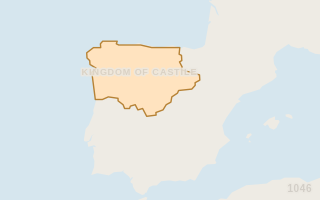
It was founded in 1065, replacing the County of Castilla.↓ In 1046, the first year its borders are mapped, it covered 166,900 km².↓

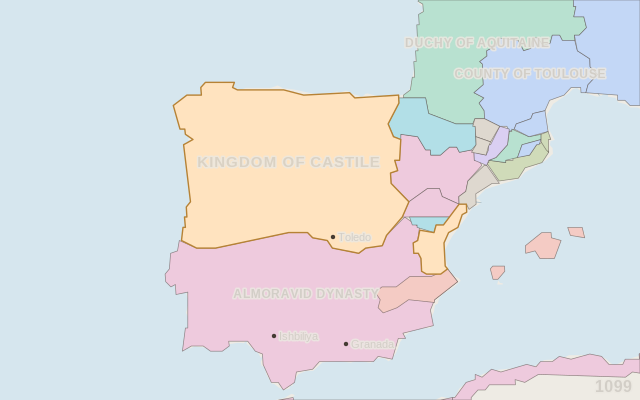
Its ground peaked in 1099 at 256,900 km².↓ Its highest office was held by 9 rulers, covering 1065 – 1230, the median reign 7 years; 1 of 8 handovers was irregular.↓ Among them, Ferdinand III of Castile, Alfonso VI of León and Castile and Alfonso VIII of Castile are the best known.↓ The atlas files 10 rows under it, most of them people.↓

The Crown of Castile followed it in 1833, after 768 years.↓

From Wikipedia’s article, retold · CC BY-SA 4.0

768 years

Longer than the Ottoman Empire, shorter than the House of Habsburg

257,000 km²

At its height in 1099 · about the size of Ecuador

9 rulers

the Monarch of the Kingdom of Castile

1 war or battle

10 entries in all

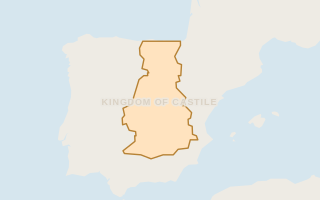
Map: Kingdom of Castile in 1099, its borders in gold among its neighbours
110011501200
Beside it on the map in 1099: Almoravid dynasty, Duchy of Aquitaine, County of Toulouse, Holy Roman Empire, Taifa of Zaragoza and Kingdom of Aragon.How far it reached, year by year: its ground inside the borders Cliopatria draws (CC BY 4.0), measured on an equal-area grid; the map shows it at its largest, with the cities of the year.

The story

Four acts, 1065 – 1833

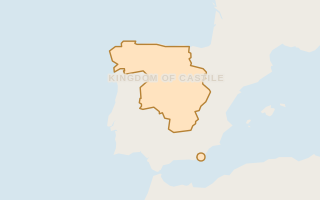
Kingdom of Castile in 1156, at the end of act I
I1065 – 1157167,000 → 217,000 km²

Kingdom, then union with León

Sancho II rules Castile as a kingdom from 1065. From 1072 Alfonso VI holds León and Castile together, and Urraca and Alfonso VII keep them joined while their kings push south against the Islamic principalities. Centuries of Moorish rule have made the high central plateau a vast sheep pasture, and Arabic gives Spanish most of its sheep-rearing words.

Watch this act on the live map, from 1065
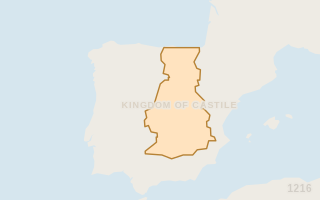
Kingdom of Castile in 1216, last mappedKingdom of Castile in 1046, first mapped
The rise and the fall in one frame: drag across it from 1046, first mapped at 166,900 km², to 1216, last mapped at 156,400 km². Open the live map in 1046 or 1216.

Before and after

Before it

After it

Where it sits in time

3000 BCE2000 BCE1000 BCE110002000Almohad Caliphate: 1121 – 1269Crown of Castile: 1230 – 1715Kingdom of Castile: 1065 – 1833

Five thousand years, 3000 BCE to 2026; the state in gold, what it replaced or followed and what replaced or followed it in grey.

Its people

Lives across the Kingdom of Castile

120014001600
Statesmen and generalsWriters, artists and thinkersAll its people on the timeline →

How it was governed

9 monarchs

9 monarchs on record, 1065 to 1230; a reign lasted 7 years at the median. Each bar is a reign, as long as it lasted.

Sancho II of Castile and León · 1065 – 1072 · deposed or killedAlfonso VI of León and Castile · 1072 – 1109 · died a natural deathUrraca of León and Castile · 1109 – 1111 · died a natural deathAlfonso VII of León and Castile · 1126 – 1157 · ended otherwise, as coded — neither deposed nor a natural deathSancho III of Castile · 1157 – 1158 · died a natural deathAlfonso VIII of Castile · 1158 – 1214 · died a natural deathHenry I of Castile · 1214 – 1217 · died a natural deathBerengaria of Castile · 1217 – 1217 · died a natural deathFerdinand III of Castile · 1217 – 1230 · died a natural death1200140016001800
How their terms ended, where it is known (9 of 9):Deposed or removed 1Died in office 7Left office alive 1
Every term, with how it ended and its source

Rulers

How 9 reigns ended - choose one to show only those

How they died, where the record says: killed 1 · died of natural causes 1 · died by accident 1.

RulerReignLengthHow it ended · sourceTo the ruler before
11th century · 2 reigns · 1 killed or removed
Sancho II of Castile and León · aged 291065 – 10727 yearsdeposed or killedcoded by Kokkonen & Sundellkilled
Alfonso VI of León and Castile · aged 321072 – 110937 yearsnatural deathcoded by Kokkonen & Sundellsibling
12th century · 4 reigns
Urraca of León and Castile · aged 281109 – 11112 yearsnatural deathcoded by Kokkonen & Sundelldied of natural causeschild
Alfonso VII of León and Castile · aged 211126 – 115731 yearsended otherwisecoded by Kokkonen & Sundellchild
Sancho III of Castile · aged 231157 – 11581 yearnatural deathcoded by Kokkonen & Sundellchild
Alfonso VIII of Castile · aged 31158 – 121456 yearsnatural deathcoded by Kokkonen & Sundellchild
13th century · 3 reigns
Henry I of Castile · aged 101214 – 12173 yearsnatural deathcoded by Kokkonen & Sundelldied by accidentchild
Berengaria of Castile · aged 371217 – 1217under a yearnatural deathcoded by Kokkonen & Sundellsibling
Ferdinand III of Castile · aged 181217 – 123013 yearsnatural deathcoded by Kokkonen & Sundellchild

9 rulers, 9 with terms dated as terms, covering 1065 – 1230. Median reign 7 years. 1 of 8 handovers irregular - a killing, a deposition, a rival claimant, a rising or a coup beside it. A blank in the last column means no kin on record, which is coverage, never “unrelated”.

Flags and arms, in order

  • Royal Banner of the Kingdom of Castile
    flag, undatedRoyal Banner of the Kingdom of Castile · CC BY-SA 3.0 · Heralder
  • Royal Arms of Castille (1214-15th Century)
    coat of arms, undatedRoyal Arms of Castille (1214-15th Century) · CC BY-SA 3.0 · Heralder

Its world

Rivals, and who else stood

Who it fought most

Wars and battles both took part in, on whichever side: the record names who took part, not who fought whom.

Meanwhile, elsewhere

The best-known states of other regions that stood while it did; the band is the Kingdom of Castile’s own years.

10001200140016001800

How it compares

Among 3,073 states

Stood longer than 94% of 3,073 states
Kingdom of Castile · 768 yearsOttoman EmpireHouse of HabsburgHow long it stood, among the states with a recorded end or still standing.
Held more ground at its peak than 63% of 1,464 states
Kingdom of Castile · 256,900 km²GuineaEcuadorThe most ground it held, among the states with a border in Cliopatria.

Why it fell

Why did the Kingdom of Castile fall?

Historians still argue. Here is what the atlas records about its last century:

What led to it, and what came of it

Reconquista · Linked · 722 – 1492ReconquistaEl Cid · Coincidence · 1048 – 1099El CidKingdom of Castile · 1065 – 1833Kingdom of Castile80010001200140016001800
linkedcoincidence

Open the investigation: every row with its evidence, the conditions at the time, the theories condition by condition, and the succession analysed.

Its centuries in the record

1000 – 1099: 1 recorded — 0 wars and battles, 0 risings, regime changes and massacres, 1 other10001100 – 1199: 6 recorded — 1 wars and battles, 0 risings, regime changes and massacres, 5 other11001200 – 1299: 1 recorded — 0 wars and battles, 0 risings, regime changes and massacres, 1 other12001300 – 1399: 0 recorded — 0 wars and battles, 0 risings, regime changes and massacres, 0 other13001400 – 1499: 1 recorded — 0 wars and battles, 0 risings, regime changes and massacres, 1 other14001500 – 1599: 1 recorded — 0 wars and battles, 0 risings, regime changes and massacres, 1 other15001600 – 1699: 0 recorded — 0 wars and battles, 0 risings, regime changes and massacres, 0 other16001700 – 1799: 0 recorded — 0 wars and battles, 0 risings, regime changes and massacres, 0 other17001800 – 1899: 0 recorded — 0 wars and battles, 0 risings, regime changes and massacres, 0 other1800

Wars and battles in red, risings, coups and massacres beside them, everything else in grey, by the century each began in. A tall bar is partly a fact about Wikipedia: better-documented centuries hold more.

Each century’s own page:1000 – 10991100 – 11991200 – 12991300 – 13991400 – 14991500 – 15991600 – 16991700 – 17991800 – 1899

Keep exploring

Share this page
Copy link
Embed the map
Cite this page

How this page is made

Drawn from Wikidata (Q179293, CC0), the opening and history of its English Wikipedia article retold by the atlas (CC BY-SA 4.0), borders from Cliopatria (CC BY 4.0), coast and rivers from Natural Earth, cities from Reba, Reitsma & Seto 2016 (CC BY 4.0), symbols from Wikimedia Commons, each under its own licence. Data built 2026-11-26 · Pastlas v2.47.1, by Oleh Voronko; the published atlas and its data are for non-commercial use.

How to read it

Areas are measured on an equal-area grid from borders simplified to about five kilometres. “c.” marks an approximate date, and a date known to the century is never printed to the year. Counts are what the atlas holds, and they follow Wikipedia’s coverage: a busy century is partly a fact about the record.

  • ends in 1715 and 1833; the atlas draws the article's infobox.

Something wrong?

Tell us and name the entry. We fix the data, not just this page.

Report a problem