Romanian revolution
unrest · 15 December 1989
State · Europe
1989 – present · 37 years · still standing
Came after  Socialist Republic of Romania and
 United Principalities of Moldavia and Wallachia
Romania after Ceaușescu: a democracy on the lower Danube, born in revolution and now inside NATO and the European Union.
Romania's present republic was born in December 1989, when a protest in Timișoara for the pastor László Tőkés grew into a national uprising and Nicolae Ceaușescu and his wife Elena were executed on 25 December. An interim council of civic figures and former communists took power, with Ion Iliescu as provisional president, and reversed much of the old regime's authoritarian policy. Romania has since joined NATO and the European Union.
Romania began in 1989, replacing the Socialist Republic of Romania and the United Principalities of Moldavia and Wallachia.↓ Its borders are first mapped in 1990, around 237,600 km².↓
Its highest office was held by 9 rulers, covering 1974 – 2025, the median reign 5 years; 1 of 8 handovers was irregular.↓ Among them,  Nicolae Ceaușescu,
 Klaus Iohannis and
 Traian Băsescu are the best known.↓ The atlas files 40 rows under it, most of them people.↓
From Wikipedia’s article, retold · CC BY-SA 4.0
Best known for
37 years
Longer than Daman and Diu, shorter than East Germany
238,000 km²
At its height in 1990 · about the size of Ghana
9 rulers
the president of Romania
1 war or battle
More per century than 92% of states · 40 entries in all
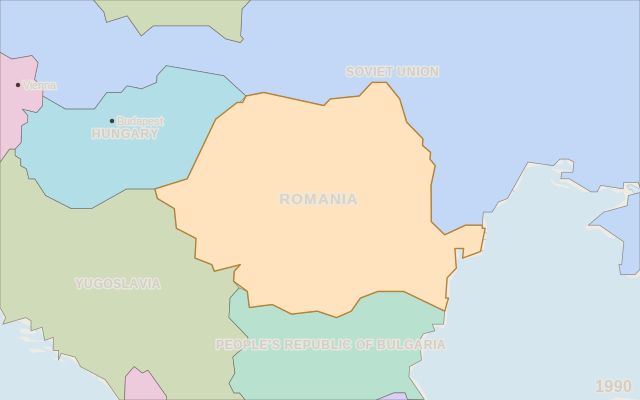
 Soviet Union,
 Yugoslavia,
 Hungary,
 People's Republic of Bulgaria,
 Czechoslovakia and
 Poland.How far it reached, year by year: its ground inside the borders Cliopatria draws (CC BY 4.0), measured on an equal-area grid; the map shows it at its largest, with the cities of the year.
The story
The best-known wars, battles, risings and changes of regime the record files under it; a war within a war is folded into it.
unrest · 15 December 1989
unrest · 22 April 1990
war · March 1990
unrest · 2012
unrest · 18 January 2017
The states the record files it as replacing or following, and those that replaced or followed it - Wikidata's own statements, each read from this state's side.
Socialist Republic of Romania · replaces · 1965 – 1989United Principalities of Moldavia and Wallachia · replaces · 1859 – 1881Five thousand years, 3000 BCE to 2026; the state in gold, what it replaced or followed and what replaced or followed it in grey.
Its people
One axis for everyone, so you can see who knew whom: the best-known, ordered by birth.
 Ion Iliescupresident · revolutionary1930 – 2025
 Emil Constantinescupresident1939 – present
 Nicolae Văcăroiupolitician1943 – present
 Adrian Năstasepolitician · diplomat1950 – present
 Traian Băsescupresident1951 – present
 Călin Popescu-Tăriceanuengineer · politician1952 – present
 Klaus Iohannispresident · statesperson1959 – present
 Viorica Dăncilăengineer · politician1963 – present
 Emil Bocscientist · politician1966 – present
 Marcel Ciolacupolitician1967 – present
 Nicolae Ciucăpolitician1967 – present
 Nicușor Danpresident · mathematician1969 – present
 Dacian Cioloșengineer · politician1969 – present
 Ilie Bolojanpresident1969 – present
 Victor Pontapolitician1972 – present
 Florin Cîțupolitician1972 – present
 Sorin Grindeanuengineer · politician1973 – present
How it was governed
9 presidents on record, 1974 to 2025; a reign lasted 5 years at the median. Each bar is a reign, as long as it lasted.
The line of president of Romania - the office this state names as its head of state.
| Ruler | Reign | Length | How it ended · source | To the ruler before |
|---|---|---|---|---|
| 20th century · 4 reigns | ||||
 Nicolae Ceaușescu · aged 56 | 1974 – 1989 | 15 years | ended by an eventWikidata's end cause on the term | |
| Ion Iliescu · aged 60 | 1990 – 1996 | 6 years | left office aliveread off the dates alonedied of natural causes | |
| Emil Constantinescu · aged 57 | 1996 – 2000 | 4 years | ending not on record | |
| Ion Iliescu · aged 70 | 2000 – 2004 | 4 years | left office aliveread off the dates alonedied of natural causes | |
| 21st century · 5 reigns | ||||
| Traian Băsescu · aged 53 | 2004 – 2014 | 10 years | ending not on record | |
 Crin Antonescu · aged 53 | 2012 – 2012 | under a year | ending not on record | |
| Klaus Iohannis · aged 55 | 2014 – 2025 | 11 years | resignedread from the ruler's own article | |
| Ilie Bolojan · aged 56 | 2025 – 2025 | under a year | ending not on record | |
| Nicușor Dan · aged 56 | 2025 – in office | in office since 2025 | still in office | |
9 rulers, 8 with terms dated as terms, covering 1974 – 2025. Median reign 5 years. 1 of 8 handovers irregular - a killing, a deposition, a rival claimant, a rising or a coup beside it. The violent-handover count is withheld: power changed hands so often that any rising falls beside one (exposure 0.71, limit 0.6). A blank in the last column means no kin on record, which is coverage, never “unrelated”.
The line of Prime Minister of Romania, drawn and never measured: a cabinet is not a reign.
 Constantin Dăscălescu | 1982 – 1989 |
 Petre Roman | 1989 – 1991 |
 Theodor Stolojan | 1991 – 1992 |
 Nicolae Văcăroiu | 1992 – 1996 |
 Victor Ciorbea | 1996 – 1998 |
 Gavril Dejeu | 1998 – 1998 |
| Radu Vasile | 1998 – 1999 |
 Mugur Isărescu | 1999 – 2000 |
| Alexandru Athanasiu | 1999 – 1999 |
 Adrian Năstase | 2000 – 2004 |
 Călin Popescu-Tăriceanu | 2004 – 2008 |
 Emil Boc | 2008 – 2012 |
 Cătălin Predoiu | 2012 – 2012 |
 Mihai Răzvan Ungureanu | 2012 – 2012 |
 Victor Ponta | 2012 – 2015 |
 Sorin Cîmpeanu | 2015 – 2015 |
 Dacian Cioloș | 2015 – 2017 |
 Mihai Tudose | 2017 – 2018 |
 Sorin Grindeanu | 2017 – 2017 |
 Mihai Fifor | 2018 – 2018 |
 Viorica Dăncilă | 2018 – 2019 |
 Ludovic Orban | 2019 – 2020 |
 Florin Cîțu | 2020 – 2021 |
 Nicolae Ciucă | 2021 – 2023 |
| Cătălin Predoiu | 2023 – 2023 |
 Marcel Ciolacu | 2024 – 2025 |
| Cătălin Predoiu | 2025 – 2025 |
 Ilie Bolojan | 2025 – … |
Each symbol with the years its own statement gives; the timeline flies the one of the year on screen.


 Nicolae Ceaușescu15 yrsKlaus Iohannis11 yrsIon Iliescu10 yrsTraian Băsescu10 yrsEmil Constantinescu4 yrs
Its world
Wars and battles both took part in, on whichever side: the record names who took part, not who fought whom.
 United KingdomIraq War4Czech RepublicIraq War4PolandIraq War4
 GeorgiaIraq War3
 United StatesIraq War3
 DenmarkIraq War3
 ItalyIraq War3
The best-known states of other regions that stood while it did; the band is Romania’s own years.
United StatesAmericas and Oceania MexicoAmericas and Oceania
 TurkeyMiddle East and North Africa
 JapanEast and Southeast Asia
 People's Republic of ChinaEast and Southeast Asia
 IndiaSouth Asia
 EgyptMiddle East and North Africa
 South AfricaSub-Saharan Africa
How it compares
Each column is a share of the states; gold is Romania.
How it began
The present Romanian state was born in the revolution of December 1989, when an uprising that began in Timișoara overthrew the communist regime and Ceaușescu was executed.
The investigation's own picture: 18 causes the record names and 0 results, the strongest six of each at their own years, joined to the state by the kind of claim - a recorded statement solid, the article's sentence dashed, a theory dash-dot.
Open the investigation: every row with its evidence, the conditions at the time, the theories condition by condition, and the succession analysed.
Wars and battles in red, risings, coups and massacres beside them, everything else in grey, by the century each began in. A tall bar is partly a fact about Wikipedia: better-documented centuries hold more.
Each century’s own page:1900 – 19992000 – 2099
“Romania”, Pastlas, a historical atlas, 2026-11-26. https://app.pastlas.com/state/romania/
Drawn from Wikidata (Q218, CC0), the opening and history of its English Wikipedia article retold by the atlas (CC BY-SA 4.0), borders from Cliopatria (CC BY 4.0), coast and rivers from Natural Earth, cities from Reba, Reitsma & Seto 2016 (CC BY 4.0), symbols from Wikimedia Commons, each under its own licence. Data built 2026-11-26 · Pastlas v2.47.1, by Oleh Voronko; the published atlas and its data are for non-commercial use.
Areas are measured on an equal-area grid from borders simplified to about five kilometres. “c.” marks an approximate date, and a date known to the century is never printed to the year. Counts are what the atlas holds, and they follow Wikipedia’s coverage: a busy century is partly a fact about the record.