State · Europe

Yugoslavia

1918 – 1992 · 74 years

Became Federal Republic of Yugoslavia and post-Yugoslavia states

The first union of the South Slavs: a kingdom, then Tito's federation of six republics, which broke apart in war.

Yugoslavia was formed after World War I, when the Kingdom of Serbia merged with the State of Slovenes, Croats and Serbs; it was the Kingdom of Serbs, Croats and Slovenes until 1929, then the Kingdom of Yugoslavia. After the Axis invasion of 1941, Communist-led Partisans fought on, and in November 1945 a Constituent Assembly made the country a federal republic. Josip Broz Tito ruled it until his death in 1980. It ceased to exist in 1992.

What the record holds

The record dates its beginning to 1918.↑ When the borders dataset first draws it, in 1919, it held 243,800 km².↓

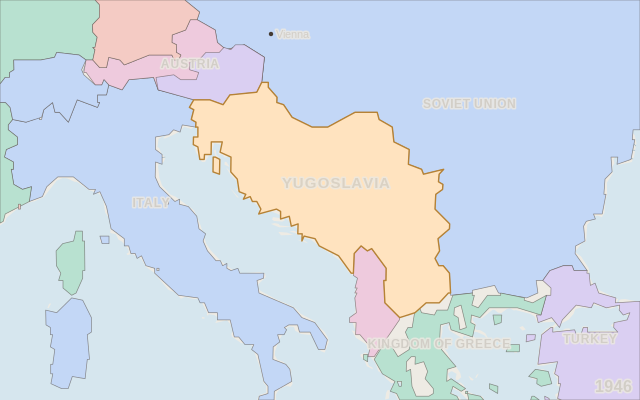
At its largest, in 1946, it held 250,300 km².↓ Its highest office was held by 26 rulers, covering 1920 – 1991, the median reign 1.5 years; 7 of 9 handovers were irregular.↓ The best known of them are Milka Planinc, Ante Marković and Anton Korošec.↓ Most of the 104 rows the atlas files under it are people.↓

In 1992, after 74 years, it was replaced by the Federal Republic of Yugoslavia and the post-Yugoslavia states.↓ Its end fits “Demographic-structural breakdown”, “Elite conflict” and “The five conditions of revolution”, every condition present.↓

From Wikipedia’s article, retold · CC BY-SA 4.0

74 years

Longer than Jammu and Kashmir, shorter than the Empire of Japan

250,000 km²

At its height in 1946 · about the size of Guinea

26 rulers

the Prime Minister of Yugoslavia

6 wars and battles

More per century than 96% of states · 104 entries in all

Map: Yugoslavia in 1946, its borders in gold among its neighbours
Yugoslav coup d'état, 1941World War II in Yugoslavia, 1941 – 1945Battle of Odžak, 19451981 protests in Kosovo, 1981193019401950196019701980
Beside it on the map in 1946: Soviet Union, Italy, Turkey, Provisional Government of the French Republic, Kingdom of Greece and Austria.How far it reached, year by year: its ground inside the borders Cliopatria draws (CC BY 4.0), measured on an equal-area grid; the map shows it at its largest, with the cities of the year.

The story

Four acts, 1918 – 1992

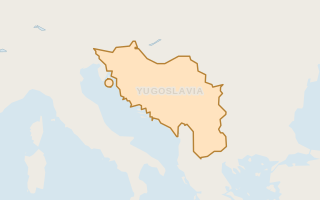
Yugoslavia in 1940, at the end of act I
I1918 – 1941

Kingdom of the South Slavs

Peter I is the first monarch of the new Kingdom of Serbs, Croats and Slovenes, recognised in Paris in 1922. His son Alexander I rules through political crisis, imposes the 6 January Dictatorship, renames the country Yugoslavia in 1929 and is assassinated in 1934. Prince Paul acts as regent until a coup in March 1941 declares Peter II of age.

Watch this act on the live map, from 1918
II1941 – 1945

Occupation and Partisan war

The Axis invades and occupies the kingdom in April 1941. Communist-led Partisans resist, proclaim a Democratic Federal Yugoslavia and win Allied backing at Tehran in 1943; in 1944 the exiled Peter II recognises their Anti-Fascist Council as the lawful government. In November 1945 an elected Constituent Assembly abolishes the monarchy.

Watch this act on the live map, from 1941
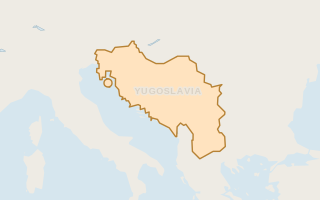
Yugoslavia in 1979, at the end of act III
III1945 – 1980250,000 → 250,000 km²

Tito's federation

Proclaimed a federal republic on 29 November 1945, Yugoslavia gains Istria, Rijeka and Zadar from Italy and lives under four decades of unchallenged communist rule. Josip Broz Tito leads it, first as prime minister and then as president, until his death in 1980; in 1963 it takes its last name, the Socialist Federal Republic of Yugoslavia, uniting six republics.

Watch this act on the live map, from 1945
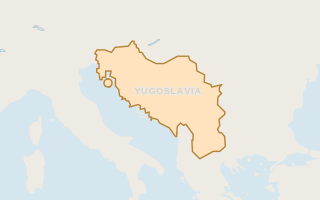
Yugoslavia in 1991, at the end of act IV
IV1980 – 1992250,000 → 250,000 km²

After Tito

After Tito's death, Milka Planinc and later Ante Marković head federal governments. Protests in Kosovo in 1981, the Paraćin massacre of 1987, the Dinamo–Red Star riot of 1990 and protests in Belgrade in 1991 mark the decade. The Yugoslav Wars begin in 1991, and in 1992 the state ends, succeeded by the Federal Republic of Yugoslavia.

Watch this act on the live map, from 1980

Before and after

After it

Where it sits in time

3000 BCE2000 BCE1000 BCE110002000Federal Republic of Yugoslavia: 1992 – 2003Yugoslavia: 1918 – 1992

Five thousand years, 3000 BCE to 2026; the state in gold, what it replaced or followed and what replaced or followed it in grey.

Its people

Lives across Yugoslavia

190019502000
Statesmen and generalsWriters, artists and thinkersLived on after it endedAll its people on the timeline →

How it was governed

26 ministers

26 ministers on record, 1920 to 1991; a reign lasted 1.5 years at the median. Each bar is a reign, as long as it lasted.

Milenko Vesnić · 1920 – 1921 · died in office, manner not recordedAnton Korošec · 1928 – 1929 · left office alivePetar Živković · 1929 – 1932 · left office aliveMilan Stojadinović · 1935 – 1939 · left office aliveDragiša Cvetković · 1939 – 1941 · left office aliveDušan Simović · 1941 – 1942 · left office aliveSlobodan Jovanović · 1942 – 1943 · left office aliveMiloš Trifunović · 1943 – 1943 · resigned or stood down, the article saysMilka Planinc · 1982 – 1986 · served out the term, the article saysAnte Marković · 1989 – 1991 · left office alive1920194019601980
How their terms ended, where it is known (10 of 10):Died in office 1Left office alive 9
Every term, with how it ended and its source

Rulers

How 10 reigns ended - choose one to show only those

How they died, where the record says: died of natural causes 1.

RulerReignLengthHow it ended · sourceTo the ruler before
20th century · 10 reigns
Milenko Vesnić · aged 581920 – 19211 yeardied in officeread off the dates alone
Anton Korošec · aged 561928 – 19291 yearleft office aliveread off the dates alone
Petar Živković · aged 501929 – 19323 yearsleft office aliveread off the dates alone
Milan Stojadinović · aged 471935 – 19394 yearsleft office aliveread off the dates alone
Dragiša Cvetković · aged 461939 – 19412 yearsleft office aliveread off the dates alone
Dušan Simović · aged 591941 – 19421 yearleft office aliveread off the dates alonedied of natural causes
Slobodan Jovanović · aged 731942 – 19431 yearleft office aliveread off the dates alone
Miloš Trifunović · aged 721943 – 1943under a yearresignedread from the ruler's own article
Milka Planinc · aged 581982 – 19864 yearsserved out the termread from the ruler's own article
Ante Marković · aged 651989 – 19912 yearsleft office aliveread off the dates alone

26 rulers, 10 with terms dated as terms, covering 1920 – 1991. Median reign 1.5 years. 7 of 9 handovers irregular - a killing, a deposition, a rival claimant, a rising or a coup beside it. A blank in the last column means no kin on record, which is coverage, never “unrelated”.

Flags and arms, in order

  • Flag of Yugoslavia (1918–1941)
    flag, 1918 – 1945Flag of Yugoslavia (1918–1941) · Public domain
  • Coat of arms of the Kingdom of Yugoslavia
    coat of arms, 1918 – 1941Coat of arms of the Kingdom of Yugoslavia · Public domain
  • Flag of Yugoslavia (1943–1946)
    flag, 1945 – 1946Flag of Yugoslavia (1943–1946) · Public domain
  • Emblem of Yugoslavia (1943–1963)
    coat of arms, 1946 – 1963Emblem of Yugoslavia (1943–1963) · Public domain
  • Flag of Yugoslavia (1946-1992)
    flag, 1946 – 1992Flag of Yugoslavia (1946-1992) · Public domain
  • Emblem of Yugoslavia (1963–1992)
    coat of arms, 1963 – 1992Emblem of Yugoslavia (1963–1992) · Public domain

Its world

Who else stood

Meanwhile, elsewhere

The best-known states of other regions that stood while it did; the band is Yugoslavia’s own years.

19201940196019802000

How it compares

Among 3,073 states

Stood longer than 41% of 3,073 states
Yugoslavia · 74 yearsJammu and KashmirEmpire of JapanHow long it stood, among the states with a recorded end or still standing.
Held more ground at its peak than 63% of 1,464 states
Yugoslavia · 250,300 km²GuineaEcuadorThe most ground it held, among the states with a border in Cliopatria.
Had more wars on record per century than 96% of 3,073 states
Yugoslavia · 2.0Wars recorded per century, among the states, counting the wars the atlas hosts under each.

Why it fell

Why did Yugoslavia fall?

Historians still argue. Here is what the atlas records about its last century:

What led to it, and what came of it

Petar Bojović · Coincidence · 1858 – 1945Petar BojovićSvetozar Pribićević · Coincidence · 1875 – 1936Svetozar PribićevićJohn of Shanghai and San Francisco · Coincidence · 1896 – 1966John of Shanghai and San FranciscoIvan Mihailov · Coincidence · 1896 – 1990Ivan MihailovViktor Pavičić · Coincidence · 1898 – 1943Viktor PavičićAleksandar Ranković · Coincidence · 1909 – 1983Aleksandar RankovićYugoslavia · 1918 – 1992YugoslaviaFederal Republic of Yugoslavia · Linked · 1992 – 2003Federal Republic of Yugoslavia1850190019502000
linkedcoincidence

Open the investigation: every row with its evidence, the conditions at the time, the theories condition by condition, and the succession analysed.

Theories that apply to its ending

  • Demographic-structural breakdown

    Goldstone 1991 · Turchin & Nefedov 2009

    Applies by its own logic: 2 of its 3 conditions held here (it needs 2), and this is the kind of outcome it predicts — unrest, adverse regime change or the state's ending.

    • famine, plague or disaster within 30 y in the state, or population up 25% over 50 y — prior; popGrowth 41
    • a war the state is fighting, still under way, or a war the state fought, ended within 10 y — warOngoing
  • Elite conflict

    Lachmann 2000 · Lachmann 2010

    Applies by its own logic: 2 of its 2 conditions held here (it needs all of them), and this is the kind of outcome it predicts — adverse regime change, unrest or the state's ending.

    • 2 or more elite groups in the regime's support, or a parliament met within 100 y — party elites, business elites, civil servants, the military (1991)
    • an elite group among the regime's opposition within 5 y, or an elite group left the regime's support over 10 y, or a monarch deposed or killed by others within 20 y, or overlapping reigns — rival claimants — within 20 y — party elites (1987)
  • The five conditions of revolution

    Goldstone 2014 · Goldstone 2001

    Applies by its own logic: 4 of its 5 conditions held here (it needs 4), and this is the kind of outcome it predicts — unrest, adverse regime change or the state's ending.

    • GDP per capita down 5% over 5 y, or a war the state is fighting, still under way, or a war the state fought, ended within 5 y, or famine within 5 y in the state — gdpFall -36; warOngoing
    • an elite group among the regime's opposition within 5 y, or an elite group left the regime's support over 10 y, or a monarch deposed or killed within 10 y, or overlapping reigns — rival claimants — within 10 y, or 2 or more reigns of two years or less within 10 y — party elites (1987)
    • mass mobilisation at 3 or more of 4 within 5 y, or a popular class among the regime's opposition within 5 y, or unrest within 5 y in the state — many large-scale and small-scale events (1990); prior
    • anti-system movements at 3 or more of 4 within 5 y — a very high level, a real and present threat (1991)

In the record

104 entries the atlas files under it, all in 1900 – 1999.

Keep exploring

Share this page
Copy link
Embed the map
Cite this page

How this page is made

Drawn from Wikidata (Q36704, CC0), the opening and history of its English Wikipedia article retold by the atlas (CC BY-SA 4.0), borders from Cliopatria (CC BY 4.0), coast and rivers from Natural Earth, cities from Reba, Reitsma & Seto 2016 (CC BY 4.0), symbols from Wikimedia Commons, each under its own licence. Data built 2026-11-26 · Pastlas v2.47.1, by Oleh Voronko; the published atlas and its data are for non-commercial use.

How to read it

Areas are measured on an equal-area grid from borders simplified to about five kilometres. “c.” marks an approximate date, and a date known to the century is never printed to the year. Counts are what the atlas holds, and they follow Wikipedia’s coverage: a busy century is partly a fact about the record.

Something wrong?

Tell us and name the entry. We fix the data, not just this page.

Report a problem