German–Polish Border Treaty
treaty · 14 November 1990
State · Europe
1989 – present · 37 years · still standing
Came after  Polish People's Republic and
 Congress Poland
Solidarity's Poland: the first communist state to return to democracy, remade by shock therapy and anchored in NATO and the EU.
In 1989 Poland became the first communist state to return to liberal democracy and free elections, after the Solidarity movement, born in 1980, helped bring down the communist government. Leszek Balcerowicz's shock therapy turned the planned economy into a market one, and by 1995 Poland was the first post-communist country back at its 1989 output. It joined NATO in 1999 and the European Union on 1 May 2004.
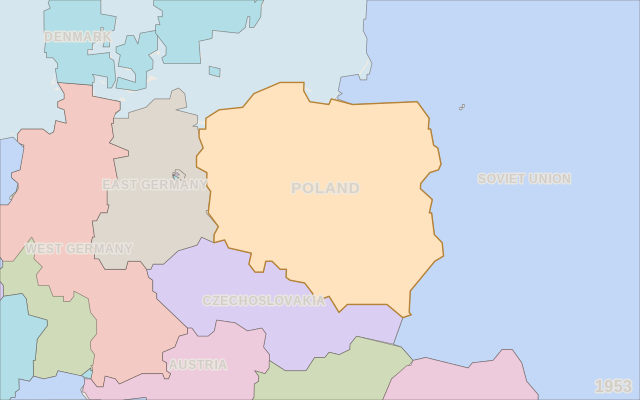
Poland began in 1989, replacing the Polish People's Republic and Congress Poland.↓ When the borders dataset first draws it, in 1953, it held 313,400 km².↓
Its highest office was held by 12 rulers, covering 1986 – 2025; 1 of 10 handovers was irregular.↓ Among them,  Lech Wałęsa,
 Lech Kaczyński and
 Andrzej Duda are the best known.↓ The atlas files 37 rows under it, most of them people.↓
From Wikipedia’s article, retold · CC BY-SA 4.0
Best known for
37 years
Longer than Daman and Diu, shorter than East Germany
313,000 km²
At its height in 1953 · about the size of Oman
12 rulers
the President of the Republic of Poland
2 wars and battles
37 entries in all
 Soviet Union,
 West Germany,
 United States,
 Czechoslovakia, East Germany and
 Austria.How far it reached, year by year: its ground inside the borders Cliopatria draws (CC BY 4.0), measured on an equal-area grid; the map shows it at its largest, with the cities of the year.
The story
The best-known wars, battles, risings and changes of regime the record files under it; a war within a war is folded into it.
treaty · 14 November 1990
battle · 1990
atrocity · 13 January 2019
unrest · 2020 – 2021
battle · 9 September 2025
The states the record files it as replacing or following, and those that replaced or followed it - Wikidata's own statements, each read from this state's side.
Polish People's Republic · replaces · 1944 – 1989Congress Poland · replaces · 1815 – 1915Five thousand years, 3000 BCE to 2026; the state in gold, what it replaced or followed and what replaced or followed it in grey.
Its people
One axis for everyone, so you can see who knew whom: the best-known, ordered by birth.
 Wojciech Jaruzelskipresident · military personnel1923 – 2014
 Tadeusz Mazowieckipolitician · writer1927 – 2013
 Jerzy Buzekengineer · chemist1940 – present
 Lech Wałęsapresident1943 – present
 Hanna Suchockapolitician · diplomat1946 – present
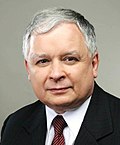 Lech Kaczyńskipresident1949 – 2010
 Jarosław Kaczyńskipolitician1949 – present
 Bronisław Komorowskipresident1952 – present
 Aleksander Kwaśniewskipresident1954 – present
 Ewa Kopaczphysician · politician1956 – present
 Donald Tuskpolitician1957 – present
 Kazimierz Marcinkiewiczphysicist · politician1959 – present
 Beata Szydłopolitician1963 – present
 Paweł Adamowiczpolitician1965 – 2019
 Mateusz Morawieckipolitician1968 – present
 Andrzej Dudapresident1972 – present
 Karol Nawrockipresident1983 – present
How it was governed
12 presidents on record, 1986 to 2025. Each bar is a reign, as long as it lasted.
The line of President of the Republic of Poland - the office this state names as its head of state.
| Ruler | Reign | Length | How it ended · source | To the ruler before |
|---|---|---|---|---|
| 20th century · 5 reigns | ||||
 Kazimierz Sabbat · aged 73 | 1986 – 1989 | 3 years | died in officeread off the dates alone | |
| Wojciech Jaruzelski · aged 66 | 1989 – 1990 | 1 year | left office aliveread off the dates alonedied of natural causes | |
 Ryszard Kaczorowski · aged 70 | 1989 – 1990 | 1 year | resignedread from the ruler's own articledied by accident | |
| Lech Wałęsa · aged 47 | 1990 – 1995 | 5 years | ending not on record | |
| Aleksander Kwaśniewski · aged 41 | 1995 – 2005 | 10 years | ending not on record | |
| 21st century · 6 reigns | ||||
| Lech Kaczyński · aged 56 | 2005 – 2010 | 5 years | died by accidentWikidata's manner of deathdied by accident | |
 Grzegorz Schetyna · aged 47 | 2010 – 2010 | under a year | ending not on record | |
 Bogdan Borusewicz · aged 61 | 2010 – 2010 | under a year | ending not on record | |
| Bronisław Komorowski · aged 58 | 2010 – 2015 | 5 years | ending not on record | |
| Andrzej Duda · aged 43 | 2015 – 2025 | 10 years | served out the termread from the ruler's own article | |
| Karol Nawrocki · aged 42 | 2025 – in office | in office since 2025 | still in office | |
12 rulers, 11 with terms dated as terms, covering 1986 – 2025. Only 39 years of the line are dated - too short for a median. 1 of 10 handovers irregular - a killing, a deposition, a rival claimant, a rising or a coup beside it. The violent-handover count is withheld: power changed hands so often that any rising falls beside one (exposure 0.93, limit 0.6). A blank in the last column means no kin on record, which is coverage, never “unrelated”.
The line of Prime Minister of Poland, drawn and never measured: a cabinet is not a reign.
 Wojciech Jaruzelski | 1981 – 1985 |
 Mieczysław Rakowski | 1988 – 1989 |
 Tadeusz Mazowiecki | 1989 – 1991 |
 Jan Krzysztof Bielecki | 1991 – 1991 |
 Jan Olszewski | 1991 – 1992 |
 Hanna Suchocka | 1992 – 1993 |
 Waldemar Pawlak | 1993 – 1995 |
 Józef Oleksy | 1995 – 1996 |
 Włodzimierz Cimoszewicz | 1996 – 1997 |
 Jerzy Buzek | 1997 – 2001 |
 Leszek Miller | 2001 – 2004 |
 Marek Belka | 2004 – 2005 |
 Kazimierz Marcinkiewicz | 2005 – 2006 |
 Jarosław Kaczyński | 2006 – 2007 |
 Donald Tusk | 2007 – 2014 |
 Ewa Kopacz | 2014 – 2015 |
 Beata Szydło | 2015 – 2017 |
 Mateusz Morawiecki | 2017 – 2023 |
| Donald Tusk | 2023 – … |
Each symbol with the years its own statement gives; the timeline flies the one of the year on screen.



 Aleksander Kwaśniewski10 yrsAndrzej Duda10 yrsBronisław Komorowski5 yrsLech Kaczyński5 yrsLech Wałęsa5 yrs
Its world
Wars and battles both took part in, on whichever side: the record names who took part, not who fought whom.
 United KingdomIraq War14
 United StatesIraq War7
 Nazi GermanyBattle of France7
 NorwayIraq War5
 DenmarkIraq War5
 AustraliaIraq War5Czech RepublicIraq War4
The best-known states of other regions that stood while it did; the band is Poland’s own years.
United StatesAmericas and Oceania MexicoAmericas and Oceania
 TurkeyMiddle East and North Africa
 JapanEast and Southeast Asia
 People's Republic of ChinaEast and Southeast Asia
 IndiaSouth Asia
 EgyptMiddle East and North Africa
 South AfricaSub-Saharan Africa
How it compares
Each column is a share of the states; gold is Poland.
How it began
It began in 1989, when the communist government fell and Poland held free elections.
The investigation's own picture: 40 causes the record names and 0 results, the strongest six of each at their own years, joined to the state by the kind of claim - a recorded statement solid, the article's sentence dashed, a theory dash-dot.
Open the investigation: every row with its evidence, the conditions at the time, the theories condition by condition, and the succession analysed.
Wars and battles in red, risings, coups and massacres beside them, everything else in grey, by the century each began in. A tall bar is partly a fact about Wikipedia: better-documented centuries hold more.
Each century’s own page:1900 – 19992000 – 2099
“Poland”, Pastlas, a historical atlas, 2026-11-26. https://app.pastlas.com/state/poland/
Drawn from Wikidata (Q36, CC0), the opening and history of its English Wikipedia article retold by the atlas (CC BY-SA 4.0), borders from Cliopatria (CC BY 4.0), coast and rivers from Natural Earth, cities from Reba, Reitsma & Seto 2016 (CC BY 4.0), symbols from Wikimedia Commons, each under its own licence. Data built 2026-11-26 · Pastlas v2.47.1, by Oleh Voronko; the published atlas and its data are for non-commercial use.
Areas are measured on an equal-area grid from borders simplified to about five kilometres. “c.” marks an approximate date, and a date known to the century is never printed to the year. Counts are what the atlas holds, and they follow Wikipedia’s coverage: a busy century is partly a fact about the record.