State · Europe

Italy

1946 – present · 80 years · still standing

Came after Kingdom of Italy

The republic voted in to replace Italy's monarchy after the war, rebuilt into an advanced economy and shaken by terror and earthquakes.

Italy became a republic through the referendum of 2 June 1946, the first national vote open to women, and King Umberto II was made to abdicate. The peace treaty took its colonies and ceded Adriatic lands to Yugoslavia, from which some 300,000 Italians emigrated. Led first by Alcide De Gasperi's Christian Democrats, the parliamentary republic made a strong economic recovery and now has one of the world's largest economies.

What the record holds

Its record opens in 1946, replacing the Kingdom of Italy.↓ When the borders dataset first draws it, in 1946, it held 288,300 km².↓

It reached its greatest extent in 1973: 288,400 km².↓ Its line counts 13 rulers, covering 1946 – 2015, the median reign 7 years; none of its 12 handovers was irregular.↓ Among them, Sergio Mattarella, Giorgio Napolitano and Francesco Cossiga are the best known.↓ The atlas files 90 rows under it, most of them people.↓

From Wikipedia’s article, retold · CC BY-SA 4.0

80 years

Longer than the Empire of Japan, shorter than the Western Roman Empire

288,000 km²

At its height in 1973 · about the size of New Zealand

13 rulers

the President of Italy

1 war or battle

More per century than 92% of states · 90 entries in all

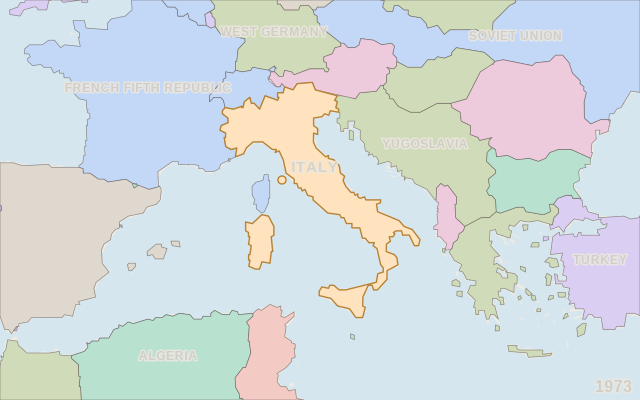
Map: Italy in 1973, its borders in gold among its neighbours
European Convention on Human Rights, 1950Treaty of Rome, 1957Treaty of Osimo, 1975Bologna massacre, 1980Rome Statute, 1998196019802000
Beside it on the map in 1973: French Fifth Republic, Francoist Spain, Algeria, Soviet Union, Yugoslavia and Socialist Republic of Romania.How far it reached, year by year: its ground inside the borders Cliopatria draws (CC BY 4.0), measured on an equal-area grid; the map shows it at its largest, with the cities of the year.

The story

Three acts, 1946 – present

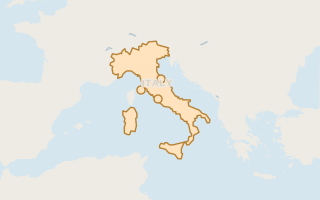
Italy in 1968, at the end of act I
I1946 – 1969288,000 → 288,000 km²

Republic and recovery

Voters choose a republic in June 1946 and the monarchy ends. The constitution is approved in 1948, the year Alcide De Gasperi's Christian Democrats win amid fears of a Communist takeover. Italy loses its colonies and Adriatic lands, signs the Treaty of Rome in 1957 and recovers strongly; the Vajont dam disaster strikes in 1963.

Watch this act on the live map, from 1946
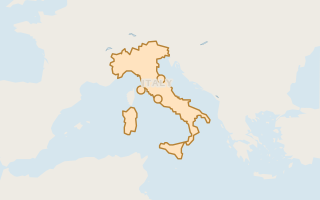
Italy in 1991, at the end of act II
II1969 – 1992288,000 → 288,000 km²

The Years of Lead

The Piazza Fontana bombing of 1969 opens the Years of Lead, a wave of political violence that lasts until 1982. A coup attempt, the Golpe Borghese, comes in 1970, and the Bologna massacre follows in 1980. Earthquakes devastate Friuli in 1976 and Irpinia in 1980. Sandro Pertini is president from 1978 to 1985.

Watch this act on the live map, from 1969
III1992 – present

From Berlusconi to Meloni

Bombs explode at Capaci and in Via D'Amelio in 1992. The leading figures of the following decades include Silvio Berlusconi, Romano Prodi, Mario Draghi and Giorgia Meloni, while Giorgio Napolitano and Sergio Mattarella serve as president. Earthquakes strike L'Aquila in 2009 and central Italy in 2016, and COVID-19 arrives in 2020.

Watch this act on the live map, from 1992

Before and after

Before it

Where it sits in time

3000 BCE2000 BCE1000 BCE110002000Kingdom of Italy: 1861 – 1946Italy: 1946 – 2026

Five thousand years, 3000 BCE to 2026; the state in gold, what it replaced or followed and what replaced or followed it in grey.

Its people

Lives across Italy

190019251950197520002025
Statesmen and generalsAll its people on the timeline →

How it was governed

13 presidents

13 presidents on record, 1946 to 2015; a reign lasted 7 years at the median. Each bar is a reign, as long as it lasted.

Alcide De Gasperi · 1946 – 1946 · left office aliveEnrico De Nicola · 1948 – 1948 · left office aliveLuigi Einaudi · 1948 – 1955 · left office aliveGiovanni Gronchi · 1955 – 1962 · left office aliveAntonio Segni · 1962 – 1964 · left office aliveGiuseppe Saragat · 1964 – 1971 · left office aliveGiovanni Leone · 1971 – 1978 · resigned or stood down, the article saysSandro Pertini · 1978 – 1985 · resigned or stood down, the article saysFrancesco Cossiga · 1985 – 1992 · resigned or stood down, the article saysOscar Luigi Scalfaro · 1992 – 1999 · left office aliveCarlo Azeglio Ciampi · 1999 – 2006 · left office aliveGiorgio Napolitano · 2006 – 2015 · resigned or stood down, the article saysSergio Mattarella · 2015 – … · resigned or stood down, the article says1960198020002020
How their terms ended, where it is known (13 of 13):Left office alive 13
Every term, with how it ended and its source

Rulers

RulerReignLengthHow it ended · sourceTo the ruler before
20th century · 11 reigns
Alcide De Gasperi · aged 651946 – 1946under a yearleft office aliveread off the dates alone
Enrico De Nicola · aged 711948 – 1948under a yearleft office aliveread off the dates alone
Luigi Einaudi · aged 741948 – 19557 yearsleft office aliveread off the dates alone
Giovanni Gronchi · aged 681955 – 19627 yearsleft office aliveread off the dates alone
Antonio Segni · aged 711962 – 19642 yearsleft office aliveread off the dates alone
Giuseppe Saragat · aged 661964 – 19717 yearsleft office aliveread off the dates alone
Giovanni Leone · aged 631971 – 19787 yearsresignedread from the ruler's own article
Sandro Pertini · aged 821978 – 19857 yearsresignedread from the ruler's own article
Francesco Cossiga · aged 571985 – 19927 yearsresignedread from the ruler's own article
Oscar Luigi Scalfaro · aged 741992 – 19997 yearsleft office aliveread off the dates alone
Carlo Azeglio Ciampi · aged 791999 – 20067 yearsleft office aliveread off the dates alonedied of natural causes
21st century · 2 reigns
Giorgio Napolitano · aged 812006 – 20159 yearsresignedread from the ruler's own article
Sergio Mattarella · aged 742015 – in officein office since 2015resignedread from the ruler's own article

13 rulers, 13 with terms dated as terms, covering 1946 – 2015. Median reign 7 years. 0 of 12 handovers irregular - a killing, a deposition, a rival claimant, a rising or a coup beside it. The violent-handover count is withheld: power changed hands so often that any rising falls beside one (exposure 1.00, limit 0.6). A blank in the last column means no kin on record, which is coverage, never “unrelated”.

Heads of government

The line of Prime Minister of Italy, drawn and never measured: a cabinet is not a reign.

Alcide De Gasperi1946 – 1947
Alcide De Gasperi1948 – 1950
Alcide De Gasperi1951 – 1953
Alcide De Gasperi1953 – 1953
Giuseppe Pella1953 – 1954
Amintore Fanfani1954 – 1954
Mario Scelba1954 – 1955
Antonio Segni1955 – 1957
Adone Zoli1957 – 1958
Amintore Fanfani1958 – 1959
Antonio Segni1959 – 1960
Amintore Fanfani1960 – 1962
Fernando Tambroni1960 – 1960
Amintore Fanfani1962 – 1963
Giovanni Leone1963 – 1963
Aldo Moro1963 – 1964
Aldo Moro1966 – 1968
Giovanni Leone1968 – 1968
Mariano Rumor1969 – 1970
Emilio Colombo1970 – 1972
Giulio Andreotti1972 – 1973
Mariano Rumor1973 – 1974
Aldo Moro1974 – 1976
Aldo Moro1976 – 1976
Giulio Andreotti1976 – 1978
Giulio Andreotti1978 – 1979
Francesco Cossiga1980 – 1980
Arnaldo Forlani1980 – 1981
Giovanni Spadolini1981 – 1982
Amintore Fanfani1982 – 1983
Bettino Craxi1983 – 1986
Bettino Craxi1986 – 1987
Amintore Fanfani1987 – 1987
Giovanni Goria1987 – 1988
Ciriaco De Mita1988 – 1989
Giulio Andreotti1989 – 1991
Giulio Andreotti1991 – 1992
Giuliano Amato1992 – 1993
Carlo Azeglio Ciampi1993 – 1994
Silvio Berlusconi1994 – 1995
Lamberto Dini1995 – 1996
Romano Prodi1996 – 1998
Massimo D'Alema1999 – 2000
Giuliano Amato2000 – 2001
Silvio Berlusconi2001 – 2005
Silvio Berlusconi2005 – 2006
Romano Prodi2006 – 2008
Silvio Berlusconi2008 – 2011
Mario Monti2011 – 2013
Enrico Letta2013 – 2014
Matteo Renzi2014 – 2016
Paolo Gentiloni2016 – 2018
Giuseppe Conte2018 – 2021
Mario Draghi2021 – 2022
Giorgia Meloni2022 – …

Flags and arms, in order

  • Flag of Italy (1861–1946)
    flag, 1861 – 1946Flag of Italy (1861–1946) · Public domain
  • Flag of Italy (1946–2003)
    flag, 1946 – 2003Flag of Italy (1946–2003) · Public domain
  • Emblem of Italy
    coat of arms, from 1948Emblem of Italy · Public domain
  • Flag of Italy (2003–2006)
    flag, 2003 – 2006Flag of Italy (2003–2006) · CC BY-SA 3.0 · Zscout370
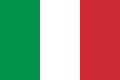
  • Flag of Italy
    flag, from 2006Flag of Italy · Public domain

Its world

Rivals, and who else stood

Who it fought most

Wars and battles both took part in, on whichever side: the record names who took part, not who fought whom.

Meanwhile, elsewhere

The best-known states of other regions that stood while it did; the band is Italy’s own years.

19401960198020002020

How it compares

Among 3,073 states

Stood longer than 42% of 3,073 states
Italy · 80 yearsEmpire of JapanWestern Roman EmpireHow long it stood, among the states with a recorded end or still standing.
Held more ground at its peak than 65% of 1,464 states
Italy · 288,400 km²Burkina FasoNew ZealandThe most ground it held, among the states with a border in Cliopatria.
Had more wars on record per century than 92% of 3,073 states
Italy · 1.0Wars recorded per century, among the states, counting the wars the atlas hosts under each.

How it began

How did Italy begin?

What led to it, and what came of it

Kingdom of Italy · Linked · 1861 – 1946Kingdom of ItalyProvince of Florence · Coincidence · 1865 – 2014Province of FlorenceBenedetto Croce · Coincidence · 1866 – 1952Benedetto CroceVictor Emmanuel III · Coincidence · 1869 – 1947Victor Emmanuel IIIMaria Montessori · Coincidence · 1870 – 1952Maria MontessoriPope Pius XII · Coincidence · 1876 – 1958Pope Pius XIIItaly · 1946 – 2026ItalyGeorge Frideric Handel · Linked · 1685 – 1759George Frideric Handel1700180019002000
linkedcoincidence

Open the investigation: every row with its evidence, the conditions at the time, the theories condition by condition, and the succession analysed.

Its centuries in the record

1900 – 1999: 68 recorded — 1 wars and battles, 10 risings, regime changes and massacres, 57 other19002000 – 2099: 14 recorded — 0 wars and battles, 2 risings, regime changes and massacres, 12 other2000

Wars and battles in red, risings, coups and massacres beside them, everything else in grey, by the century each began in. A tall bar is partly a fact about Wikipedia: better-documented centuries hold more.

Each century’s own page:1900 – 19992000 – 2099

Keep exploring

Share this page
Copy link
Embed the map
Cite this page

How this page is made

Drawn from Wikidata (Q38, CC0), the opening and history of its English Wikipedia article retold by the atlas (CC BY-SA 4.0), borders from Cliopatria (CC BY 4.0), coast and rivers from Natural Earth, cities from Reba, Reitsma & Seto 2016 (CC BY 4.0), symbols from Wikimedia Commons, each under its own licence. Data built 2026-11-26 · Pastlas v2.47.1, by Oleh Voronko; the published atlas and its data are for non-commercial use.

How to read it

Areas are measured on an equal-area grid from borders simplified to about five kilometres. “c.” marks an approximate date, and a date known to the century is never printed to the year. Counts are what the atlas holds, and they follow Wikipedia’s coverage: a busy century is partly a fact about the record.

  • Wikidata records foundings in 476 and 1861 and 1946; the atlas draws the present-day state from 1861.
  • Still standing: the span runs to the year of the build, 2026.

Something wrong?

Tell us and name the entry. We fix the data, not just this page.

Report a problem