State · Europe

Czechoslovakia

1918 – 1992 · 74 years

Came after Austria-Hungary and Kingdom of Bohemia · became Czech and Slovak Federative Republic

A Central European republic of Czechs and Slovaks, born of Austria-Hungary's collapse, dismembered after Munich, ruled by communists, then peacefully divided.

Czechoslovakia, with its capital at Prague, declared independence in 1918 as Austria-Hungary broke up, led by Tomáš Masaryk and Edvard Beneš. A democracy between the wars, it lost the Sudetenland to Nazi Germany after the Munich Agreement of 1938 and was carved up in 1939. Restored in 1945, it fell to a communist coup in 1948, and the Prague Spring of 1968 was ended by a Soviet-led invasion. The Velvet Revolution ended communist rule in 1989.

What the record holds

It was founded in 1918, replacing Austria-Hungary and the Kingdom of Bohemia.↓ In 1919, the first year its borders are mapped, it covered 120,500 km².↓

It reached its greatest extent in 1922: 144,500 km².↓ Its line counts 12 rulers, covering 1918 – 1992, the median reign 3 years; 2 of 12 handovers were irregular.↓ Among them, Václav Havel, Tomáš Masaryk and Alexander Dubček are the best known.↓ The atlas files 51 rows under it, most of them people.↓

The Czech and Slovak Federative Republic replaced it in 1992, after 74 years.↓ 2 theories of why states fall have every condition present at its end: “Elite conflict” and “The five conditions of revolution”.↓

From Wikipedia’s article, retold · CC BY-SA 4.0

74 years

Longer than Jammu and Kashmir, shorter than the Empire of Japan

145,000 km²

At its height in 1922 · about the size of Bangladesh

12 rulers

the President of Czechoslovakia

3 wars and battles

51 entries in all

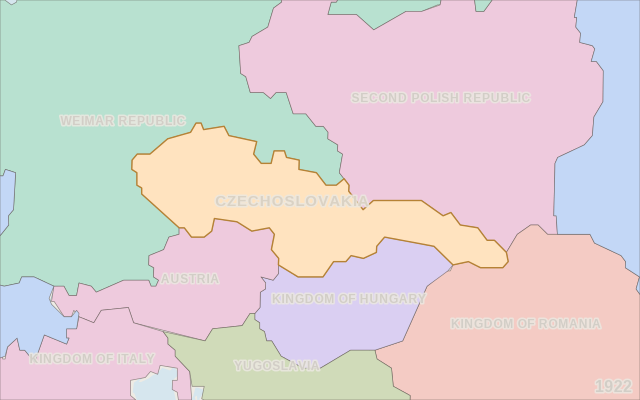
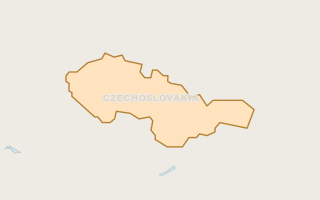
Map: Czechoslovakia in 1922, its borders in gold among its neighbours
Sudeten German uprising, 1938Operation Cowboy, 1945Prague offensive, 19451930194019501960
Beside it on the map in 1922: Weimar Republic, Second Polish Republic, Kingdom of Romania, Soviet Union, Kingdom of Hungary and Austria.How far it reached, year by year: its ground inside the borders Cliopatria draws (CC BY 4.0), measured on an equal-area grid; the map shows it at its largest, with the cities of the year.

The story

Four acts, 1918 – 1992

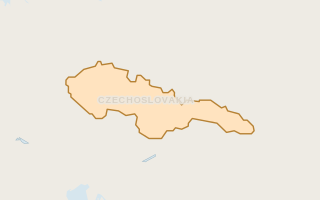
Czechoslovakia in 1937, at the end of act I
I1918 – 1938

A democracy of many peoples

Founded in October 1918 and confirmed by the Treaty of Saint-Germain-en-Laye, the state joins Bohemia, Moravia, part of Silesia, Slovakia and Carpathian Ruthenia. Czechs make up 51%, Germans 22% and Slovaks 16%, and minorities denied autonomy grow restless. Under Masaryk it stays democratic, and Beneš builds the Little Entente against Hungarian claims.

Watch this act on the live map, from 1918
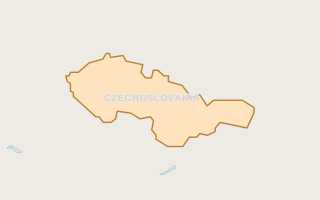
Czechoslovakia in 1947, at the end of act II
II1938 – 194885,600 → 129,000 km²

Munich, occupation, restoration

At Munich in September 1938 Britain and France cede the Sudetenland, which Nazi Germany occupies; Hungary and Poland take further slices. In March 1939 the rump is split into a Slovak State and a German protectorate, and Beneš leads a government-in-exile. Freed by the Red Army, the country returns without Carpathian Ruthenia, and most ethnic Germans are expelled.

Watch this act on the live map, from 1938

Before and after

Before it

After it

Where it sits in time

3000 BCE2000 BCE1000 BCE110002000Austria-Hungary: 1867 – 1918Kingdom of Bohemia: 1198 – 1918Czech and Slovak Federative Republic: 1990 – 1992Czechoslovakia: 1918 – 1992

Five thousand years, 3000 BCE to 2026; the state in gold, what it replaced or followed and what replaced or followed it in grey.

Its people

Lives across Czechoslovakia

1850190019502000
Statesmen and generalsScientists and explorersWriters, artists and thinkersLived on after it endedAll its people on the timeline →

How it was governed

12 presidents

12 presidents on record, 1918 to 1992; a reign lasted 3 years at the median. Each bar is a reign, as long as it lasted.

Tomáš Masaryk · 1918 – 1935 · left office aliveEdvard Beneš · 1935 – 1938 · left office aliveEmil Hácha · 1938 – 1939 · left office aliveEdvard Beneš · 1945 – 1948 · died in office, manner not recordedKlement Gottwald · 1948 – 1953 · died in office of natural causesAntonín Zápotocký · 1953 – 1957 · died in office, manner not recordedAntonín Novotný · 1957 – 1968 · left office aliveAlexander Dubček · 1968 – 1969 · deposed, the article saysLudvík Svoboda · 1968 – 1975 · left office aliveGustáv Husák · 1975 – 1989 · left office aliveMiloš Jakeš · 1987 – 1989 · resigned or stood down, the article saysKarel Urbánek · 1989 – 1989 · no death date to read the end againstVáclav Havel · 1989 – 1992 · left office alive1920194019601980
a second row: a reign that began before the last had ended — rival claimants, or a shared throne
How their terms ended, where it is known (12 of 13):Deposed or removed 1Died in office 3Left office alive 8Not on record 1
Every term, with how it ended and its source

Rulers

3 terms are shared from Czechoslovak Socialist Republic.

How 13 reigns ended - choose one to show only those

How they died, where the record says: died of natural causes 5 · died by accident 1.

RulerReignLengthHow it ended · sourceTo the ruler before
20th century · 13 reigns · 1 killed or removed
Tomáš Masaryk · aged 681918 – 193517 yearsleft office aliveread off the dates alone
Edvard Beneš · aged 511935 – 19383 yearsleft office aliveread off the dates alone
Emil Hácha · aged 661938 – 19391 yearleft office aliveread off the dates alonedied of natural causes
Edvard Beneš · aged 611945 – 19483 yearsdied in officeread off the dates alone
Klement Gottwald · aged 521948 – 19535 yearsdied in officeWikidata's manner of deathdied of natural causes
Antonín Zápotocký · aged 691953 – 19574 yearsdied in officeread off the dates alone
Antonín Novotný · aged 531957 – 196811 yearsleft office aliveread off the dates alonedied of natural causes
Alexander Dubček · from the line of Czechoslovak Socialist Republic1968 – 19691 yeardeposedread from the ruler's own articledied by accident
Ludvík Svoboda · aged 731968 – 19757 yearsleft office aliveread off the dates alonedied of natural causes
Gustáv Husák · aged 621975 – 198914 yearsleft office aliveread off the dates alone
Miloš Jakeš · from the line of Czechoslovak Socialist Republic1987 – 19892 yearsresignedread from the ruler's own article
Karel Urbánek · from the line of Czechoslovak Socialist Republic1989 – 1989under a yearending not on record
Václav Havel · aged 531989 – 19923 yearsleft office aliveread off the dates alonedied of natural causes

12 rulers, 12 with terms dated as terms, covering 1918 – 1992. Median reign 3 years. 2 of 12 handovers irregular - a killing, a deposition, a rival claimant, a rising or a coup beside it. The violent-handover count is withheld: power changed hands so often that any rising falls beside one (exposure 0.69, limit 0.6). A blank in the last column means no kin on record, which is coverage, never “unrelated”.

Heads of government

The line of Prime Minister of Czechoslovakia, drawn and never measured: a cabinet is not a reign.

Karel Kramář1918 – 1919
Vlastimil Tusar1919 – 1920
Jan Černý1920 – 1921
Edvard Beneš1921 – 1922
Antonín Švehla1922 – 1926
Antonín Švehla1926 – 1929
Jan Černý1926 – 1926
František Udržal1929 – 1932
Jan Malypetr1932 – 1935
Milan Hodža1935 – 1938
Rudolf Beran1938 – 1939
Jan Syrový1938 – 1938
Jan Šrámek1940 – 1945
Zdeněk Fierlinger1945 – 1946
Klement Gottwald1946 – 1948
Antonín Zápotocký1948 – 1953
Viliam Široký1953 – 1963
Jozef Lenárt1963 – 1968
Oldřich Černík1968 – 1970
Lubomír Štrougal1970 – 1988
Ladislav Adamec1988 – 1989
Marián Čalfa1989 – 1992
Jan Stráský1992 – 1992

Flags and arms, in order

  • Middle coat of arms of Czechoslovakia
    coat of arms, 1920 – 1960Middle coat of arms of Czechoslovakia · CC BY-SA 3.0
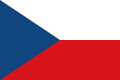
  • Flag of the Czech Republic
    flag, from 1920Flag of the Czech Republic · Public domain
  • Lesser coat of arms of Czechoslovakia
    coat of arms, 1920 – 1960Lesser coat of arms of Czechoslovakia · CC BY-SA 3.0
  • Coat of arms of Czechoslovakia (1960–1990)
    coat of arms, 1960 – 1990Coat of arms of Czechoslovakia (1960–1990) · CC BY-SA 4.0 · TFerenczy
  • Herb Czechosłowacji (1990-1992)
    coat of arms, 1990 – 1992Herb Czechosłowacji (1990-1992) · Public domain

Its world

Rivals, and who else stood

Who it fought most

Wars and battles both took part in, on whichever side: the record names who took part, not who fought whom.

Meanwhile, elsewhere

The best-known states of other regions that stood while it did; the band is Czechoslovakia’s own years.

19201940196019802000

How it compares

Among 3,073 states

Stood longer than 41% of 3,073 states
Czechoslovakia · 74 yearsJammu and KashmirEmpire of JapanHow long it stood, among the states with a recorded end or still standing.
Held more ground at its peak than 53% of 1,464 states
Czechoslovakia · 144,500 km²TajikistanBangladeshThe most ground it held, among the states with a border in Cliopatria.

Why it fell

Why did Czechoslovakia fall?

Historians still argue. Here is what the atlas records about its last century:

1969

Alexander Dubček, deposed or removed in office

What led to it, and what came of it

Kingdom of Bohemia · Linked · 1198 – 1918Kingdom of BohemiaAustria-Hungary · Linked · 1867 – 1918Austria-HungaryWorld War I · In the article · 1914 · “The area was part of the Austro-Hungarian Empire until it collapsed at the end of World War I.”World War IIvan Horbachevsky · Coincidence · 1854 – 1942Ivan HorbachevskyAlphonse Mucha · Coincidence · 1860 – 1939Alphonse MuchaYevhen Chykalenko · Coincidence · 1861 – 1929Yevhen ChykalenkoCzechoslovakia · 1918 – 1992CzechoslovakiaCzech and Slovak Federative Republic · Linked · 1990 – 1992Czech and Slovak Federative Repu…12001400160018002000
in the articlelinkedcoincidence

Open the investigation: every row with its evidence, the conditions at the time, the theories condition by condition, and the succession analysed.

Theories that apply to its ending

  • Elite conflict

    Lachmann 2000 · Lachmann 2010

    Applies by its own logic: 2 of its 2 conditions held here (it needs all of them), and this is the kind of outcome it predicts — adverse regime change, unrest or the state's ending.

    • 2 or more elite groups in the regime's support, or a parliament met within 100 y — party elites, business elites, civil servants (1991)
    • an elite group among the regime's opposition within 5 y, or an elite group left the regime's support over 10 y, or a monarch deposed or killed by others within 20 y, or overlapping reigns — rival claimants — within 20 y — rivalClaimants -2
  • The five conditions of revolution

    Goldstone 2014 · Goldstone 2001

    Applies by its own logic: 4 of its 5 conditions held here (it needs 4), and this is the kind of outcome it predicts — unrest, adverse regime change or the state's ending.

    • GDP per capita down 5% over 5 y, or a war the state is fighting, still under way, or a war the state fought, ended within 5 y, or famine within 5 y in the state — gdpFall -14
    • an elite group among the regime's opposition within 5 y, or an elite group left the regime's support over 10 y, or a monarch deposed or killed within 10 y, or overlapping reigns — rival claimants — within 10 y, or 2 or more reigns of two years or less within 10 y — rivalClaimants -2; shortReigns 2
    • mass mobilisation at 3 or more of 4 within 5 y, or a popular class among the regime's opposition within 5 y, or unrest within 5 y in the state — many large-scale and small-scale events (1989); rural middle classes (1987); prior
    • a foreign patron left the regime's support, or its foreign policy became its own, within 5 y — a foreign patron left the regime's support (1992)

In the record

51 entries the atlas files under it, all in 1900 – 1999.

Keep exploring

Share this page
Copy link
Embed the map
Cite this page

How this page is made

Drawn from Wikidata (Q33946, CC0), the opening and history of its English Wikipedia article retold by the atlas (CC BY-SA 4.0), borders from Cliopatria (CC BY 4.0), coast and rivers from Natural Earth, cities from Reba, Reitsma & Seto 2016 (CC BY 4.0), symbols from Wikimedia Commons, each under its own licence. Data built 2026-11-26 · Pastlas v2.47.1, by Oleh Voronko; the published atlas and its data are for non-commercial use.

How to read it

Areas are measured on an equal-area grid from borders simplified to about five kilometres. “c.” marks an approximate date, and a date known to the century is never printed to the year. Counts are what the atlas holds, and they follow Wikipedia’s coverage: a busy century is partly a fact about the record.

Something wrong?

Tell us and name the entry. We fix the data, not just this page.

Report a problem