Budapest Memorandum
treaty · 5 December 1994
State · Europe
The Third Hungarian Republic: born in a peaceful exit from communism, a member of the European Union, and marked by Orbán's rule.
Hungary left communism peacefully in 1989, pushed by economic stagnation, pressure at home and shifting relations within the Warsaw Pact. Round Table Talks opened in March, and the reburial of Imre Nagy in June marked communism's symbolic end. Free elections in May 1990 made József Antall prime minister of a coalition led by the Hungarian Democratic Forum. Hungary joined the European Union in 2004; its democracy eroded during Viktor Orbán's rule with Fidesz, which lasted from 2010 to 2026.
It was founded in 1989, replacing the  Hungarian People's Republic.↓ When the borders dataset first draws it, in 1990, it held 91,800 km².↓
At its largest, in 1996, it held 91,900 km².↓ Its highest office was held by 11 rulers, covering 1989 – 2026; none of its 12 handovers was irregular.↓ The best known of them are  János Áder,
 Katalin Novák and
 László Sólyom.↓ Most of the 25 rows the atlas files under it are people.↓
From Wikipedia’s article, retold · CC BY-SA 4.0
Best known for
37 years
Longer than Daman and Diu, shorter than East Germany
91,900 km²
At its height in 1996 · about the size of Malawi
11 rulers
the President of Hungary
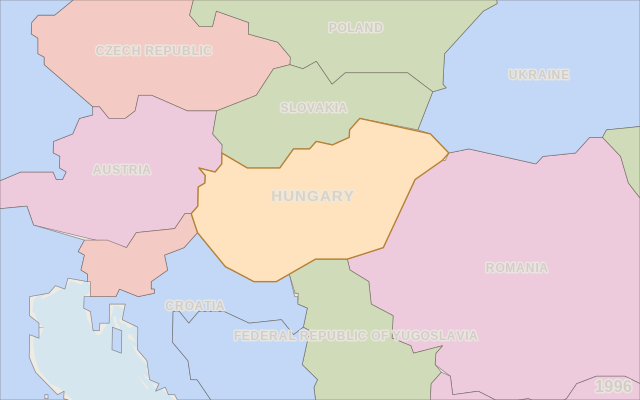
 Romania,
 Ukraine,
 Czech Republic,
 Austria,
 Poland and
 Slovakia.How far it reached, year by year: its ground inside the borders Cliopatria draws (CC BY 4.0), measured on an equal-area grid; the map shows it at its largest, with the cities of the year.
The story
The best-known wars, battles, risings and changes of regime the record files under it; a war within a war is folded into it.
treaty · 5 December 1994
unrest · 2006
unrest · 2014
The states the record files it as replacing or following, and those that replaced or followed it - Wikidata's own statements, each read from this state's side.
Hungarian People's Republic · replaces · 1949 – 1989Five thousand years, 3000 BCE to 2026; the state in gold, what it replaced or followed and what replaced or followed it in grey.
Its people
One axis for everyone, so you can see who knew whom: the best-known, ordered by birth.
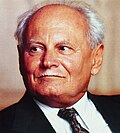 Árpád Gönczpresident · poet1922 – 2015
 Ferenc Mádlpresident1931 – 2011
 Gyula Hornpolitician · diplomat1932 – 2013
 Mátyás Szűröspresident · diplomat1933 – present
 László Sólyompresident · statesperson1942 – 2023
 Pál Schmittpresident · diplomat1942 – present
 Péter Medgyessypolitician1942 – present
 Miklós Némethpolitician1948 – present
 Tamás Sulyokpresident1956 – present
 János Áderpresident1959 – present
 László Kövérpresident1959 – present
 Ferenc Gyurcsánypolitician · writer1961 – present
 Viktor Orbánpolitician1963 – present
 Gordon Bajnaipolitician1968 – present
 Katalin Novákpresident1977 – present
 Péter Magyarpolitician · diplomat1981 – present
How it was governed
11 presidents on record, 1989 to 2026. Each bar is a reign, as long as it lasted.
The line of President of Hungary - the office this state names as its head of state.
| Ruler | Reign | Length | How it ended · source | To the ruler before |
|---|---|---|---|---|
| 20th century · 4 reigns | ||||
| Mátyás Szűrös · aged 56 | 1989 – 1990 | 1 year | not re-electedWikidata's end cause on the term | |
| Árpád Göncz · aged 68 | 1990 – 1990 | under a year | left office aliveread off the dates alone | |
| Árpád Göncz · aged 73 | 1995 – 2000 | 5 years | left office aliveread off the dates alone | |
| Ferenc Mádl · aged 69 | 2000 – 2005 | 5 years | left office aliveread off the dates alone | |
| 21st century · 9 reigns | ||||
| László Sólyom · aged 63 | 2005 – 2010 | 5 years | left office aliveread off the dates alone | |
| Pál Schmitt · aged 68 | 2010 – 2012 | 2 years | resignedWikidata's end cause on the term | |
| László Kövér · aged 53 | 2012 – 2012 | under a year | ending not on record | |
| János Áder · aged 53 | 2012 – 2022 | 10 years | ending not on record | |
| Katalin Novák · aged 45 | 2022 – 2024 | 2 years | resignedWikidata's end cause on the term | |
| László Kövér · aged 65 | 2024 – 2024 | under a year | ending not on record | |
| Tamás Sulyok · aged 68 | 2024 – 2026 | 2 years | ended by an eventWikidata's end cause on the term | |
 Ágnes Forsthoffer · aged 46 | 2026 – 2026 | under a year | ending not on record | |
 András Baka · aged 74 | 2026 – in office | in office since 2026 | still in office | |
11 rulers, 11 with terms dated as terms, covering 1989 – 2026. Only 37 years of the line are dated - too short for a median. 0 of 12 handovers irregular - a killing, a deposition, a rival claimant, a rising or a coup beside it. The violent-handover count is withheld: power changed hands so often that any rising falls beside one (exposure 1.00, limit 0.6). A blank in the last column means no kin on record, which is coverage, never “unrelated”.
The line of Prime Minister of Hungary, drawn and never measured: a cabinet is not a reign.
 György Lázár | 1975 – 1987 |
 Károly Grósz | 1987 – 1988 |
 Miklós Németh | 1988 – 1990 |
| József Antall | 1990 – 1993 |
 Péter Boross | 1993 – 1994 |
 Gyula Horn | 1994 – 1998 |
 Viktor Orbán | 1998 – 2002 |
 Péter Medgyessy | 2002 – 2004 |
 Ferenc Gyurcsány | 2004 – 2009 |
 Gordon Bajnai | 2009 – 2010 |
| Viktor Orbán | 2010 – 2026 |
 Péter Magyar | 2026 – … |
Each symbol with the years its own statement gives; the timeline flies the one of the year on screen.


33 more in the atlas.
János Áder10 yrsÁrpád Göncz5 yrsFerenc Mádl5 yrsLászló Sólyom5 yrsKatalin Novák2 yrsIts world
Wars and battles both took part in, on whichever side: the record names who took part, not who fought whom.
 United KingdomIraq War2
 EstoniaIraq War2
 NorwayIraq War2
 LatviaIraq War2UkraineIraq War2Czech RepublicIraq War2SlovakiaIraq War2
The best-known states of other regions that stood while it did; the band is Hungary’s own years.
 United StatesAmericas and Oceania
 MexicoAmericas and Oceania
 TurkeyMiddle East and North Africa
 JapanEast and Southeast Asia
 People's Republic of ChinaEast and Southeast Asia
 IndiaSouth Asia
 EgyptMiddle East and North Africa
 South AfricaSub-Saharan Africa
How it compares
Each column is a share of the states; gold is Hungary.
How it began
The republic was born of a peaceful transition in 1989, as round-table talks with the opposition ended the communist party's monopoly.
The investigation's own picture: 22 causes the record names and 0 results, the strongest six of each at their own years, joined to the state by the kind of claim - a recorded statement solid, the article's sentence dashed, a theory dash-dot.
Open the investigation: every row with its evidence, the conditions at the time, the theories condition by condition, and the succession analysed.
Wars and battles in red, risings, coups and massacres beside them, everything else in grey, by the century each began in. A tall bar is partly a fact about Wikipedia: better-documented centuries hold more.
Each century’s own page:1900 – 19992000 – 2099
“Hungary”, Pastlas, a historical atlas, 2026-11-26. https://app.pastlas.com/state/hungary/
Drawn from Wikidata (Q28, CC0), the opening and history of its English Wikipedia article retold by the atlas (CC BY-SA 4.0), borders from Cliopatria (CC BY 4.0), coast and rivers from Natural Earth, cities from Reba, Reitsma & Seto 2016 (CC BY 4.0), symbols from Wikimedia Commons, each under its own licence. Data built 2026-11-26 · Pastlas v2.47.1, by Oleh Voronko; the published atlas and its data are for non-commercial use.
Areas are measured on an equal-area grid from borders simplified to about five kilometres. “c.” marks an approximate date, and a date known to the century is never printed to the year. Counts are what the atlas holds, and they follow Wikipedia’s coverage: a busy century is partly a fact about the record.