First Battle of Höchstädt
battle · 20 September 1703
State · Europe
907 – 1805 · 898 years
The Duchy of Bavaria began in 907.↑ When the borders dataset first draws it, in 1260, it held 28,600 km².↓
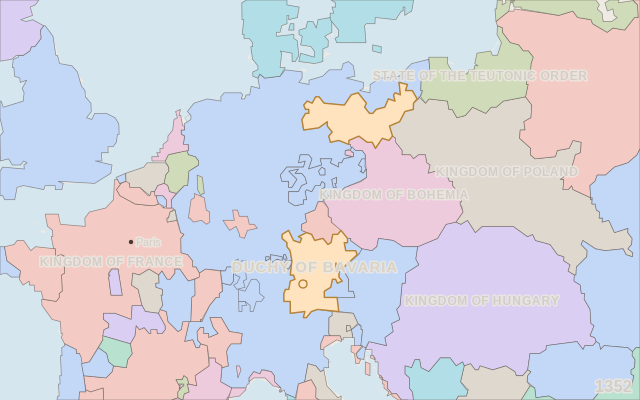
It reached its greatest extent in 1352: 96,700 km².↓ The record names 54 rulers in its line, covering 937 – 1623, the median reign 15 years; 6 of 24 handovers were irregular.↓ The best known of them are  Henry II, Holy Roman Emperor,
 Henry III, Holy Roman Emperor and
 Louis IV, Holy Roman Emperor.↓ Most of the 71 rows the atlas files under it are people.↓ Its record closes in 1805, after 898 years.↑
Best known for
898 years
Longer than the Holy Roman Empire, shorter than the Byzantine Empire
96,700 km²
At its height in 1352 · about the size of Portugal
54 rulers
the Duke of Bavaria
19 wars and battles
71 entries in all
 Holy Roman Empire,
 Kingdom of Hungary,
 Kingdom of France,
 Kingdom of Poland,
 Grand Duchy of Lithuania and
 Kingdom of England.How far it reached, year by year: its ground inside the borders Cliopatria draws (CC BY 4.0), measured on an equal-area grid; the map shows it at its largest, with the cities of the year.
The story
The best-known wars, battles, risings and changes of regime the record files under it; a war within a war is folded into it.
battle · 20 September 1703
battle · 13 August 1704
battle · 2 July 1704
battle · 3 December 1800
battle · 16 October 1805
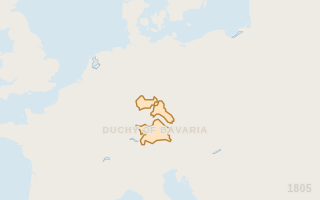
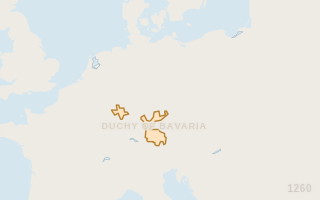
Five thousand years, 3000 BCE to 2026; the state in gold.
Its people
One axis for everyone, so you can see who knew whom: the best-known, ordered by birth.
 Henry I of Bavariaduke920 – 955
 Henry II of Bavariaruler951 – 995
 Henry II, Holy Roman Emperorduke973 – 1024
 Henry III, Holy Roman Emperorduke · writer1016 – 1056
 Henry IX of Bavariaperson1075 – 1126
 Otto I, Duke of Bavariaduke1117 – 1183
 Louis I, Duke of Bavariaduke1174 – 1231
 Otto III of Bavariaduke1261 – 1312
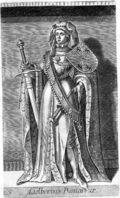 Albert I of Bavariapolitician1336 – 1404
 Albrecht Dürermathematician · painter1471 – 1528
 William IV of Bavariaperson1493 – 1550
 Albert V of Bavariaduke1528 – 1579
 William V of Bavariaduke1548 – 1626
 Maximilian I, Elector of Bavariaduke1573 – 1651
 Karl Mack von Leiberichmilitary officer
 Ludwig Feuerbachphilosopher · theologian
How it was governed
54 dukes on record, 937 to 1623; a reign lasted 15 years at the median. Each bar is a reign, as long as it lasted.
The line of Duke of Bavaria - the office this state names as its head of state.
| Ruler | Reign | Length | How it ended · source | To the ruler before |
|---|---|---|---|---|
| 10th century · 4 reigns | ||||
| Eberhard, Duke of Bavaria | 937 – 938 | 1 year | left office aliveread off the dates alone | |
| Henry I of Bavaria · aged 28 | 948 – 955 | 7 years | died in officeread off the dates alone | |
| Henry III of Bavaria · aged 43 | 983 – 985 | 2 years | left office aliveread off the dates alone | |
| Henry II, Holy Roman Emperor · aged 22 | 995 – 1004 | 9 years | left office aliveread off the dates alone | |
| 11th century · 4 reigns | ||||
| Henry V of Bavaria · aged 44 | 1004 – 1009 | 5 years | left office aliveread off the dates alone | in-law |
| Henry V of Bavaria · aged 57 | 1017 – 1026 | 9 years | died in officeread off the dates alone | |
| Henry III, Holy Roman Emperor · aged 11 | 1027 – 1042 | 15 years | left office aliveread off the dates alonedied of natural causes | |
| Conrad II of Bavaria · aged 2 | 1054 – 1055 | 1 year | died in officeread off the dates alone | child |
| 12th century · 4 reigns · 2 killed or removed | ||||
 Henry II of Austria · aged 34 | 1141 – 1156 | 15 years | left office aliveread off the dates alonedied by accident | |
 Henry the Lion · aged 27 | 1156 – 1180 | 24 years | exiledread from the ruler's own article | |
| Otto I, Duke of Bavaria · aged 63 | 1180 – 1183 | 3 years | died in officeread off the dates alone | |
| Louis I, Duke of Bavaria · aged 10 | 1183 – 1231 | 48 years | killedread from the ruler's own article | |
| 13th century · 4 reigns | ||||
 Otto II of Bavaria · aged 25 | 1231 – 1253 | 22 years | died in officeread off the dates alone | child |
 Henry XIII of Bavaria · aged 18 | 1253 – 1255 | 2 years | left office aliveread off the dates alone | child |
 Louis II, Duke of Bavaria · aged 24 | 1253 – 1294 | 41 years | died in officeread off the dates alone | sibling |
| Otto III of Bavaria · aged 29 | 1290 – 1312 | 22 years | died in officeread off the dates alone | |
| 14th century · 4 reigns | ||||
 Louis IV, Holy Roman Emperor · aged 19 | 1301 – 1347 | 46 years | died in officeWikidata's manner of deathdied of natural causes | |
 Stephen II of Bavaria · aged 28 | 1347 – 1349 | 2 years | left office aliveread off the dates alone | |
 Otto V of Bavaria · aged 1 | 1347 – 1349 | 2 years | left office aliveread off the dates alone | sibling |
| Stephen II of Bavaria · aged 30 | 1349 – 1375 | 26 years | died in officeread off the dates alone | sibling |
| 15th century · 1 reign | ||||
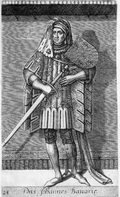 John III of Bavaria · aged 43 | 1417 – 1425 | 8 years | died in officeread off the dates alone | nephew or niece |
| 16th century · 4 reigns · 1 killed or removed | ||||
 Louis X of Bavaria · aged 21 | 1516 – 1545 | 29 years | died in officeread off the dates alone | |
| Albert V of Bavaria · aged 22 | 1550 – 1579 | 29 years | died in officeread off the dates alone | |
| William V of Bavaria · aged 31 | 1579 – 1597 | 18 years | abdicatedWikidata's end cause on the term | child |
| Maximilian I, Elector of Bavaria · aged 24 | 1597 – 1623 | 26 years | left office aliveread off the dates alone | child |
54 rulers, 23 with terms dated as terms, covering 937 – 1623. Median reign 15 years. 6 of 24 handovers irregular - a killing, a deposition, a rival claimant, a rising or a coup beside it. A blank in the last column means no kin on record, which is coverage, never “unrelated”.
The line also names 16 holders with a page of their own whose term the record gives no first year, so the table cannot place them: Henry VII of Bavaria, Henry IV, Holy Roman Emperor, Leopold, Duke of Bavaria, Stephen III of Bavaria, Frederick, Duke of Bavaria, John II of Bavaria, Louis VII of Bavaria, Ernest, Duke of Bavaria, William III of Bavaria, Henry XVI of Bavaria, Albert III of Bavaria, Louis VIII of Bavaria, Louis IX of Bavaria, John IV of Bavaria, Sigismund, Duke of Bavaria, George, Duke of Bavaria.
Each symbol with the years its own statement gives; the timeline flies the one of the year on screen.


 Louis I, Duke of Bavaria48 yrsLouis IV, Holy Roman Emperor46 yrsLouis II, Duke of Bavaria41 yrsAlbert V of Bavaria29 yrsLouis X of Bavaria29 yrs
Its world
Wars and battles both took part in, on whichever side: the record names who took part, not who fought whom.
Holy Roman EmpireBattle of Blenheim5 Habsburg monarchyBattle of Blenheim2
 Kingdom of EnglandBattle of Blenheim2Kingdom of FranceBattle of Blenheim2
The best-known states of other regions that stood while it did; the band is the Duchy of Bavaria’s own years.
 KathmanduSouth Asia
 Ottoman EmpireMiddle East and North Africa
 BruneiEast and Southeast Asia
 Mughal EmpireSouth Asia
 Qing dynastyEast and Southeast Asia
How it compares
Each column is a share of the states; gold is the Duchy of Bavaria.
Why it fell
Historians still argue. Here is what the atlas records about its last century:
5
wars and battles in its last century
Wars and battles in red, risings, coups and massacres beside them, everything else in grey, by the century each began in. A tall bar is partly a fact about Wikipedia: better-documented centuries hold more.
Each century’s own page:900 – 9991000 – 10991100 – 11991200 – 12991300 – 13991400 – 14991500 – 15991600 – 16991700 – 17991800 – 1899
“Duchy of Bavaria”, Pastlas, a historical atlas, 2026-11-26. https://app.pastlas.com/state/duchy-of-bavaria/
Drawn from Wikidata (Q47261, CC0), borders from Cliopatria (CC BY 4.0), coast and rivers from Natural Earth, cities from Reba, Reitsma & Seto 2016 (CC BY 4.0), symbols from Wikimedia Commons, each under its own licence. Data built 2026-11-26 · Pastlas v2.47.1, by Oleh Voronko; the published atlas and its data are for non-commercial use.
Areas are measured on an equal-area grid from borders simplified to about five kilometres. “c.” marks an approximate date, and a date known to the century is never printed to the year. Counts are what the atlas holds, and they follow Wikipedia’s coverage: a busy century is partly a fact about the record.